
News
Amazon Ends FBA Commingling on March 31, 2026: What Amazon Sellers Need to Know
March 24, 2026
Key Takeaways
- Amazon ends FBA commingling on March 31, 2026, requiring brand owners with Brand Representative roles to use manufacturer barcodes and resellers to use Amazon barcodes.
- Resellers without Brand Representative status in Amazon Brand Registry must apply Amazon barcode stickers even when products already have UPC or manufacturer barcodes.
- Brand owners with Brand Representative selling roles can skip Amazon barcode stickers for eligible products with manufacturer barcodes, simplifying multi-channel inventory management.
- The policy creates a role-based barcode framework where Brand Registry enrollment alone does not guarantee manufacturer barcode eligibility for FBA shipments.
- Sellers should audit their Brand Registry selling role, review SKU-level barcode eligibility, and update warehouse SOPs before the March 31, 2026 deadline.
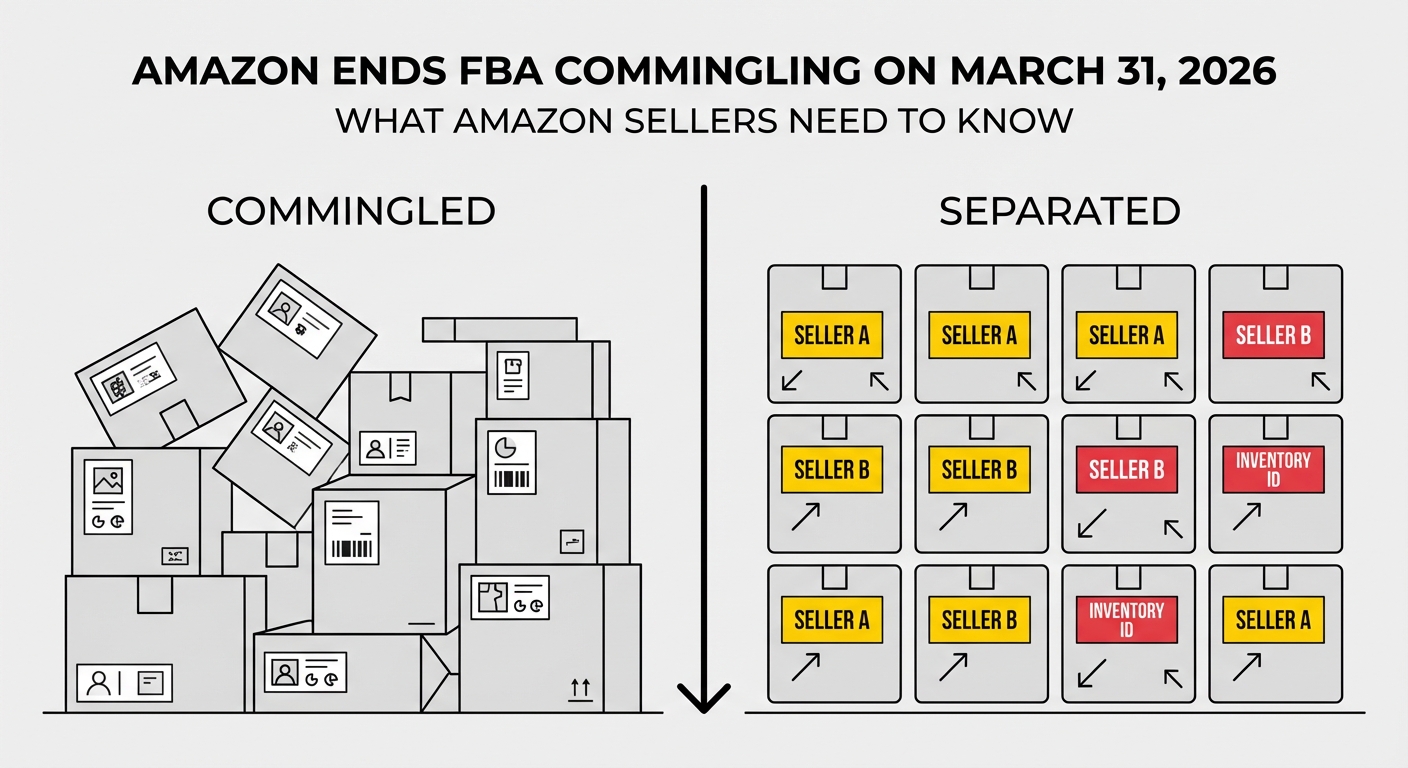
Amazon has confirmed a major FBA policy change: commingling practices will end effective March 31, 2026. For Amazon sellers, this is not a minor logistics update. It changes how inventory must be identified, labeled, and sent into FBA, and it creates a clear divide between brand owners and resellers. From a compliance perspective, this is the kind of update sellers should act on early, not after inbound issues begin.
Commingling is Amazon’s practice of fulfilling an order using an exact product match from the closest available inventory in its fulfillment network, even if that inventory originally belonged to a different seller. Amazon says it can now maintain fast delivery without relying on commingling because most sellers already keep inventory closer to customers. The new rules apply to inventory shipped on or after March 31, 2026.
What Amazon Commingling Means and Why Amazon Is Ending It
Amazon defines commingling as fulfilling customer orders using exact product matches from the closest available inventory in the Amazon fulfillment network, even if that inventory belonged to a different seller. Amazon says it can now maintain fast delivery without commingling because most sellers already keep inventory closer to customers.
That explanation is important because it shows that Amazon is not presenting this as a temporary test or a limited category change. It is a supply-chain level policy shift. Amazon is effectively saying that faster delivery no longer requires pooled seller inventory under the old commingled model.
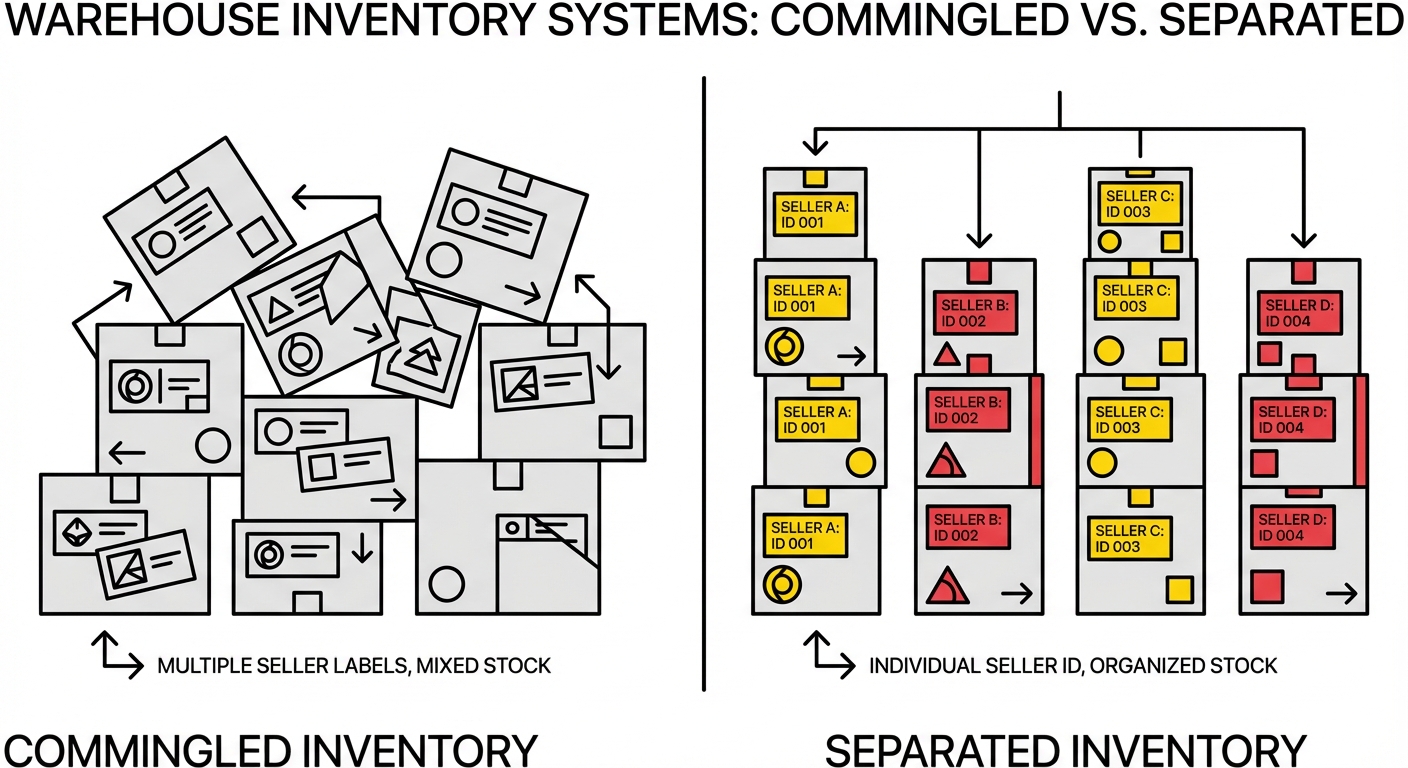
From a marketplace integrity perspective, this change also supports stronger inventory traceability and clearer separation between brand-controlled stock and reseller stock. For Amazon sellers, that means barcode handling is becoming more than an operational detail. It is increasingly part of the broader compliance framework that affects authenticity control, listing quality, and account health.
Why this matters for sellers:
Less pooled inventory across different sellers
More emphasis on SKU-level traceability
Stronger separation between brand owners and resellers
Higher operational discipline required for future FBA shipments
When Amazon removes shared inventory logic, it also removes one layer of ambiguity. That is good for strong brands, but dangerous for sellers with messy prep workflows or weak internal controls.
Amazon Commingling Policy Update 2026:
What Exactly Is Changing
Amazon’s announcement is clear on the high-level rule: commingling ends on March 31, 2026. But the operational impact depends on who you are and how your relationship to the brand is defined inside Amazon’s ecosystem. Amazon states that it will update the eligibility criteria for manufacturer barcodes at the same time that it ends commingling practices. The result is a new, role-based framework for FBA barcode handling.
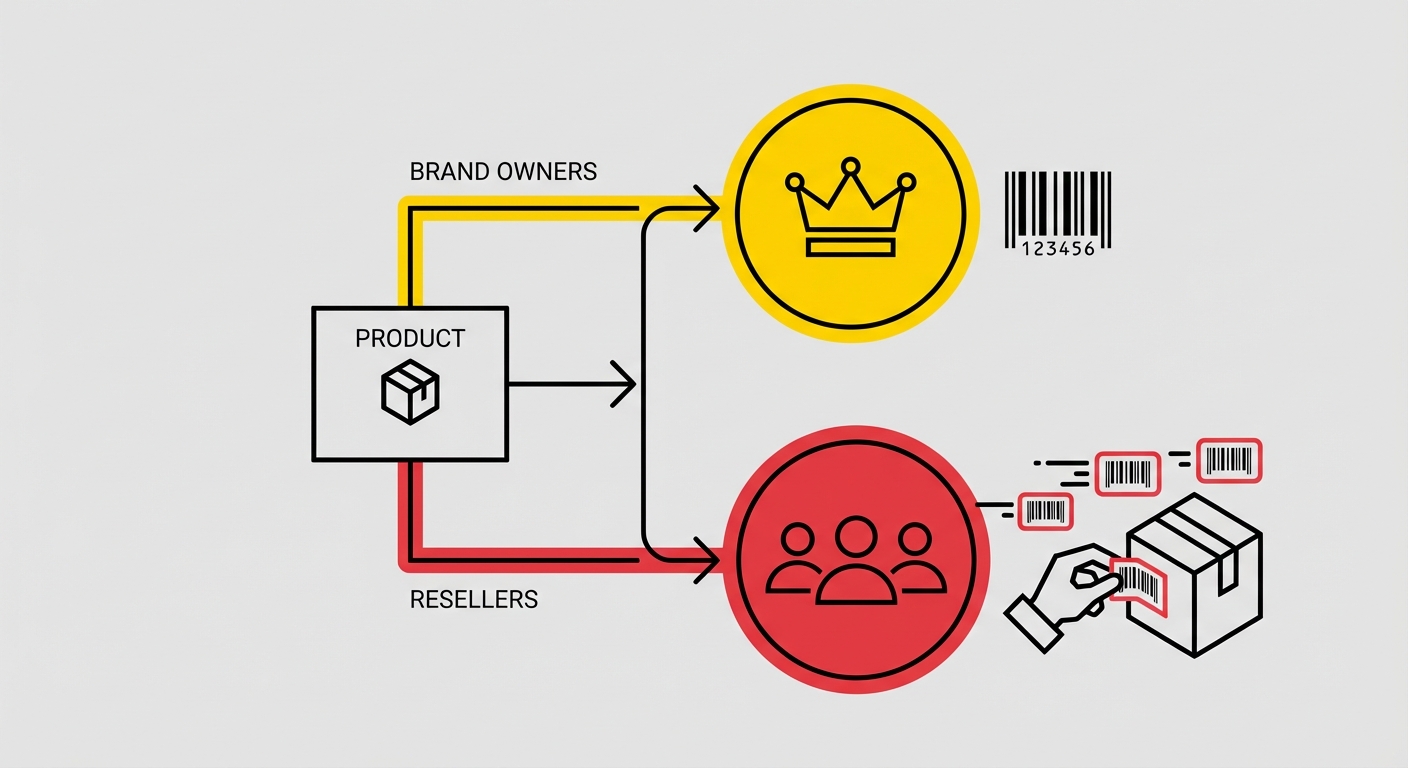
If you are a brand owner with the Brand Representative selling role in Amazon Brand Registry, you can continue to use manufacturer barcodes without stickers for eligible products. If you are a reseller and do not have that Brand Representative role, Amazon will require Amazon barcodes even when the product already has a manufacturer barcode. And if a product does not have a manufacturer barcode at all, then Amazon barcode labeling will be required for everyone. Amazon’s help pages also confirm that manufacturer barcodes can only be used for eligible products, and products that are not eligible must use Amazon barcodes.
Here is what changes:
Brand owners with the Brand Representative selling role in Amazon Brand Registry will no longer need Amazon barcode stickers for products that already have manufacturer barcodes, such as UPC or ISBN.
Resellers who are not enrolled in Amazon Brand Registry as a Brand Representative selling role will be required to use Amazon barcode stickers even if the product already has a manufacturer barcode.
Products without manufacturer barcodes will still require Amazon barcode stickers for both brand owners and resellers.
This is the point many Amazon sellers will misunderstand. The policy is not saying that anyone associated with a brand can skip stickers. It is saying that the benefit applies to accounts that hold the right Brand Registry role.
Important Note: “We are in Brand Registry” is not enough. The real question is: what selling role does the account have?
Expert Take: This single misunderstanding may become one of the biggest sources of 2026 shipment errors.
Sellers will assume they qualify for manufacturer barcode treatment when Amazon still sees them as resellers.
Amazon Brand Registry Roles and Barcode Eligibility:
The Rule Most Sellers Will Miss
Amazon’s own Brand Registry role guide explains that the Reseller role is for external, third-party sellers authorized to sell a brand’s products in the Amazon store. Amazon also makes clear that reseller access is more limited than Brand Representative access.
That distinction is critical here. A seller may have a legitimate agreement with a brand, may be authorized to sell the brand’s products, and may even be connected to the brand inside Amazon systems — yet still not qualify for the barcode flexibility Amazon is reserving for Brand Representatives.
Sellers most likely to be affected by this:
Wholesale sellers
Distributors
Aggregators
Agencies operating brand accounts
Authorized third-party resellers
Multi-brand operators using centralized prep workflows
For these businesses, the change is not theoretical. It may require a full relabeling review, changes to prep SOPs, and possibly new SKUs for future-compliant inventory flows.
Expert Take: If you sell branded products but do not directly own the brand account, you should assume nothing. Check the role first. That is step one of compliance here.
Amazon Barcode vs Manufacturer Barcode:
New FBA Barcode Rules for 2026
Amazon’s barcode rules already distinguish between products that are eligible for manufacturer barcode tracking and products that are not. Amazon’s help pages state that eligible products can use manufacturer barcodes such as ISBN, UPC, EAN, or JAN, while products that are not eligible must use Amazon barcodes.
After March 31, 2026, that baseline rule remains — but Amazon adds a second layer: seller role eligibility. So future barcode decisions depend on both:
whether the product is eligible for manufacturer barcode tracking, and
whether the seller account qualifies to use that method under Amazon’s updated framework.
In practical terms:
You may continue using manufacturer barcodes if:
the SKU is eligible for manufacturer barcode tracking, and
you are the brand owner with the Brand Representative role.
You will need Amazon barcodes if:
you are a reseller, even when the item has a UPC, or
the product itself is not eligible for manufacturer barcode tracking.
How the End of Amazon Commingling Impacts Brand Owners
For true brand owners, this policy change can be a real operational advantage. Amazon states that brand owners with the Brand Representative selling role will no longer need to apply Amazon barcode stickers to prevent commingling for products that already have manufacturer barcodes. Amazon also says this creates more flexibility because sellers will no longer need to pre-allocate units to Amazon or other channels.
That is a meaningful improvement for brands that sell across multiple channels. If the same unit can move through Amazon and non-Amazon channels without Amazon-specific relabeling, inventory handling becomes cleaner and more scalable. In practice, this gives brand owners more operational flexibility while keeping inventory management simpler and more consistent across channels. This is an expert operational interpretation of Amazon’s policy update.
Potential benefits for brand owners:
Less stickering and prep work
Cleaner multi-channel inventory planning
Better separation from reseller inventory
Lower exposure to pooled-inventory confusion
Stronger brand protection logic inside FBA
Still, brand owners should not assume every SKU qualifies automatically. Amazon’s help documentation makes clear that manufacturer barcode usage still depends on product eligibility.
Expert Take: Brand owners should run a SKU-by-SKU audit, not just celebrate the announcement. The benefit is real, but only if catalog-level execution is correct.
How the End of Amazon Commingling Impacts Resellers and Wholesale Sellers
For resellers, this update is much less favorable. Amazon’s announcement says resellers who are not enrolled as Brand Representatives will need Amazon barcode stickers even when the product already has a manufacturer barcode.
That means more than just printing labels. It means changing how your team thinks about inbound. Any seller who previously relied on stickerless manufacturer-barcode workflows may need to rebuild part of the FBA prep process.
Resellers should expect:
More labeling work
Higher prep-center complexity
Greater risk of inbound defects if SOPs are outdated
More SKU-level control requirements
Less room for barcode ambiguity after March 31
For wholesale sellers, this can become expensive fast if there are hundreds or thousands of replenished ASINs. The risk is not only labor cost. The bigger risk is inconsistency — some SKUs handled one way, others another way, and teams no longer knowing which barcode logic applies. That kind of confusion is exactly how preventable operational problems escalate. This is an expert operational assessment grounded in Amazon’s role-based barcode change and barcode-setting limitations.
How to Prepare for Amazon Commingling Changes
The best way to avoid problems is to prepare early and document the transition clearly.
Recommended action plan for sellers:
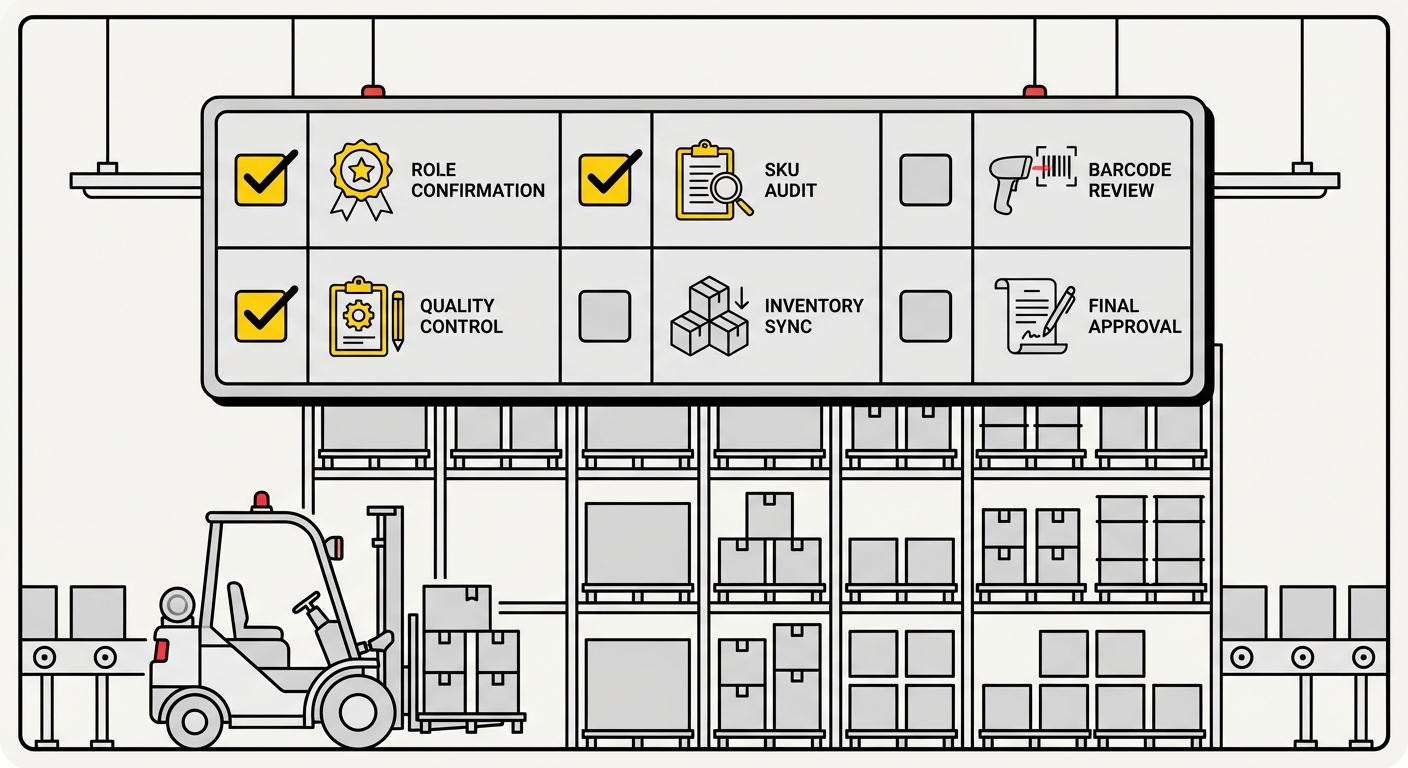
Confirm your Brand Registry selling role
Check whether your account is truly a Brand Representative or only a Reseller.Audit SKU eligibility for manufacturer barcodes
Review which FBA offers are eligible and which require Amazon barcodes.Review your FBA barcode preference and listing setup
Make sure the barcode logic at the SKU level matches what Amazon allows. Amazon forum guidance notes barcode preference is set at the SKU level.Identify SKUs that may require a new setup
Amazon provides help for switching to manufacturer barcodes and creating new listings or new SKUs where needed.Update warehouse and prep-center SOPs
Your operational team should know exactly which shipments require Amazon barcodes after March 31. This is an expert recommendation based on the official rule change and its operational consequences.Train your team before the deadline
Catalog managers, logistics teams, VA teams, and prep partners should all understand the new framework. This is an expert recommendation grounded in the role-based nature of the change.Document your transition decisions
Keep internal records of role checks, SKU audits, and SOP updates. This can help if you later need to explain an isolated operational error in a compliance context. This is expert advice, not a direct Amazon instruction.
Common Amazon Seller Mistakes After a Barcode Policy Update
Whenever Amazon changes a workflow tied to compliance, the same pattern appears: sellers underestimate the change, apply partial fixes, and then try to explain problems after the fact.
The most likely mistakes here are:
Assuming Brand Registry alone is enough
Assuming every UPC-based SKU is automatically eligible
Forgetting that reseller accounts are treated differently
Waiting too long to review active shipments
Letting old and new barcode workflows overlap
Failing to retrain warehouse or prep teams
Treating this as a logistics issue instead of a compliance issue
The last point is the one most sellers ignore. Barcode rules are about inventory identification. Inventory identification affects traceability. Traceability affects how Amazon evaluates responsibility when something goes wrong. That is why this update matters beyond FBA operations. This is an expert compliance conclusion based on the policy structure and how Amazon typically evaluates seller controls.
Amazon Seller Compliance Risk:
Why This Policy Matters for Account Health
Not every barcode error will lead to an Amazon seller account suspension. But serious sellers should still take this policy update very seriously. When Amazon changes how inventory must be tracked and identified, sellers are expected to adapt. If your account keeps shipping under an outdated barcode logic, Amazon will judge those shipments using the 2026 rules, not the 2025 ones.
This matters most for:
high-volume FBA sellers,
wholesale and reseller accounts,
brands with hybrid channel inventory,
sellers already under closer account-health scrutiny,
businesses in categories sensitive to authenticity or sourcing concerns.
From a reinstatement perspective, these are the kinds of changes that often surface later in appeals. The seller says the issue was operational. Amazon sees that the operation did not match the required control framework. That is why transition planning is not optional here. This is expert commentary based on real-world Amazon compliance and reinstatement logic.
What to Do If Your Amazon Seller Account Is Suspended
If your Amazon seller account gets suspended, the most important thing is not to rush with a generic appeal. Most sellers lose time and often make the situation worse by submitting template-based responses that do not address the real root cause. This is where professional support makes a difference.
At Mr. Jeff AMZ, we specialize in Amazon account reinstatement and complex compliance cases. Instead of templates, we build policy-aligned appeals based on how Amazon’s Seller Performance team actually reviews cases.
Why sellers choose Mr. Jeff AMZ:
600+ successfully reinstated accounts
3-Level Escalation Strategy (Seller Central → Account Health → Executive level)
Dedicated appeal manager for your case
Deep expertise in Section 3, inauthentic, dropshipping, and verification suspensions
Full case handling — from investigation to final reinstatement
If your account is already deactivated or at risk — the best move is to act early with a structured strategy.
👉 Request a Free Case Review and get clear, expert guidance on how to reinstate your Amazon seller account.

Author
Rick
Senior Reinstatement Consultant at Mr. Jeff AMZ
Rick is a Senior Reinstatement Consultant at Mr. Jeff AMZ with 6 years of experience appealing Amazon suspensions. He specializes in solving complex Amazon issues like Section 3, IP, and review-related enforcement, helping sellers recover deactivated accounts. His superpower is knowing Amazon's policies better than most Amazon reviewers do and building a compelling, watertight case for any position.
Connect on LinkedInFrequently Asked Questions
What is FBA commingling and when is Amazon ending it?
FBA commingling is Amazon's practice of fulfilling customer orders using exact product matches from the closest available inventory in its fulfillment network, even if that inventory originally belonged to a different seller. Amazon is ending this practice on March 31, 2026, and the new rules will apply to all inventory shipped on or after this date.
Who can continue using manufacturer barcodes after March 31, 2026?
Only brand owners with the Brand Representative selling role in Amazon Brand Registry will be able to continue using manufacturer barcodes after the policy change. All other sellers, including resellers, will need to use Amazon-issued barcodes (FNSKU labels) for their FBA inventory.
Why is Amazon ending the commingling practice?
Amazon states that it can now maintain fast delivery without commingling because most sellers already keep inventory closer to customers. The change also supports stronger inventory traceability and creates a clearer separation between brand-controlled stock and reseller stock, improving marketplace integrity and authenticity control.
What are the main impacts of this policy change for Amazon sellers?
The key impacts include:
- Less pooled inventory across different sellers
- More emphasis on SKU-level traceability
- Stronger separation between brand owners and resellers
- Higher operational discipline required for FBA shipments
Do I need to take action before March 31, 2026?
Yes, sellers should act early rather than waiting until the deadline. The article emphasizes this is the kind of update sellers should prepare for in advance, not after inbound issues begin. Early preparation will help avoid costly mistakes and potential account suspension.
What's the difference between brand owners and resellers under the new policy?
The new policy creates a clear divide between brand owners and resellers. Brand owners with proper Brand Registry status can continue using manufacturer barcodes, while resellers will be required to use Amazon-issued FNSKU labels. This role-based framework strengthens brand control and inventory traceability.
Will this policy change affect delivery speeds for customers?
According to Amazon, delivery speeds will not be affected. The company states it can maintain fast delivery without commingling because most sellers already keep inventory positioned closer to customers, making the pooled inventory model unnecessary for speed.