News
Amazon Dangerous Goods Questions Are Now Live: What Sellers Need to Know
October 27, 2026
Key Takeaways
- Amazon's new dangerous goods compliance questions took effect October 26, 2026, requiring sellers to answer technical questions when creating or editing listings for refrigerators, shock absorbers, markers, and pool chemicals.
- Any listing edit in the four affected product categories can trigger the new compliance questions, even routine updates to titles or descriptions, not just major changes.
- Sellers must provide specific technical data including refrigerant type and mass for appliances, ink base for markers, and TCCA concentration for pool chemicals before editing listings.
- Amazon allows 14 business days to provide dangerous goods compliance documentation for inventory already at fulfillment centers before potential disposal at seller's expense.
- Dangerous goods policy violations can result in account deactivation, not just blocked listings, requiring a Plan of Action explaining root cause and corrective measures.
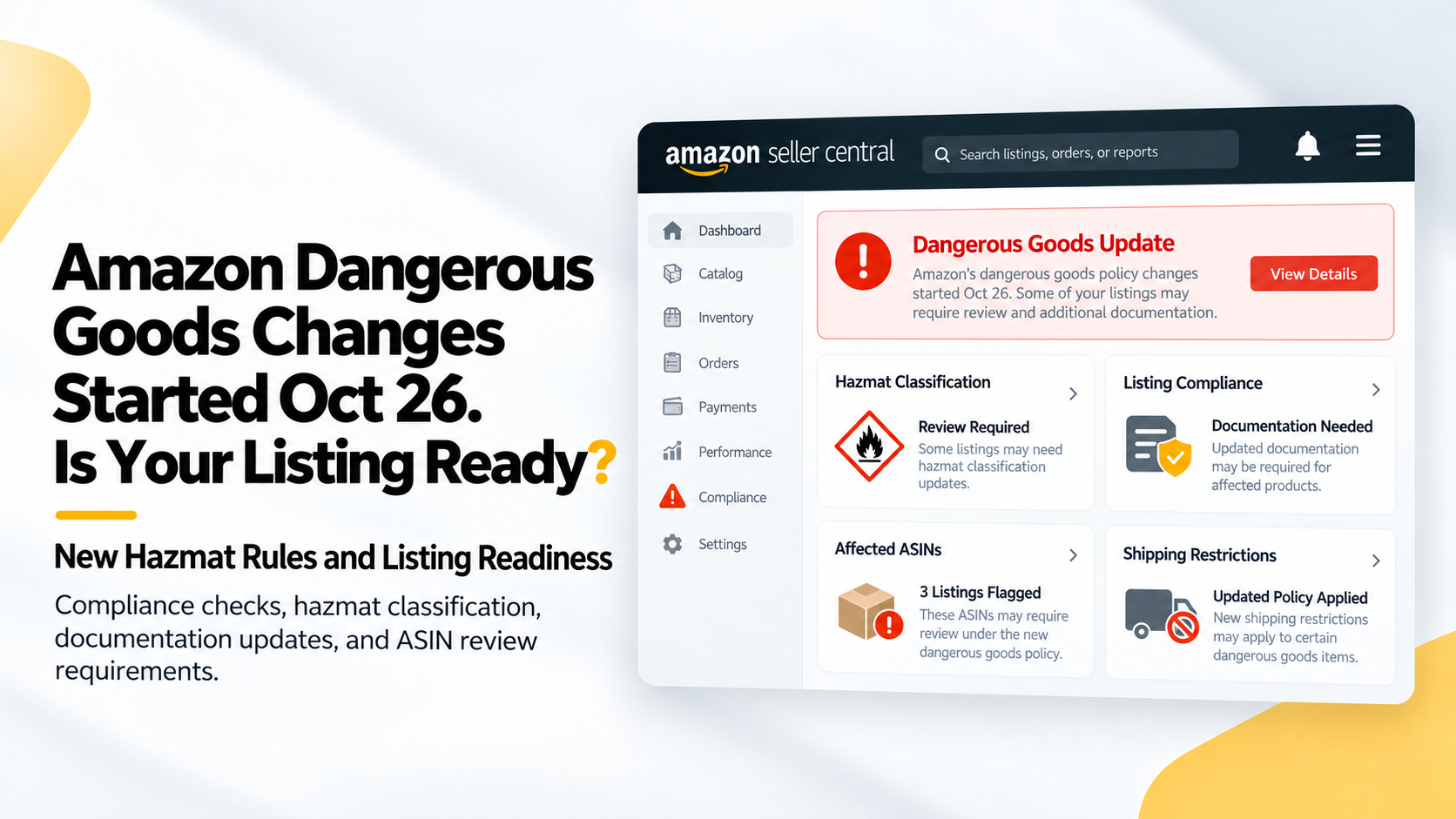
Amazon's new dangerous goods compliance requirements took effect on October 26, 2026. Sellers who create or edit listings in four affected product groups must now answer additional questions about their products' technical properties.
The change affects refrigerators and air conditioners, shock absorbers, markers and writing instruments, and pool and spa chemicals. Existing listings do not require an immediate update solely because of the new requirements. However, the next listing edit can trigger the additional questions.
Even a routine catalog update could become a compliance issue if you don't have the required product information ready.
For Amazon sellers, especially during the busy Q4 season, this means preparing technical documentation before making listing changes.
Here's what Amazon has announced, which products are affected, and how to protect your listings from avoidable compliance problems.
What Changed in Amazon's Dangerous Goods Compliance Requirements?
On September 25, 2026, Amazon announced new dangerous goods compliance questions, effective October 26, 2026.
According to Amazon, the additional questions are intended to:
Improve the identification and classification of dangerous goods.
Make additional shipping methods available where appropriate.
Reduce unnecessary inventory disposal costs and fees.
The questions appear when sellers create or edit listings in four specified product groups.
The most important detail: Amazon's announcement does not distinguish between major and minor listing edits.
This means sellers should treat their next catalog update as a potential trigger for the new compliance questions, whether they are updating product descriptions, titles, bullet points, or other listing information.
Importantly, the new requirements do not automatically mean that every product in the affected categories is classified as hazardous.
Amazon uses product-specific information to determine whether dangerous goods restrictions apply and which fulfillment methods may be available.
Does the Update Apply Only to Amazon US?
No. Amazon has published corresponding announcements across multiple marketplaces, including the US, UK, France, Germany, and Poland.
The affected product groups and October 26 effective date are consistent across these announcements. Sellers operating in other marketplaces should verify the requirements in their local Seller Central.
Which Products Are Affected by Amazon's New Dangerous Goods Questions?
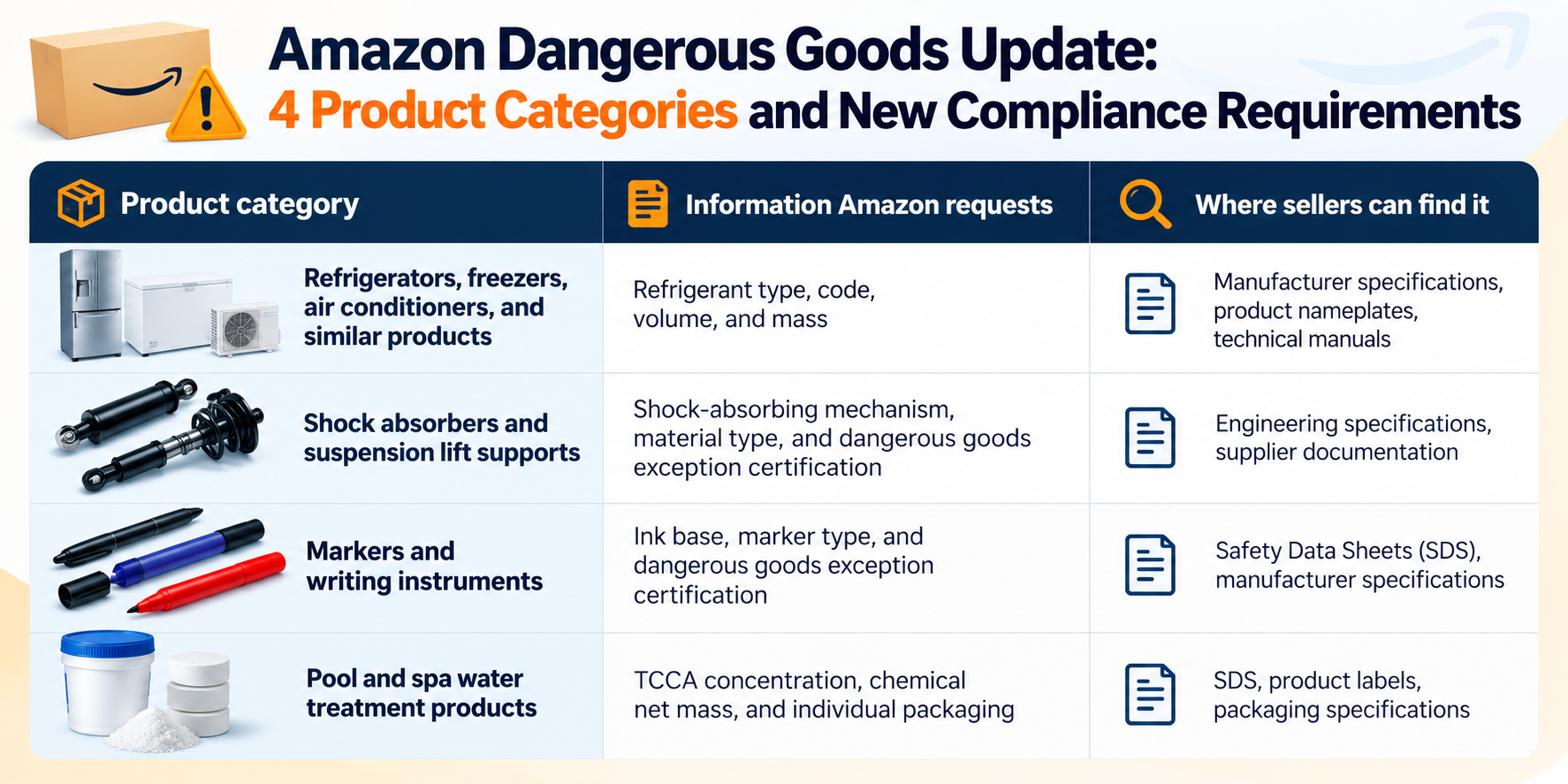
Amazon has introduced additional compliance questions for four product groups. Each group has different requirements based on the product's technical properties, chemical composition, and packaging.
Here's what sellers need to know about each category:
1. Refrigerators, Freezers, Air Conditioners, and Similar Products
Amazon requires additional information about the refrigerant used in these products, including:
Whether the unit contains pre-charged refrigerant.
Refrigerant type and code (such as R-32 or R-290).
Refrigerant volume.
Total refrigerant mass, expressed as a range in grams.
What sellers should do: Check the manufacturer's technical specifications, product nameplate, or user manual. Make sure the refrigerant details match the exact product model listed on Amazon. Never estimate refrigerant quantities based on similar models.
2. Shock Absorbers and Suspension Lift Supports
For these automotive components, Amazon requests information about the shock-absorbing mechanism, material type, and certification of any applicable dangerous goods exception.
Products that appear similar may contain different mechanisms or materials, which can affect their classification.
What sellers should do: Obtain engineering specifications or written confirmation from the manufacturer. Verify that your product qualifies for any claimed exception before submitting the compliance answers.
3. Markers and Writing Instruments
Amazon requires information about the ink properties and type of writing instrument, including:
Ink base.
Marker type.
Certification of any applicable dangerous goods exception.
Not all markers contain the same ink formulations, even when sold under the same brand. Differences in chemical composition may affect dangerous goods classification.
What sellers should do: Review the product's Safety Data Sheet (SDS), ink specifications, or manufacturer documentation. Confirm that the information accurately reflects the exact product being sold.
4. Pool and Spa Water Treatment Chemicals
For pool and spa chemicals, Amazon focuses on chemical composition, ingredient quantities, and packaging. Sellers must provide information about:
Whether the product contains more than 80% trichloroisocyanuric acid (TCCA).
Whether the net mass of TCCA exceeds 1 kg.
Whether individual units are separately wrapped.
These details help Amazon evaluate the product's dangerous goods classification and applicable handling requirements.
What sellers should do: Check the current SDS, product label, and packaging specifications. Verify chemical concentrations and net mass for each applicable formulation or package size.
Important: The new questions do not automatically mean that every product in these categories is classified as dangerous goods. Amazon uses the submitted information to determine the appropriate classification and fulfillment restrictions.
You can find the detailed requirements in Amazon's Dangerous Goods Required Information and Documentation guidelines.
What to Prepare Before Your Next Listing Edit
What to Prepare Before Your Next Listing Edit
List the affected ASINs. Include variations and "similar" products. Amazon names refrigerators, freezers and air conditioners without a full list, so treat anything with a compressor and a pre-charged refrigerant as in scope. Note each ASIN's status on the Manage dangerous goods classification page before you touch it.
Collect documents from suppliers, in writing. Per ASIN you need a current SDS where one applies (Amazon expects it dated within five years, with all 16 standard sections and a product name and brand that match your detail page), plus the category data above and the packaging and shipping details.
Make everything agree. Your documents, your answers and the detail page must say the same thing. Amazon says products with incomplete, inaccurate or conflicting information may be blocked for sale through FBA. A refrigerant named in a bullet or image has to match the SDS.
Name one person to answer, then test one edit. Nobody should guess a refrigerant or an ink base from a product title. Edit a single ASIN first, record the before and after, and check its status again afterwards, because Amazon's review process page says changed catalog information can trigger another review.
If Amazon classifies a product wrongly, upload a corrected SDS or exemption sheet, or use Dispute classification on the Manage dangerous goods classification page. Exemption sheets cover battery products and products without harmful chemicals, so a refrigerant appliance, a marker or a pool chemical usually needs an SDS. For inventory already at Amazon, the identification guide gives 14 business days to meet safety compliance requirements.
How Long Does an Amazon Dangerous Goods Review Take?
Amazon's dangerous goods review guidance generally indicates a review period of approximately two business days after the required, accurate documentation is received. However, the process can take longer if the submitted information is incomplete, incorrect, or requires clarification.
If Amazon rejects a document or requests additional information, a new review cycle may be necessary after resubmission. For sellers preparing Q4 listing updates or FBA shipments, even a short classification delay can affect inventory planning.
The best approach is to submit complete, consistent information the first time rather than relying on repeated corrections.
What if Your Inventory Is Already at an Amazon Fulfillment Center?
There is an additional risk when products are already stored at an Amazon fulfillment center.
If Amazon identifies inventory as potentially dangerous goods and requests compliance documentation, sellers may have 14 business days to provide the necessary information. Failure to meet the applicable requirements can result in inventory being disposed of at the seller's expense.
This deadline is not automatically triggered by every listing edit. It applies in the circumstances described in Amazon's dangerous goods identification and review procedures.
If Amazon sends you such a notice, review the stated deadline immediately and follow the instructions provided for the affected ASIN.
Can Amazon Deactivate Your Account Over Dangerous Goods Violations?
Yes. Amazon's Dangerous Goods policy says that any violation of dangerous goods regulations or of the policy leads to corrective actions. The examples Amazon lists include deactivating your seller-fulfilled or Amazon-fulfilled offers and deactivating your account, and the list is not exhaustive.
The identification guide adds that incorrect or incomplete information can get products blocked for sale, require corrective actions, or cost you your selling privileges.
In practice, the first consequence is usually a blocked product or a stuck FBA shipment, not an account action. Amazon does not say which mistakes in the new questions could escalate. Our reading: treat account-level action as possible, rather than assuming a blocked listing is the worst case.
If an offer or an account is deactivated, the fix has two parts: correct the listing data and the documents, then appeal the deactivation with a Plan of Action that explains the cause and the controls you added.
If a listing has already been deactivated after a dangerous goods review, or an account suspension is tied to a compliance issue, that is the kind of case the Mr.Jeff AMZ reinstatement team handles. Contact us and get a free consultation with an Amazon appeal specialist.
What to Do if Amazon Deactivated Your Listing or Account
If Amazon has blocked your ASIN or deactivated your seller account following a dangerous goods review, start by identifying the exact enforcement reason.
A dangerous goods classification issue, a documentation rejection, and an account-level policy violation may require different responses.
1. Review the Amazon Notice
Read the notification in Seller Central or Account Health carefully.
Identify whether Amazon is requesting additional information, a corrected SDS, a classification dispute, or an appeal.
Do not assume that every blocked listing requires the same reinstatement process.
2. Identify and Correct the Underlying Problem
Check whether the issue involves inaccurate product data, missing documentation, inconsistent technical information, or an actual policy violation.
If Amazon's classification appears incorrect, follow the appropriate dispute process and submit supporting evidence.
3. Follow the Applicable Reactivation Process
If Amazon has deactivated an offer or seller account, follow the instructions shown in Seller Central or Account Health.
Depending on the case, Amazon may request corrected documentation, an explanation of the issue, or a formal appeal.
If a Plan of Action is required, it should clearly address:
The root cause of the violation.
The corrective actions already completed.
The preventive measures implemented to avoid recurrence.
Avoid submitting repeated appeals without addressing the specific reason Amazon identified.
Get Help With Amazon Listing or Account Reinstatement
A dangerous goods compliance issue can become more complicated when it results in a blocked listing, restricted inventory, or seller account deactivation.
Correcting the product information is important, but the appropriate resolution also depends on Amazon's enforcement notice and the evidence available.
At Mr. Jeff AMZ, we help Amazon sellers investigate account deactivations, address compliance-related violations, and develop case-specific reinstatement strategies.
If your selling account has been deactivated following a dangerous goods compliance issue, our team can review the case and help determine the appropriate next steps.
Not sure why Amazon deactivated your account?
💡 Start with our free Amazon Suspension Analyzer to identify the likely reason behind your deactivation and explore possible next steps.
➡️ Or contact Mr. Jeff AMZ to request a free consultation with an Amazon account reinstatement specialist.

Author
Helen
Head of Client Success at Mr. Jeff AMZ
Helen leads Sales & Client Success at Mr. Jeff AMZ, guiding Amazon sellers from their first suspension panic to a fully recovered account. With years of frontline experience managing reinstatement cases, she translates Amazon's dense policy language into clear, actionable next steps and keeps sellers informed at every stage of the appeal.
Connect on LinkedInFrequently Asked Questions
When did Amazon's new dangerous goods compliance requirements take effect?
Amazon's new dangerous goods compliance requirements took effect on October 26, 2026. These requirements apply when sellers create or edit listings in the four affected product categories.
Which product categories are affected by Amazon's new dangerous goods questions?
Amazon has introduced additional compliance questions for four product groups:
- Refrigerators, freezers, air conditioners, and similar products
- Shock absorbers
- Markers and writing instruments
- Pool and spa chemicals
Do I need to update my existing listings immediately to comply with the new requirements?
No, existing listings do not require an immediate update solely because of the new requirements. However, the next time you edit a listing in an affected category—even a routine catalog update—could trigger the additional compliance questions.
What type of listing edits can trigger the new dangerous goods questions?
Amazon's announcement does not distinguish between major and minor listing edits. This means any catalog update—including changes to product descriptions, titles, bullet points, or other listing information—could potentially trigger the new compliance questions.
Does this dangerous goods update apply only to Amazon US sellers?
No, the update applies to multiple Amazon marketplaces, including the US, UK, France, Germany, and Poland. The affected product groups and October 26 effective date are consistent across these announcements. Sellers should verify requirements in their local Seller Central.
What information do I need to provide for refrigerators and air conditioners?
For refrigerators, freezers, air conditioners, and similar products, Amazon requires information about the refrigerant, including:
- Whether the unit contains pre-charged refrigerant
- Refrigerant type and code (such as R-32 or R-290)
How can I avoid listing restrictions or compliance issues with these new requirements?
Prepare your technical documentation before making any listing changes to products in the affected categories. Have product-specific information ready, including details about chemical composition, technical properties, and packaging. This is especially important during the busy Q4 season when unexpected compliance issues could impact your sales.