Case Studies
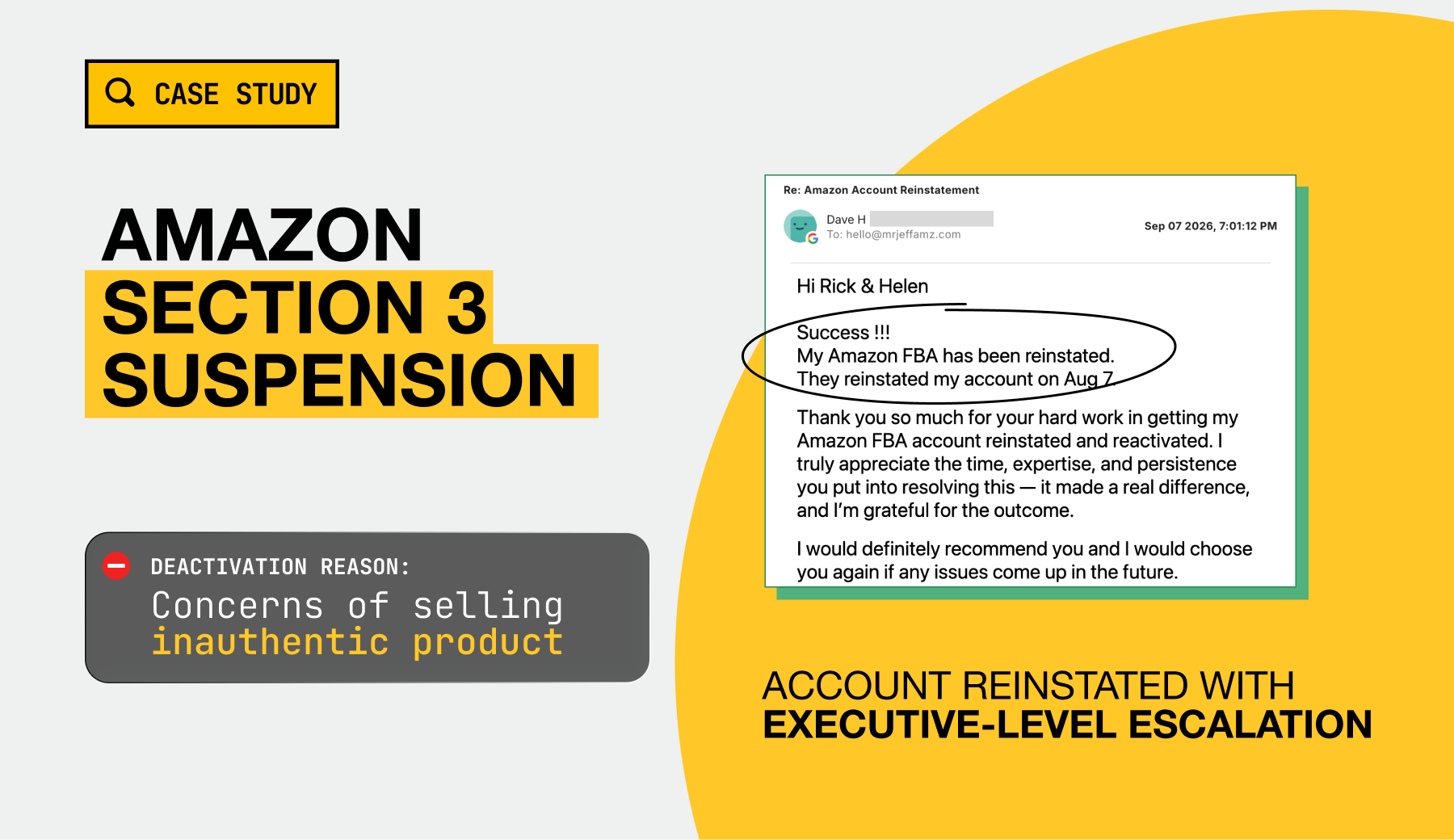
Amazon Inauthentic Item Suspension: Reinstated With Executive-Level Escalation
September 11, 2026
Key Takeaways
- An Amazon seller passed a video verification interview for Inauthentic Item Concern but was still deactivated because retail arbitrage sourcing did not meet Amazon's supply chain documentation standards.
- After six Seller Central appeals and a Better Business Bureau complaint all failed, two executive escalation letters successfully reinstated the account on August 7, 2026.
- Retail receipts from Target, Walmart, or Costco do not satisfy Amazon's authenticity requirements once an account is flagged, even if the products are genuine.
- Amazon's Inauthentic Item Concern focuses on verifiable invoices from authorized distributors, not whether sellers answer video interview questions honestly.
- The reinstatement required acknowledging the retail arbitrage sourcing problem and providing documentation of new authorized supplier relationships rather than disputing Amazon's findings.
Amazon flagged the client's account for an Inauthentic Item Concern and scheduled a video verification interview as part of the review. He showed up, answered every question honestly, and sent every document Amazon asked for afterward. His account was deactivated anyway.
That surprises most sellers, but an Inauthentic Item Concern is rarely about whether you're telling the truth. It's about whether your supply chain can prove where the product actually came from. You can be completely honest in the interview and still lose the account if that proof isn't there. Here is what the concern was really pointing to, and how we got the account back after two rounds of executive escalation.
The Challenge
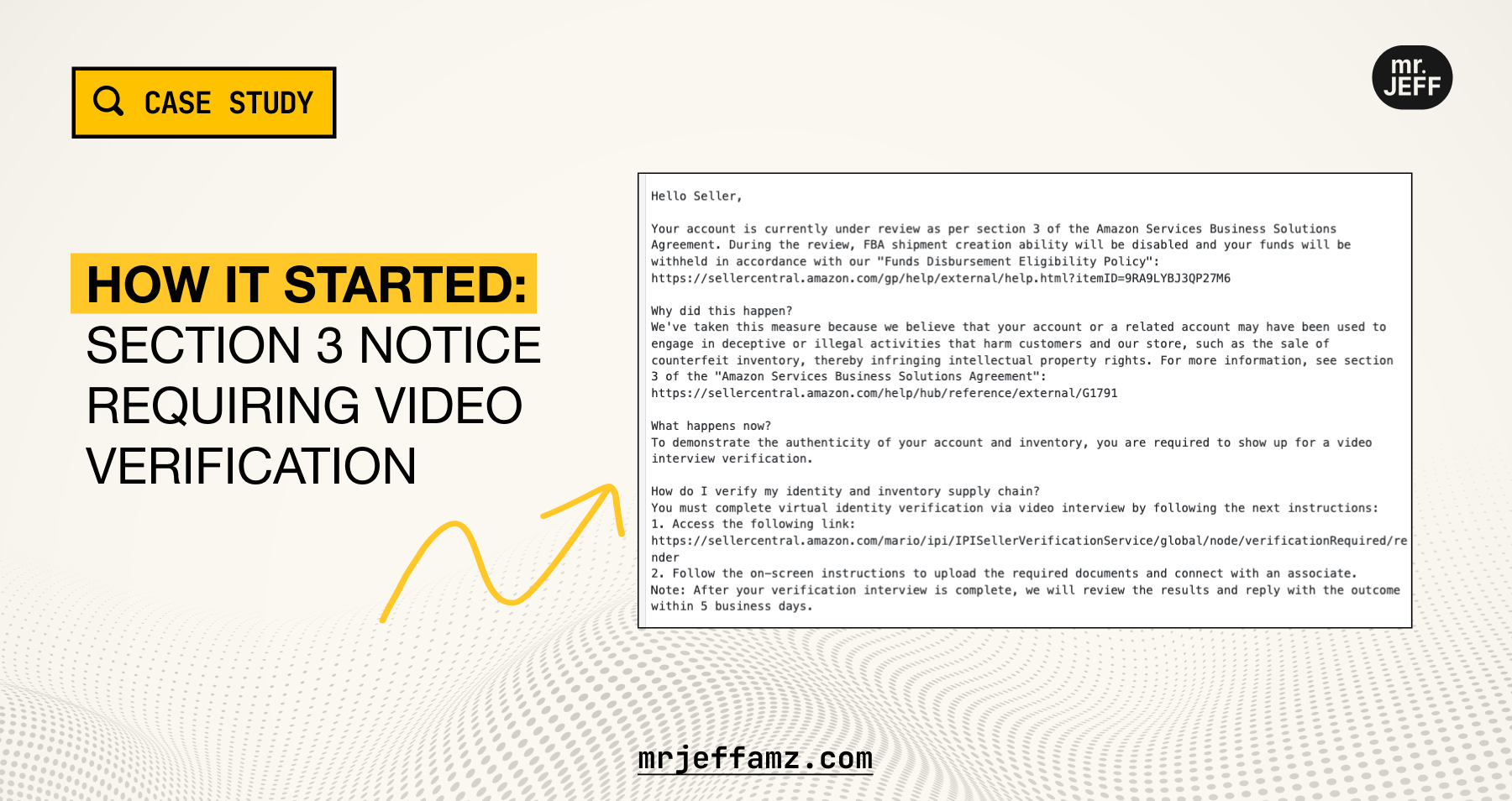
On May 1, 2026, Amazon FBAseller Dave received a notice from Amazon requiring him to complete a video verification interview:
"Hello Seller,
Your account is currently under review as per section 3 of the Amazon Services Business Solutions Agreement. During the review, FBA shipment creation ability will be disabled and your funds will be withheld in accordance with our Funds Disbursement Eligibility Policy.
Why did this happen? We've taken this measure because we believe that your account or a related account may have been used to engage in deceptive or illegal activities that harm customers and our store, such as the sale of counterfeit inventory, thereby infringing intellectual property rights.
What happens now? To demonstrate the authenticity of your account and inventory, you are required to show up for a video interview verification."
Dave attended the interview, answered every question genuinely, and afterward submitted every document Amazon requested. As far as he could tell, he had done everything asked of him.
Four days later, on May 5, 2026, his account was deactivated for an Inauthentic Item Concern anyway.
He made a few attempts to appeal the decision on his own, but Amazon rejected every appeal without any meaningful explanation.
On June 20, six weeks after the deactivation, Dave reached out to Mr. Jeff AMZ for help getting his account back.
What Is a Section 3 Deactivation for Authenticity Concerns
Section 3 of the Amazon Services Business Solutions Agreement covers deceptive or illegal activity, including the sale of counterfeit or inauthentic inventory. When Amazon suspects a violation, it can deactivate the account, disable FBA shipment creation, and withhold funds while it investigates, often requiring a video verification interview to confirm the seller's identity and the authenticity of the supply chain.
Clearing the flag has nothing to do with the interview itself. It requires recent, unaltered invoices from a verifiable, authorized distributor. Retail receipts, from Target, Walmart, Costco, or any local store, are not accepted, no matter how genuine the product is. That's why sellers who source through retail arbitrage can pass the interview completely and still stay deactivated: the documentation is what Amazon is actually weighing, not the conversation.
What the Case Investigation Revealed
This reinstatement was led by our senior reinstatement manager, Rick.
We started with the basics and conducted a full case investigation:
Reviewed the current state of the account
Went through every previous appeal Dave had submitted
Examined Amazon's rejection notices
Checked what supporting evidence was already on file
Reviewed the supply chain behind the flagged listings
That review turned up the real issue. Dave's supplier did not meet Amazon's criteria, because the products had been sourced from local retail stores rather than an authorized distributor or manufacturer. This is commonly known as retail arbitrage, and while it's a legitimate way to sell on Amazon in general, it does not satisfy the documentation standard Amazon expects once an account is flagged for supply chain verification. Retail invoices don't establish the kind of traceable chain of custody Amazon is looking for in these cases.
This was the root cause of the deactivation, and it was exactly what the appeal and the Plan of Action needed to address.
Our Reinstatement Strategy
Step 1: Building an Appeal That Faced the Real Issue
We crafted an appeal that acknowledged the sourcing problem rather than sidestepping it. Denying an issue that genuinely exists rarely works, and in this case it would have wasted a case that still had a real path forward. We gathered all relevant compliance documentation, and laid out a clear plan for sourcing from proper, authorized suppliers going forward, so Amazon could see not just an explanation but a credible change.
Step 2: Seller Central Submissions
We began the reinstatement process with submissions through Seller Central. In total, we submitted 6 appeals, each one revised from the last: tightening the explanation, adding further supporting evidence, and refining the corrective action plan as Dave worked to bring on legitimate, authorized suppliers.
Despite the appeal fully meeting Amazon's requirements, every submission ended in rejection without any clear justification. At that point, it was clear that further back-and-forth with the Seller Performance team was not going to reinstate the account, so we moved to a multi-level case escalation.
Step 3: Filing a Complaint With the Better Business Bureau (BBB)
With Seller Central producing nothing but generic rejections, we escalated externally and filed a complaint with the Better Business Bureau, laying out the case, the root cause we had identified, and the corrective steps Dave had already taken.
The BBB complaint applied pressure from outside Amazon's internal queue, which is a step most sellers never take. It still didn't move the account. Amazon responded to the complaint but held its position, which told us the case needed to go further up than any external consumer channel could reach.
Step 4: Preparing the Executive Escalation
With the standard and external routes closed, we shifted focus to an escalation to Amazon executives, the highest level available for a case like this.
Rather than sending the escalation immediately, we spent time strengthening it first. We took several preparatory steps to maximize the chances of it being accepted: tightening the documentation, making sure the corrective plan was concrete and specific, and ensuring the case read as complete and compelling before it ever reached an executive's desk. An escalation only gets one strong impression, and we wanted the first one to be the right one.
Step 5: The Escalation Letters
We sent the first executive escalation. It laid out the case in full: the retail arbitrage sourcing behind the flag, the corrective steps already taken, and the documentation backing all of it. Amazon reviewed it and declined to reinstate.
We didn't treat that as a dead end. We went back through the letter, tightened the weakest parts of the argument, and added further proof of the corrective actions Dave had already put in place with his new suppliers. The second letter went out shortly after.
The Result
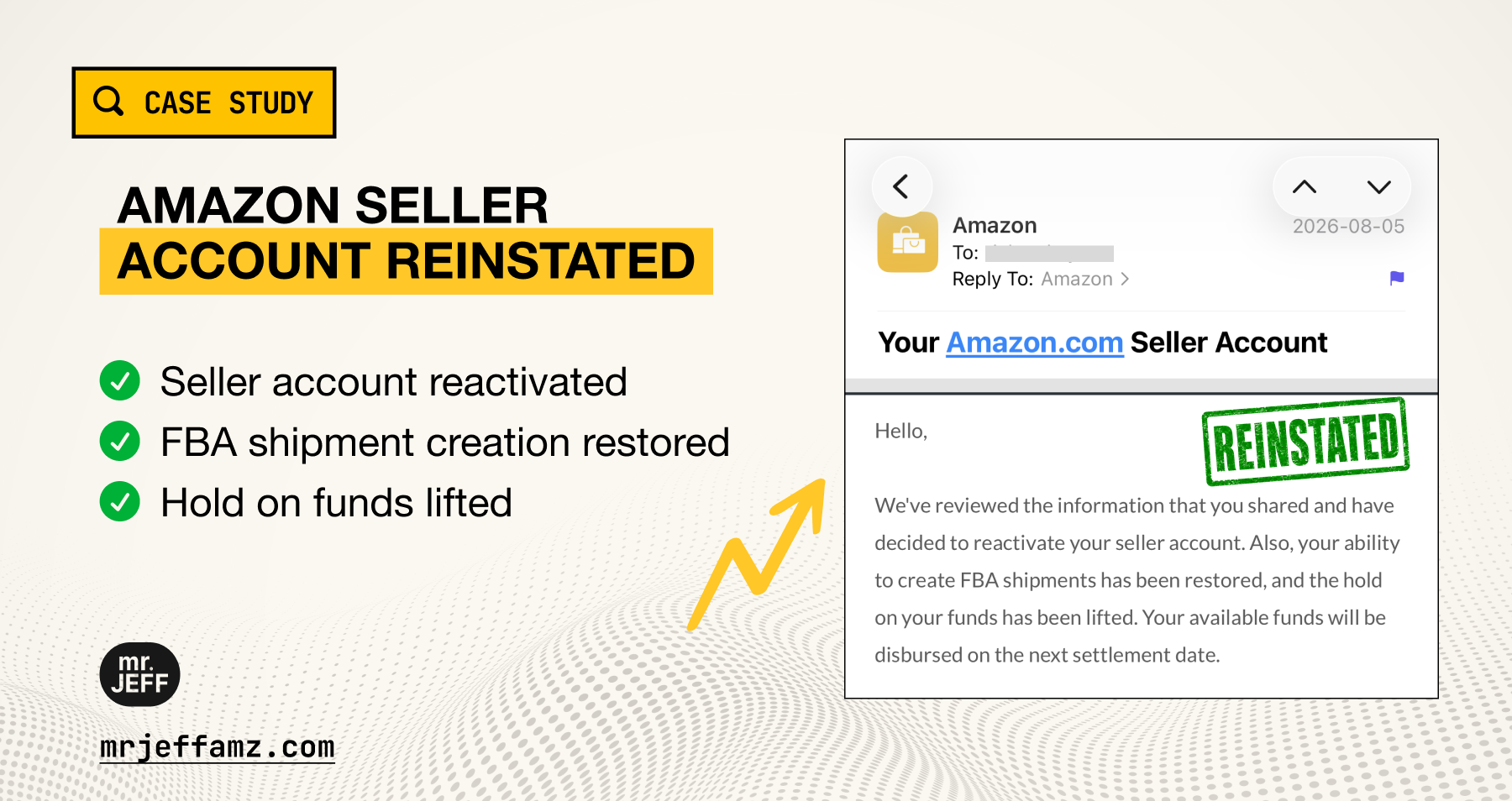
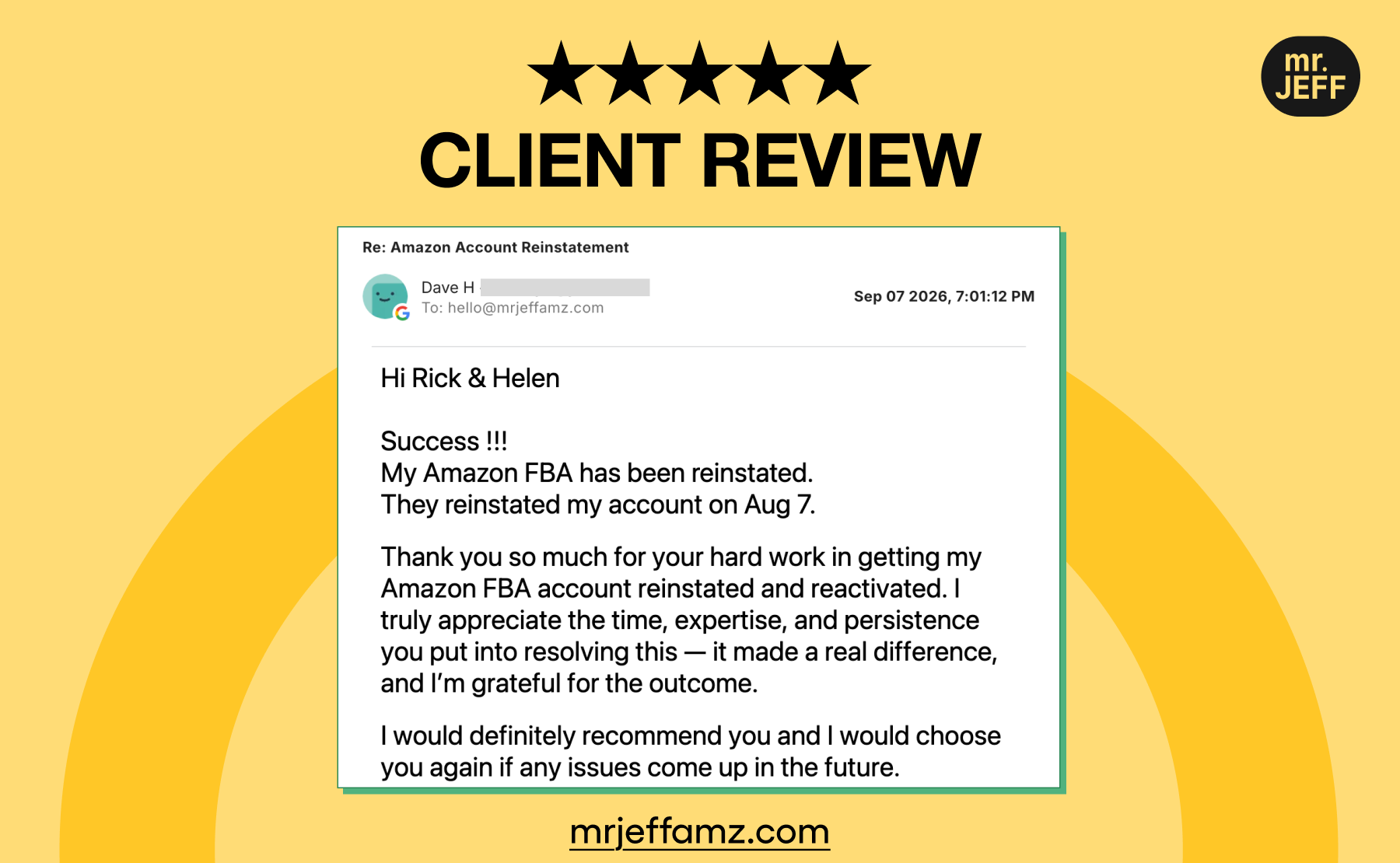
Account successfully reinstated on August 7, 2026, after the second executive escalation letter.
This was a genuinely complex case. Amazon rejected every early attempt, and by most standards, the account looked unrecoverable. What turned it around was the Mr. Jeff AMZ approach: acknowledging the real issue instead of arguing against it, then escalating the case through every available channel until it reached someone with the authority to act.
Dave got his account back, his funds released, and got back to doing what he does best: selling on Amazon.
He was glad to share a testimonial about working with Mr. Jeff AMZ:
Key Lessons for Amazon Sellers
Passing the interview and clearing the concern are not the same thing.
A video verification interview checks your identity, but an Inauthentic Item Concern checks your supply chain. You can be completely honest on camera and still lose the account if your sourcing doesn't meet Amazon's documentation standard.
Retail arbitrage sourcing can trigger and sustain an Inauthentic Item Concern.
Buying from retail stores is a legitimate sales strategy, but retail invoices often don't establish the chain of custody Amazon requires once an account is flagged. If you rely on retail sourcing, know that this is a real exposure.
Denying a real problem wastes the appeal.
When the sourcing issue was genuine, we didn't build the case around disputing it. We acknowledged it and showed exactly how it would be fixed. An appeal that argues against a true fact rarely survives review.
Preparation before an escalation matters as much as the escalation itself.
We didn't send the executive letter the moment the other channels failed. We strengthened the documentation and the corrective plan first, because an executive-level case makes its strongest impression once, not gradually.
A rejected escalation isn't the end of the escalation route.
The first executive letter didn't resolve the case. The second one did. Escalating to the right level is only half the strategy. What you put in the letter is the other half.
Need Help With Amazon Account Reinstatement?
If your Amazon seller account was deactivated for an Inauthentic Item Concern, and every appeal keeps getting rejected, that doesn't mean the account is lost. In cases like this, strategic escalation to the right channels, backed by professional help, is often what decides the outcome.
At Mr. Jeff AMZ, we specialize in reinstating suspended Amazon seller accounts, even in the most complex cases. Our team has successfully helped 650+ sellers get their accounts back and return to selling.
Here's what you get when you work with Mr. Jeff AMZ:
Insider Expertise — Our specialists include ex-Amazon staff and top Amazon sellers who understand exactly how Amazon reviews appeals behind the scenes.
Custom Plans — No Templates — Every submission is built from scratch, fully tailored to your specific violation type and account history.
Unlimited Revisions — We work on your case until reinstatement. No revision limits, no hidden fees.
Dedicated 1-on-1 Support — You'll have a personal senior reinstatement manager guiding you through every step of the process.
Fast-Track for Urgent Cases — If your business is on pause and time matters, we offer priority handling for urgent reinstatement cases.
Honest Case Review — If reinstatement isn't realistically possible, we'll tell you upfront. No false promises. No wasted time.
Get a Free Expert Case Review
If your Amazon seller account has been suspended for an Inauthentic Item Concern, don't build your appeal around the video interview alone.
Fill out the form and get a free expert consultation with a detailed review of your Amazon suspension case.

Author
Helen
Head of Client Success at Mr. Jeff AMZ
Helen leads Sales & Client Success at Mr. Jeff AMZ, guiding Amazon sellers from their first suspension panic to a fully recovered account. With years of frontline experience managing reinstatement cases, she translates Amazon's dense policy language into clear, actionable next steps and keeps sellers informed at every stage of the appeal.
Connect on LinkedInFrequently Asked Questions
Why was my Amazon account deactivated even though I passed the video verification interview?
Passing the video verification interview doesn't guarantee account reinstatement. Amazon's primary concern is whether your supply chain documentation proves product authenticity, not whether you answered questions honestly. If your invoices don't meet Amazon's standards—such as being from an authorized distributor rather than retail receipts—your account can still be deactivated.
What is a Section 3 deactivation on Amazon?
Section 3 of the Amazon Services Business Solutions Agreement covers deceptive or illegal activity, including the sale of counterfeit or inauthentic inventory. When Amazon suspects a violation, it can deactivate your account, disable FBA shipment creation, and withhold your funds while investigating the authenticity of your products and supply chain.
Why doesn't Amazon accept retail receipts as proof of authenticity?
Amazon requires invoices from verifiable, authorized distributors to prove product authenticity. Retail receipts from stores like Target, Walmart, or Costco are not accepted because they don't establish a direct supply chain from the manufacturer or authorized source—even if the products themselves are completely genuine.
Can retail arbitrage sellers get reinstated after an Inauthentic Item Concern?
Retail arbitrage sellers face significant challenges with Inauthentic Item Concerns because their sourcing method typically doesn't produce the documentation Amazon requires. Reinstatement usually requires obtaining proper invoices from authorized distributors or demonstrating an alternative compliant supply chain through strategic escalation.
What is executive-level escalation and how does it help with Amazon reinstatement?
Executive-level escalation involves taking your case directly to Amazon's senior leadership teams when standard appeals have been rejected. This approach can be effective when your appeal has merit but isn't being properly reviewed at lower levels. In this case, two rounds of executive escalation were required to get the account reinstated.
What documents does Amazon require to clear an Inauthentic Item Concern?
Amazon typically requires:
- Recent, unaltered invoices from a verifiable supplier
- Documentation from an authorized distributor in your supply chain
- Proof that establishes a clear chain of custody from manufacturer to seller
The invoices must be authentic and show the products in question were sourced through legitimate wholesale channels.
How long does it typically take to get reinstated after an Inauthentic Item Concern?
Timeline varies significantly based on your documentation and appeal strategy. In this case, the seller was deactivated on May 5 and sought professional help on June 20—six weeks after deactivation—after multiple failed self-appeals. Working with experienced consultants who understand executive escalation can potentially shorten this timeline.