Case Studies
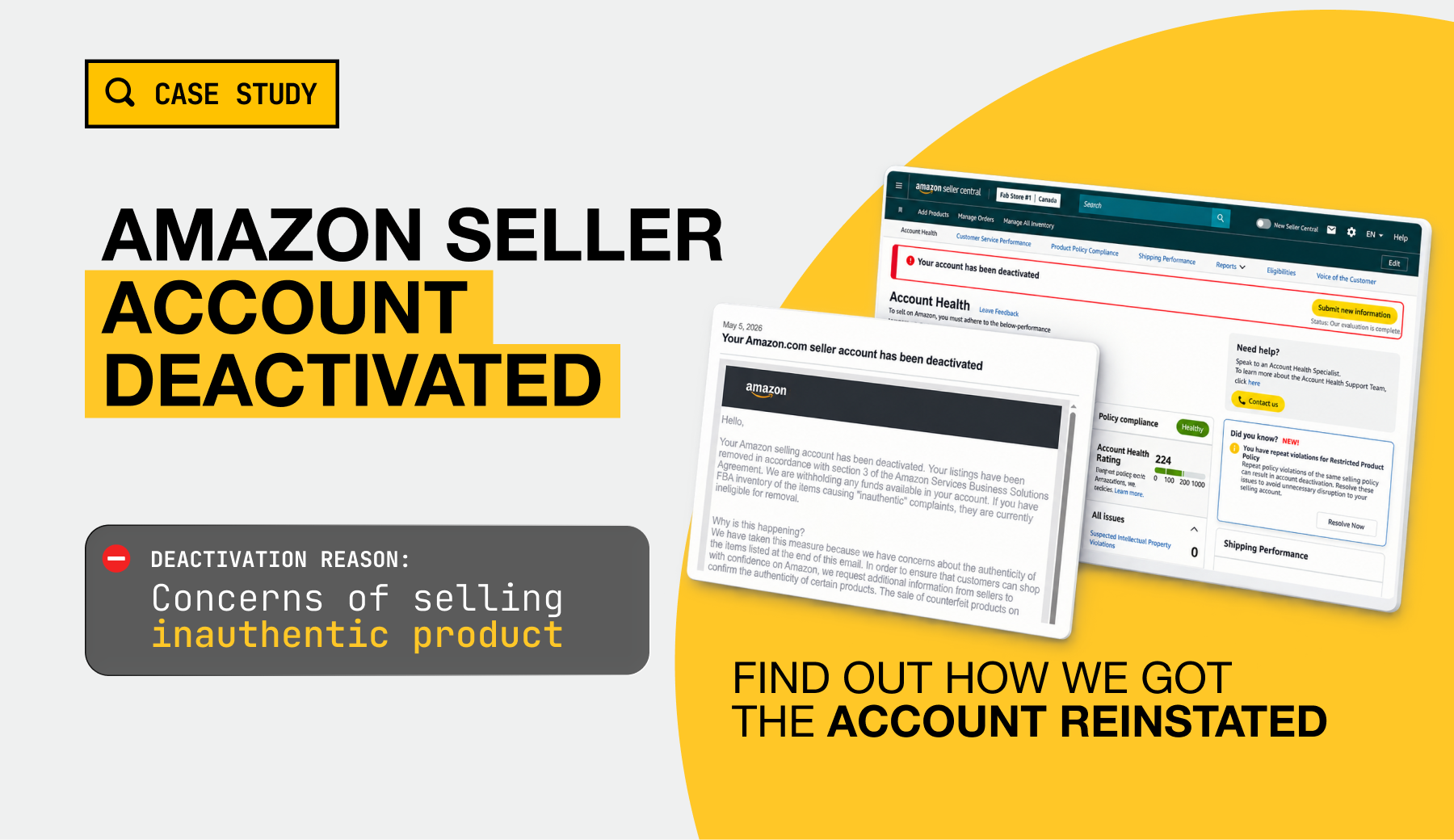
Amazon Inauthentic Suspension: Reinstated After a Missing LOA and "Manipulated Documents" Claim
September 3, 2026
Key Takeaways
- Amazon suspended a seller for inauthentic items despite legitimate brand invoices, rejecting appeals until escalation through the Better Business Bureau succeeded.
- Brands that refuse to issue letters of authorization as company policy are not restricting resale, but Amazon appeals must explicitly explain this distinction.
- Amazon claimed the seller's legitimate invoices were manipulated documents, requiring a point-by-point evidentiary response to address the specific objection.
- Repeated identical rejections mean the appeal argument must change fundamentally, not just be reworded, to break the automated denial cycle.
- BBB escalation secured reinstatement after Seller Central appeals stalled, though persistence was required as the first BBB response also repeated Amazon's rejection.
Most sellers assume that buying straight from the brand is the strongest proof they can offer Amazon. Marcus (client name has been changed to protect confidentiality) believed the same thing when his account was deactivated over an inauthentic item complaint. His invoices came directly from the brand. He was confident the case would be simple. It wasn't, and the reason had nothing to do with whether his products were genuine.
In this case study we break down why a completely legitimate sourcing chain still kept getting rejected, what changed the outcome, and why the escalation path mattered as much as the paperwork.
The Challenge
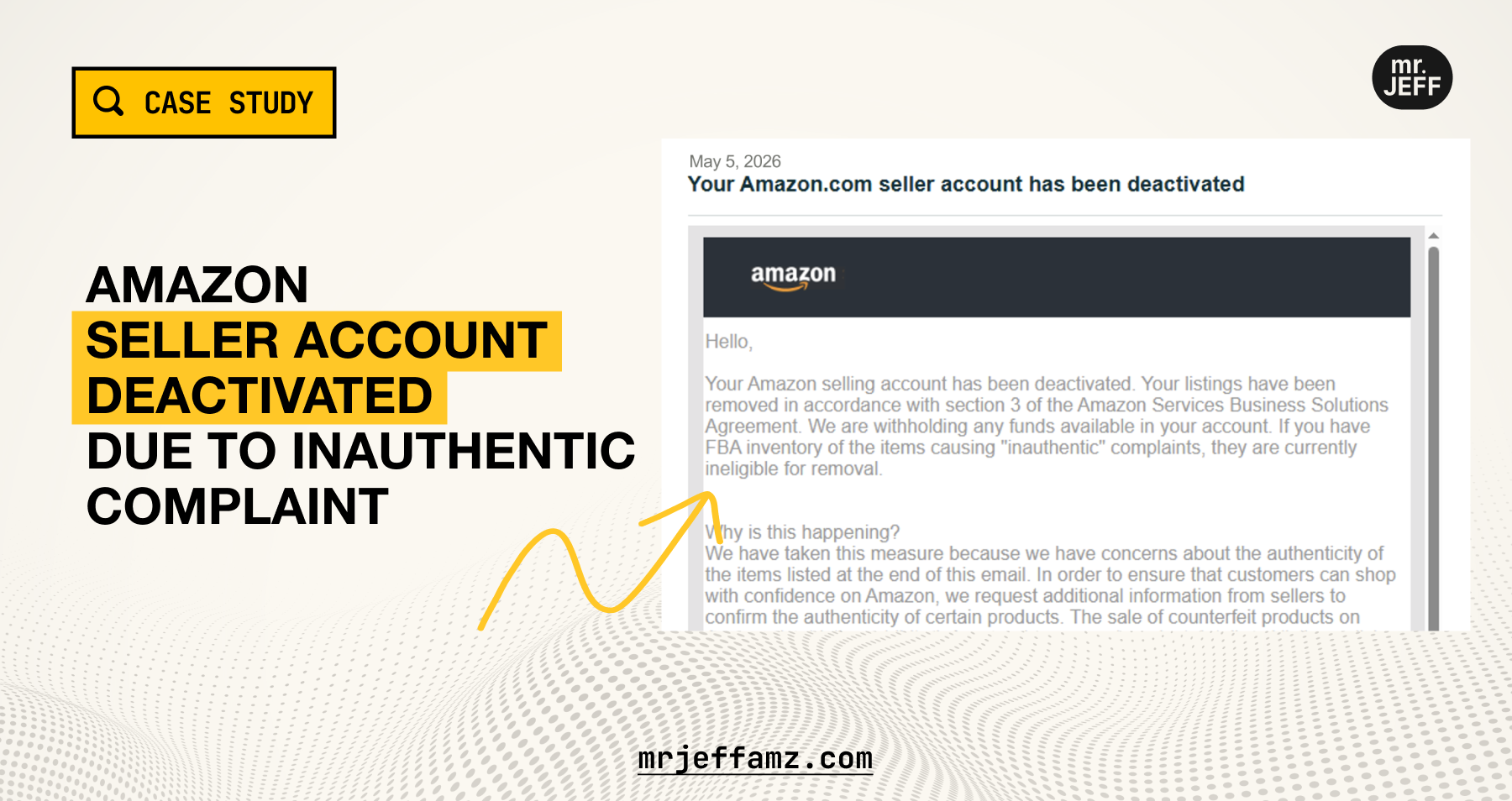
Marcus's account was deactivated after Amazon received reports alleging his products were inauthentic. The deactivation was groundless. He sourced the product directly from the brand itself, with invoices to prove it.
He submitted his documentation through Seller Central. Rejected.
He revised the explanation and submitted again. Rejected, with the same response each time.
The situation was further complicated by the client’s attempts to involve the brand directly. Following the instructions of the Account Health team, he repeatedly contacted the brand to request a letter of authorization or any other additional supporting documents.
The brand confirmed several times that they do not issue letters of authorization as a matter of policy, even though they fully allow resellers to sell their products. Eventually, the brand stopped responding, and the relationship became strained
By the time Marcus reached out to Mr. Jeff AMZ, he had already spent months on appeals built around the same argument: the products are authentic, here are the invoices.
What Is an Amazon Inauthentic Complaint Suspension
An inauthentic complaint suspension is triggered when Amazon receives reports, usually from buyers or brand owners, alleging that items sold under a listing are not genuine. Amazon's default posture is procedural: deactivate first, then ask the seller to prove the goods are authentic before considering reinstatement.
Most sellers treat this as a documentation problem, and in one sense it is. But invoices alone don't always close the case, especially when Amazon expects a document, like a letter of authorization, that not every brand is willing to provide.
Mr. Jeff Expert Insight: A brand refusing to issue a letter of authorization is not the same as a brand refusing to authorize resale. Amazon's system doesn't automatically know the difference, so the appeal has to spell it out.
Our Investigation
We started with a full audit of everything already on file: every invoice, every prior appeal, and every response Amazon had sent back. We cross-checked the invoices against the brand relationship and confirmed there was nothing ambiguous about where the product came from.
Our first submission was rejected too. But it was rejected differently. For the first time, Amazon gave a specific reason: it claimed the invoices were "manipulated." They weren't. They were original documents issued directly by the brand. Still, the specificity told us something useful. Amazon's reviewers were finally engaging with the file closely enough to raise a concrete objection, which meant we had something exact to answer instead of a form rejection to guess at.
The real gap wasn't the product. It was the brand's authorization policy. The brand would not issue a letter of authorization, but its own policy explicitly allowed unrestricted resale. Nothing in Marcus's earlier appeals had drawn that distinction clearly enough for a reviewer to act on it.
By the numbers: In our experience, a meaningful share of inauthentic complaint cases involve brands that simply don't issue letters of authorization as a matter of internal policy, not because resale is restricted. Appeals that don't explain that distinction tend to get the same automated rejection, no matter how many times they're resubmitted.
Reinstatement Strategy
Step 1: Full Documentation Audit
We reviewed every invoice and every prior communication with the brand to confirm the sourcing chain was clean and to identify exactly what had already been submitted, so nothing was repeated without reason.
Step 2: Responding Directly to the Manipulation Claim
Rather than treating Amazon's manipulation claim as an insult to brush past, we addressed it as an evidentiary question, laying out point by point why the invoices were authentic originals from the brand.
Step 3: Explaining the Brand's Authorization Policy
We built the core of the appeal around the distinction Amazon's system had missed: the brand does not issue letters of authorization by policy, but its own terms allow resale without restriction. We paired this explanation with fresh proof of direct cooperation between Marcus and the brand.
Step 4: Appealing Through Seller Central
We submitted the revised appeal. Even with the manipulation claim addressed and the authorization policy explained, the response that came back read like another automated denial rather than a considered decision.
Step 5: Escalating to the Better Business Bureau
Once every relevant fact and every document was formally on record in Amazon's system, resubmitting again was unlikely to change anything. We filed a complaint with the Better Business Bureau to put the case in front of a different review process.
Step 6: Persisting Through the BBB Review
The first response through the BBB channel repeated Amazon's earlier rejection. We continued pressing the case through the BBB rather than letting it stall, until Amazon carried out a proper, thorough review of the file.
The Result
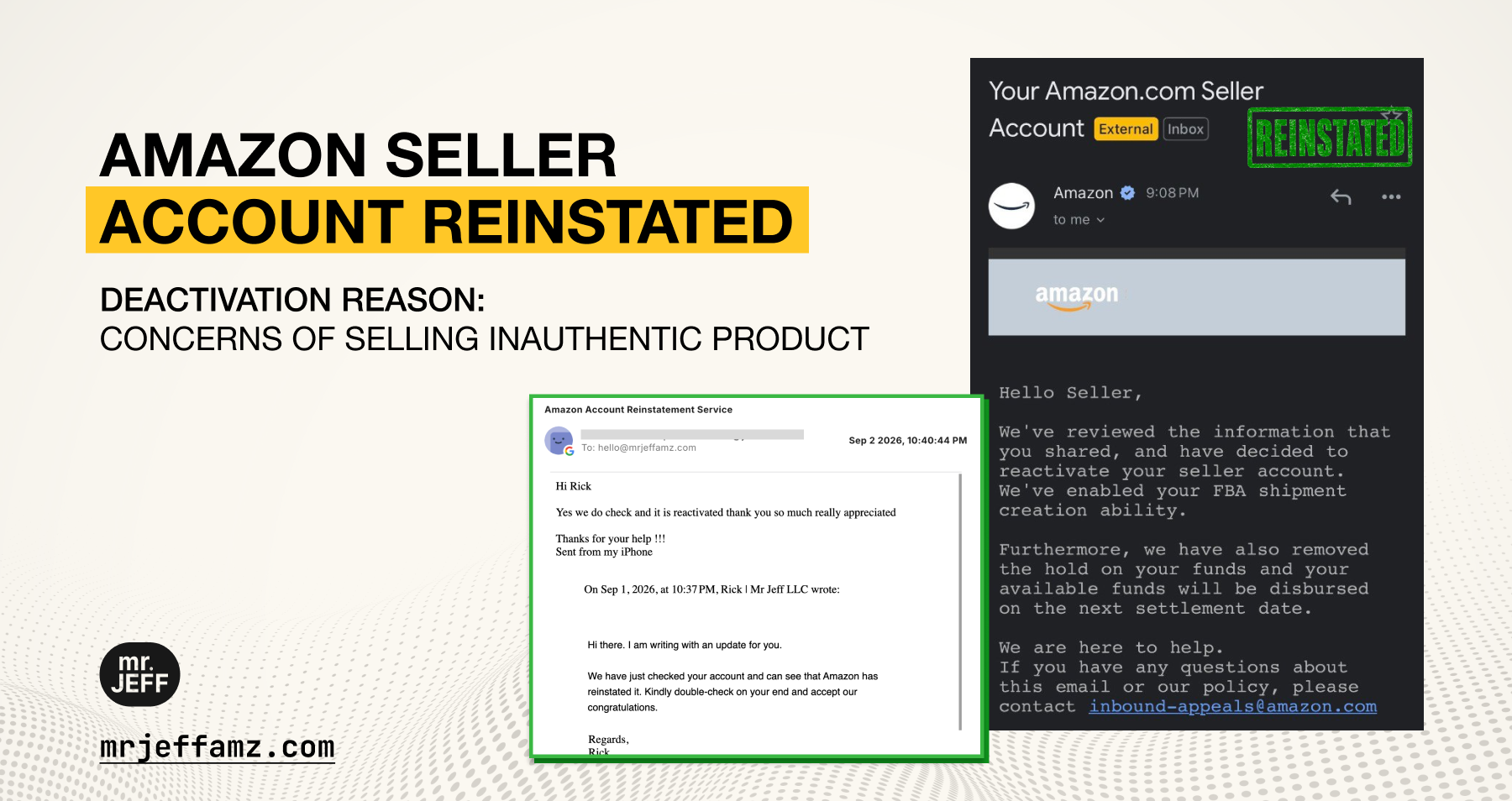
The account was fully reinstated after Amazon completed a proper review through the BBB escalation.
Marcus's account was reactivated, and he was back to selling under the same brand relationship that had nearly cost him his business.
What changed the outcome wasn't a stronger repeat of the original argument. It was identifying the exact gap in the case, the authorization policy Amazon's system didn't understand, addressing the manipulation claim head-on, and applying pressure through the BBB once Seller Central appeals stopped producing real reviews.

Key Lessons for Amazon Sellers
Genuine sourcing doesn't guarantee reinstatement on its own.
Marcus's products were authentic from day one. What kept the account suspended wasn't a lack of proof, it was a gap between what Amazon's system expects and what a seller, working alone, knows how to explain.
A brand's refusal to issue a letter of authorization isn't automatically a red flag.
Many established brands don't issue LOAs as a matter of internal policy, even when they fully permit resale. An appeal needs to make that distinction explicit, backed by the brand's actual resale terms.
Identical rejections mean the argument needs to change, not just the wording.
If a resubmitted appeal comes back with the same response, restating the same point more clearly rarely helps. Something in how the case is framed needs to change.
A "manipulated documents" claim needs a direct, evidence-based response.
Amazon's specific objections, even inaccurate ones, are worth answering point by point. A specific claim from a reviewer is often more useful to work with than a generic denial.
When Seller Central stalls, the BBB is a real escalation path.
Even a BBB complaint doesn't always work on the first response. Persistence through that channel is often what finally secures a genuine human review after appeals have gone quiet.
Need Help With Amazon Account Reinstatement?
If your account has been deactivated over an inauthentic complaint and your brand won't issue a letter of authorization, the issue may not be your invoices. It may be that Amazon's system hasn't been shown the difference between "no LOA" and "no authorization to resell."
At Mr. Jeff AMZ, we specialize in reinstating suspended Amazon seller accounts, even in the most complex cases. Our team has successfully helped 700+ sellers get their accounts back and return to selling.
Here's what you get when you work with Mr. Jeff AMZ:
Insider Expertise — Our specialists include ex-Amazon staff and top Amazon sellers who understand exactly how Amazon reviews appeals behind the scenes.
Custom Plans — No Templates — Every submission is built from scratch, fully tailored to your specific violation type and account history.
Unlimited Revisions — We work on your case until reinstatement. No revision limits, no hidden fees.
Dedicated 1-on-1 Support — You'll have a personal senior reinstatement manager guiding you through every step of the process.
Fast-Track for Urgent Cases — If your business is on pause and time matters, we offer priority handling for urgent reinstatement cases.
Honest Case Review — If reinstatement isn't realistically possible, we'll tell you upfront. No false promises. No wasted time.
Get a Free Expert Case Review
If your Amazon seller account has been suspended, don't spend another submission repeating an argument that's already been rejected.
Fill out the form and get a free expert consultation with a detailed review of your Amazon suspension case.

Author
Rick
Senior Reinstatement Consultant at Mr. Jeff AMZ
Rick is a Senior Reinstatement Consultant at Mr. Jeff AMZ with 6 years of experience appealing Amazon suspensions. He specializes in solving complex Amazon issues like Section 3, IP, and review-related enforcement, helping sellers recover deactivated accounts. His superpower is knowing Amazon's policies better than most Amazon reviewers do and building a compelling, watertight case for any position.
Connect on LinkedInFrequently Asked Questions
What is an Amazon inauthentic suspension and why does it happen?
An inauthentic suspension occurs when Amazon receives reports—typically from buyers or brand owners—alleging that products sold under a listing are not genuine. Amazon's standard response is to deactivate the account first, then require the seller to prove product authenticity before considering reinstatement.
Why would Amazon reject legitimate invoices directly from a brand?
Even genuine invoices can be rejected if Amazon's review team believes they appear altered or "manipulated," or if they expect additional documentation like a letter of authorization (LOA). Amazon's automated and manual review processes don't always recognize legitimate sourcing chains, especially when the documentation doesn't match their expected format.
What should I do if a brand refuses to issue a letter of authorization?
A brand refusing to issue an LOA is not the same as refusing to authorize resale. Many brands have policies against issuing LOAs while still permitting resellers. Your appeal must clearly explain this distinction to Amazon, providing evidence that the brand allows resale even without formal authorization letters.
Can I still get reinstated if Amazon claims my documents are manipulated?
Yes, reinstatement is still possible. When Amazon makes a "manipulated documents" claim, it often signals a need for strategic escalation rather than simply resubmitting the same paperwork. Working with experienced professionals can help you address this specific objection and present your documentation in a way that satisfies Amazon's requirements.
How long does the Amazon inauthentic suspension appeal process typically take?
The timeline varies significantly depending on the complexity of the case. As seen in this case study, sellers can spend months submitting appeals with the same arguments before finding the right approach. Strategic escalation and properly framed documentation can help shorten this timeline considerably.
Should I contact the brand directly when facing an inauthentic complaint?
While Amazon's Account Health team may advise this, proceed with caution. Repeatedly requesting documentation the brand cannot or will not provide can strain your supplier relationship—as happened in this case where the brand eventually stopped responding. Consider alternative strategies before risking your brand partnerships.
Why is the escalation path important in Amazon suspension appeals?
The escalation path matters as much as the paperwork itself. Standard appeals through Seller Central may continue to be rejected even with legitimate documentation. Strategic escalation can bring your case to reviewers who can properly evaluate the nuances of your situation, such as understanding that a brand's policy against issuing LOAs doesn't indicate unauthorized resale.