
Case Studies
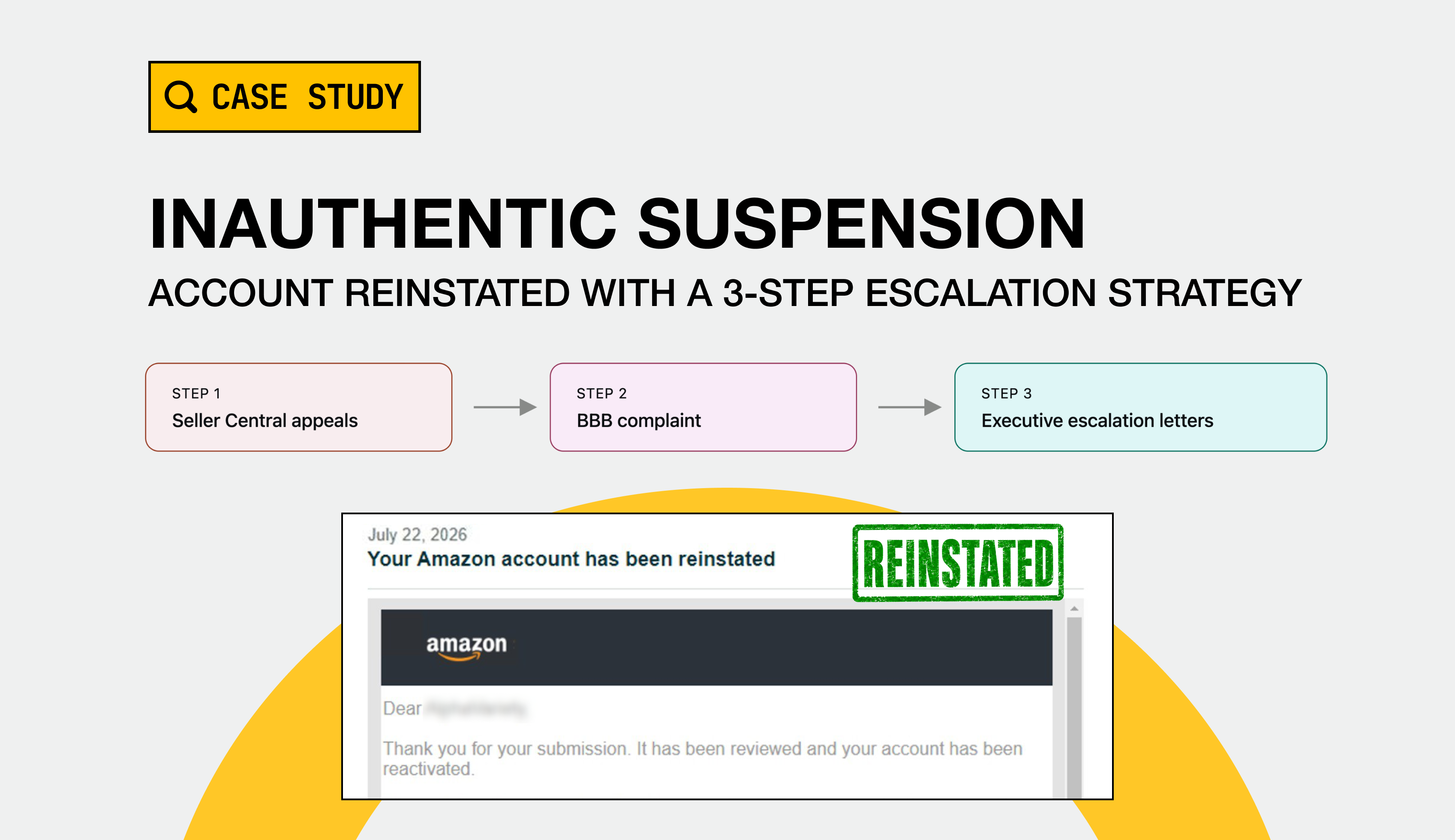
Amazon Inauthentic Suspension: Reinstated with a 3-Step Escalation Strategy
July 31, 2026
Key Takeaways
- Amazon can reject authenticity appeals even for genuine products if the supplier sourced inventory from Amazon itself, creating an illegitimate supply chain.
- A July 2026 reinstatement required four executive escalation letters after standard Seller Central appeals and BBB complaints were ignored for five months.
- Repeatedly rejected appeals with identical responses indicate the underlying supply chain issue has not been identified, not that the appeal wording needs improvement.
- FBA inventory held during an inauthenicity suspension can trigger secondary requirements like video verification that create additional reinstatement obstacles.
- Standard Seller Central appeals for inauthentic complaints often receive automatic denials without substantive review, requiring executive escalation for manual case evaluation.
Most sellers assume that if their products are genuine, proving it should be simple. Submit the invoices, show the supply chain, done. Derek believed exactly that when his account was deactivated over inauthentic complaints, and it cost him months of rejected appeals before he found out why.
In this case study we break down what actually blocked his case, why standard appeals never stood a chance, and the four-letter escalation that finally got his account back.
The Challenge
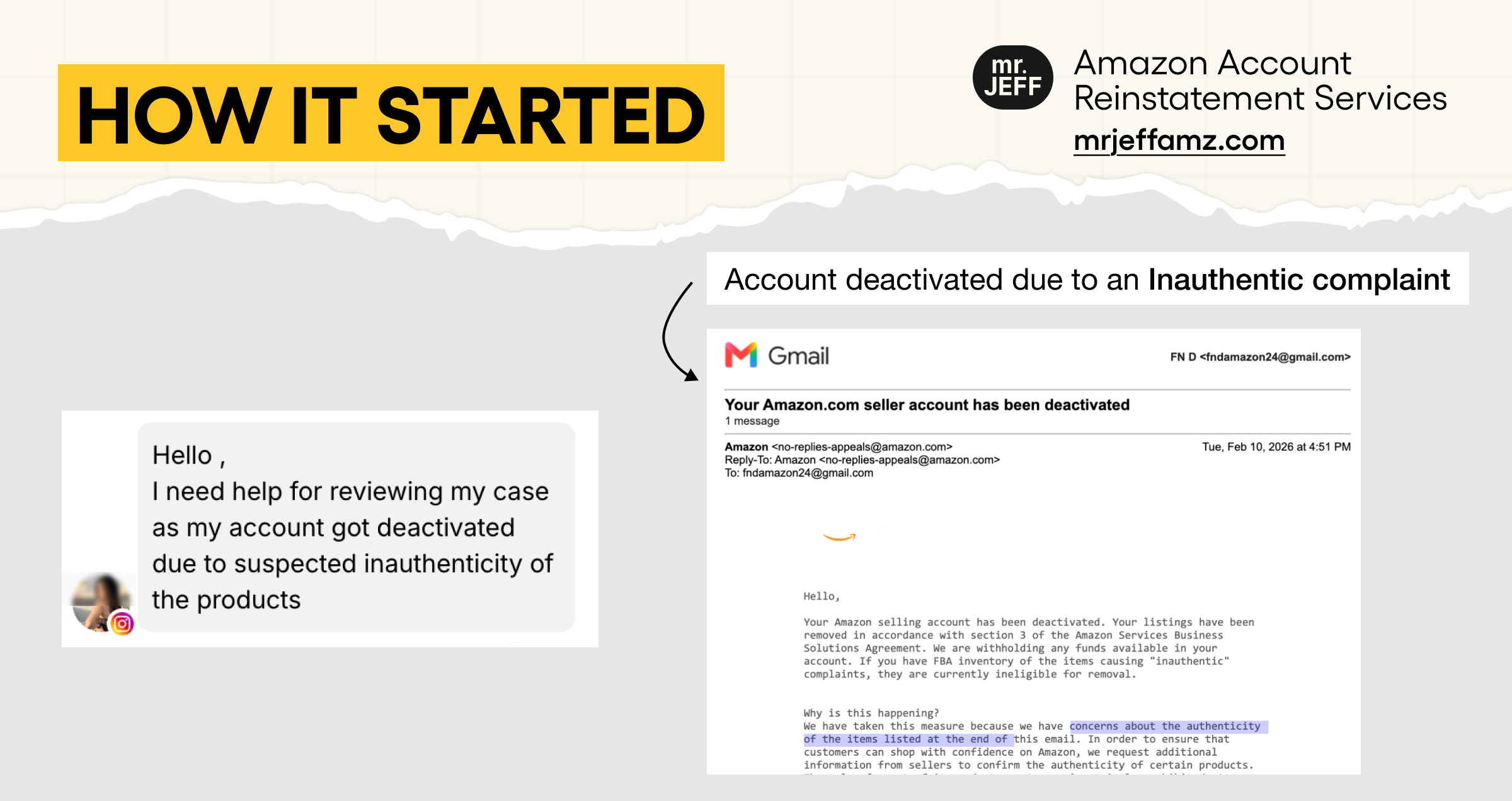
In February 2026, Gwendolyn's Amazon account was deactivated after Amazon received complaints alleging her products were inauthentic. She was confident the deactivation was a mistake. The products were real, sourced from a real supplier, and she had invoices to prove it.
She submitted her documentation through Seller Central. Rejected. She submitted it again, refining the explanation. Rejected again. No matter how she presented the case, Amazon wasn't moving.
By May 2026, three months into the deactivation, Gwendolyn reached out to Mr. Jeff AMZ. She had already made multiple submissions on her own, all built around the same argument: the products are authentic, here is the proof.
What Is an Amazon Inauthentic Complaints Suspension
An inauthenticity suspension is triggered when Amazon receives reports, usually from buyers or brand owners, alleging that items sold under a listing are not genuine. Amazon's response is procedural rather than investigative at first: the account is deactivated and the seller is asked to submit supply chain documentation proving the goods are authentic.
That sounds like a documentation problem, and most sellers treat it as one. But Amazon isn't only checking whether your invoices are real. It's checking whether your entire sourcing chain would survive scrutiny, and it will reject a submission over a single weak link even when everything else is in order.
Mr. Jeff Expert Insight: A seller can have completely genuine products and still fail every appeal, because the issue was never the product. It was where the product came from.
Our Investigation
We started where we always do: by figuring out what was actually driving the rejections, not what the notice said was driving them.
We investigated Gwendolyn's supplier. This is where we found the problem. The supplier wasn't sourcing from a manufacturer, a distributor, or any conventional wholesale channel. They were buying the product directly from Amazon.
To Gwendolyn, the products were authentic, because they were literally Amazon's own stock. To Amazon, that sourcing chain was a red flag it would never accept, no matter how many invoices backed it up. An invoice proving you bought a genuine product from a supplier who bought it from Amazon doesn't establish a legitimate, independent supply chain. It proves the opposite.
This explained everything. It explained why Gwendolyn's submissions were technically accurate and still rejected. It explained why no amount of rewording the same argument was ever going to change the outcome.
By the numbers: In our experience, a meaningful share of inauthentic complaint cases involve products that are genuinely authentic. What sinks the appeal isn't the product, it's a sourcing chain that can't be verified as legitimate and independent.
Reinstatement Strategy
Step 1: Explaining the Real Risk to the Client
Before writing a single appeal, we walked Gwendolyn through exactly why her previous submissions had failed. The product being real was never in question. The problem was that her supplier's own sourcing practice made the chain impossible for Amazon to accept. We laid out what would need to change and what the case would need to demonstrate going forward.
Step 2: Building the Case Strategy
We put together a detailed strategy addressing the actual root cause rather than resubmitting the same authenticity argument. That meant identifying what a defensible supply chain needed to look like and what evidence could support it.
Step 3: Appealing Through Seller Central
We began submitting appeals through the standard channel. They were rejected, and not with any indication they'd been meaningfully reviewed. The responses read like automatic denials rather than considered decisions.
Step 4: Escalating to the Better Business Bureau
With Seller Central exhausted, we filed a complaint with the Better Business Bureau, laying out the full situation and requesting their intervention. The BBB complaint didn't move Amazon either. The appeals kept coming back rejected.
Step 5: Preparing the Executive Escalation
At this point we started preparing for the next stage of our process: a direct escalation to Amazon executives. While that was in motion, we kept every other channel active. We continued updating and resubmitting appeals through Seller Central and stayed in ongoing contact with the Account Health team, so the case never went quiet while the escalation was being built.
During this same stretch, Gwendolyn's inventory held in Amazon's warehouses triggered a video verification requirement. We prepared her for the call and helped her pass it, keeping that inventory from becoming a second problem stacked on top of the first.
Step 6: The Executive Letters
Once it was clear that Seller Central appeals were being dismissed without real review, we sent our first letter directly to Amazon executives, laying out the case in detail and requesting a manual review.
It was ignored. We sent an updated version. Ignored again. We sent a third. Same result.
We sent a fourth updated letter, refining the case each time and continuing to follow up.
On the fourth executive letter, the case was finally reviewed properly.
The Result
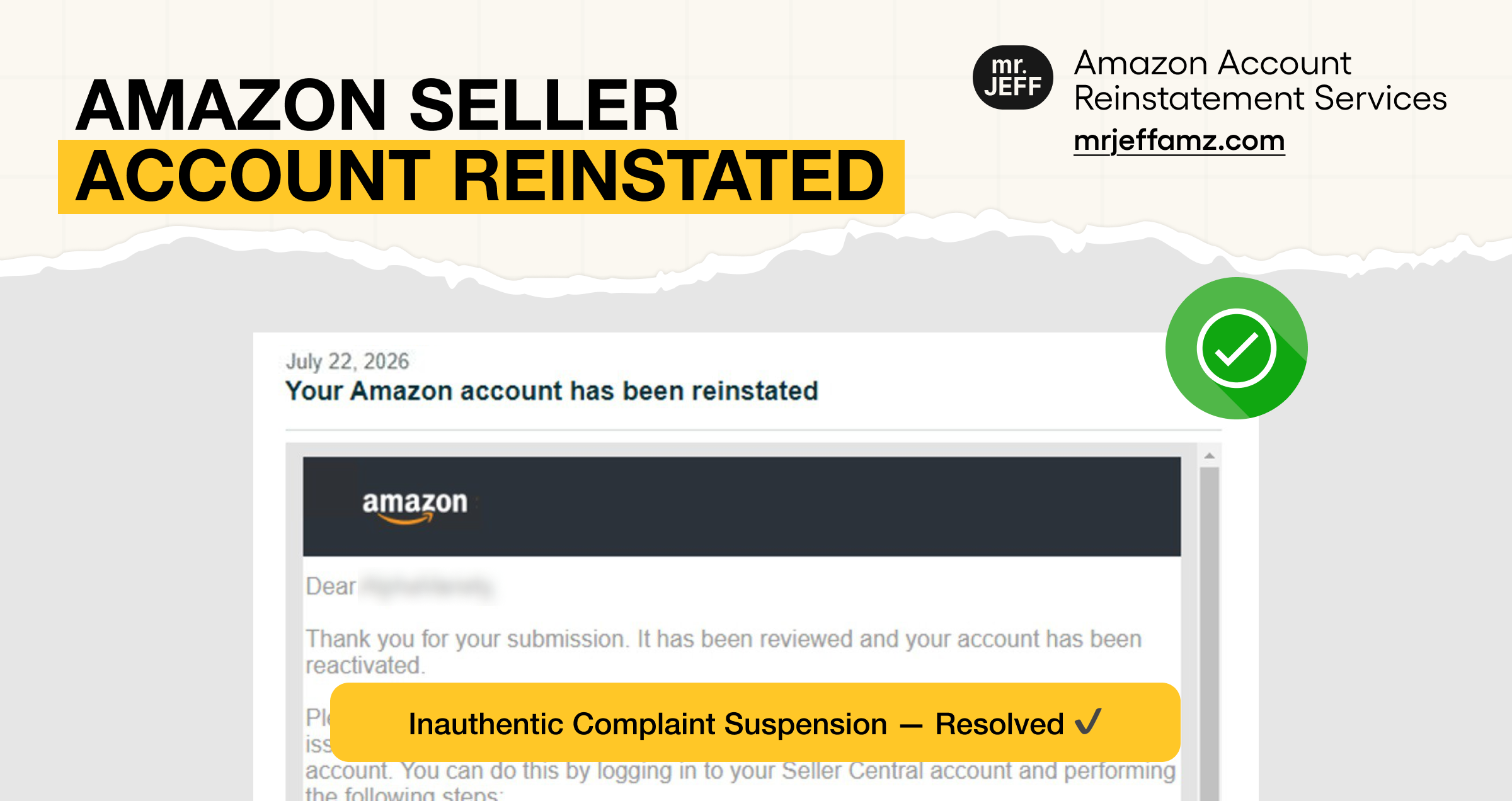
Amazon seller account fully reinstated on July 22, 2026, after four escalated letters to Amazon executives.
Gwendolyn's account was reactivated, her inventory was no longer at risk, and she was back to selling.
What got this case over the line wasn't a stronger version of the original argument. It was diagnosing the real problem in the supply chain, then applying escalating pressure through every available channel until someone with the authority to fix it actually looked at the file.
Key Lessons for Amazon Sellers
Genuine products can still fail an authenticity appeal.
Amazon isn't only asking whether your product is real. It's asking whether your supply chain is legitimate and independent. A product bought from a supplier who sourced it from Amazon itself will never satisfy that standard, no matter how real the goods are.
Identical rejections mean you haven't found the real issue.
If a resubmitted appeal comes back rejected in the same way, restating the same argument more clearly won't change it. Something in the underlying chain needs to change, not the wording.
Seller Central isn't always a meaningful review.
Rejections that arrive quickly and without explanation often signal that the appeal wasn't substantively reviewed. When that pattern repeats, escalation outside the standard queue becomes necessary.
Escalation takes persistence, not one attempt.
The first executive letter rarely works. This case took four before it landed in front of someone who reviewed it properly. Sellers who give up after one unanswered letter often abandon the exact channel that would have worked.
Held inventory brings its own risks.
A suspension involving FBA inventory can trigger secondary requirements, like video verification, while the main case is still open. Missing one of these can create a second problem on top of the original suspension.
Need Help With Amazon Account Reinstatement?
If your account has been deactivated over inauthentic product complaints and your documentation keeps getting rejected, the issue may not be your invoices. It may be somewhere further up your supply chain that a standard appeal will never surface.
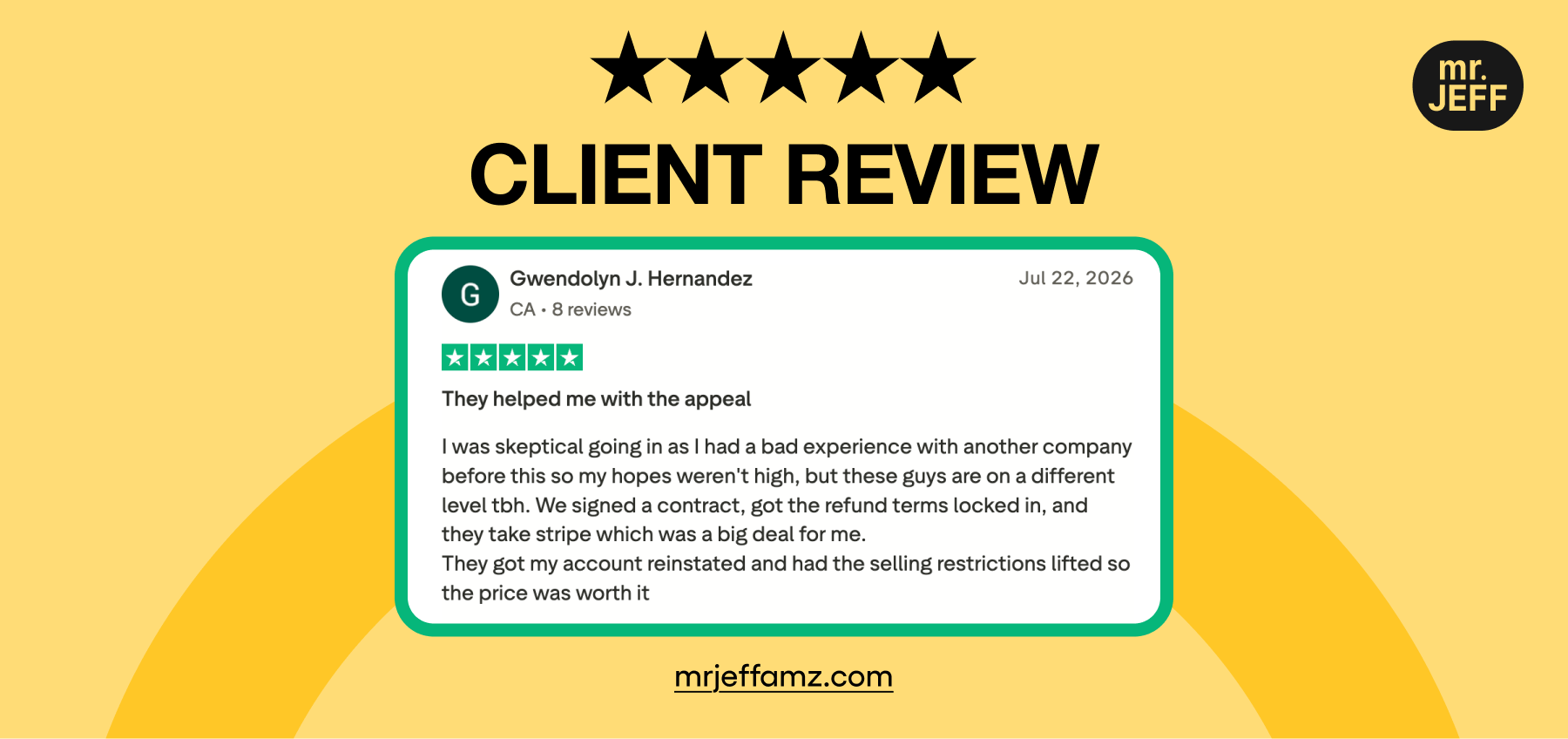
At Mr. Jeff AMZ, we specialize in reinstating suspended Amazon seller accounts, even in the most complex cases. Our team has successfully helped 650+ sellers get their accounts back and return to selling.
Here's what you get when you work with Mr. Jeff AMZ:
Insider Expertise — Our specialists include ex-Amazon staff and top Amazon sellers who understand exactly how Amazon reviews appeals behind the scenes.
Custom Plans — No Templates — Every submission is built from scratch, fully tailored to your specific violation type and account history.
Unlimited Revisions — We work on your case until reinstatement. No revision limits, no hidden fees.
Dedicated 1-on-1 Support — You'll have a personal senior reinstatement manager guiding you through every step of the process.
Fast-Track for Urgent Cases — If your business is on pause and time matters, we offer priority handling for urgent reinstatement cases.
Honest Case Review — If reinstatement isn't realistically possible, we'll tell you upfront. No false promises. No wasted time.
Get a Free Expert Case Review
If your Amazon seller account has been suspended, don't spend another submission repeating an argument that's already been rejected twice.
Fill out the form and get a free expert consultation with a detailed review of your Amazon suspension case.

Author
Rick
Senior Reinstatement Consultant at Mr. Jeff AMZ
Rick is a Senior Reinstatement Consultant at Mr. Jeff AMZ with 6 years of experience appealing Amazon suspensions. He specializes in solving complex Amazon issues like Section 3, IP, and review-related enforcement, helping sellers recover deactivated accounts. His superpower is knowing Amazon's policies better than most Amazon reviewers do and building a compelling, watertight case for any position.
Connect on LinkedInFrequently Asked Questions
What is an Amazon inauthentic suspension?
An inauthentic suspension occurs when Amazon receives complaints from buyers or brand owners alleging that products sold under your listing are not genuine. Amazon then deactivates the account and requires the seller to submit supply chain documentation proving the goods are authentic before reinstatement can be considered.
Why would Amazon reject my appeal if my products are genuine?
Amazon doesn't just verify that your products are real—they evaluate whether your entire sourcing chain would survive scrutiny. Even with genuine products and valid invoices, your appeal can be rejected if there's a single weak link in your supply chain, such as a supplier who sources products through unconventional channels.
Can I source products from Amazon and resell them on Amazon?
This is extremely risky. As demonstrated in this case, buying products from Amazon and reselling them creates a sourcing chain that Amazon will not accept as legitimate. Even though the products are technically authentic, an invoice showing your supplier purchased from Amazon doesn't establish an independent, verifiable supply chain.
What documentation does Amazon require to prove product authenticity?
Amazon typically requires invoices that demonstrate a legitimate, independent supply chain—meaning documentation showing products were sourced from authorized manufacturers, distributors, or conventional wholesale channels. The invoices must clearly link your products to a verifiable source that isn't Amazon itself.
What is an escalation strategy for Amazon account reinstatement?
An escalation strategy involves taking your case beyond standard Seller Central submissions to higher levels within Amazon. This case study references a 3-step escalation approach that was used after multiple standard appeals failed. Escalations are typically necessary when conventional appeals aren't addressing the underlying issue Amazon has with your account.
How long does it typically take to resolve an inauthentic suspension?
Resolution time varies significantly based on the complexity of the case. In this example, the seller spent three months submitting appeals on her own before seeking professional help. Complex cases involving supply chain issues often take longer because the root cause must be identified and addressed before a successful appeal can be crafted.
Should I keep submitting the same appeal if Amazon rejects it?
No. Repeatedly submitting the same argument or documentation that has already been rejected will not yield different results. If your appeals are being rejected, it's crucial to investigate why they're failing—often the real issue isn't what the rejection notice states, but something deeper in your supply chain or documentation.