
News
Amazon Seller News August 2026: Policy Updates, Fees, and Enforcement Trends
August 7, 2026
Key Takeaways
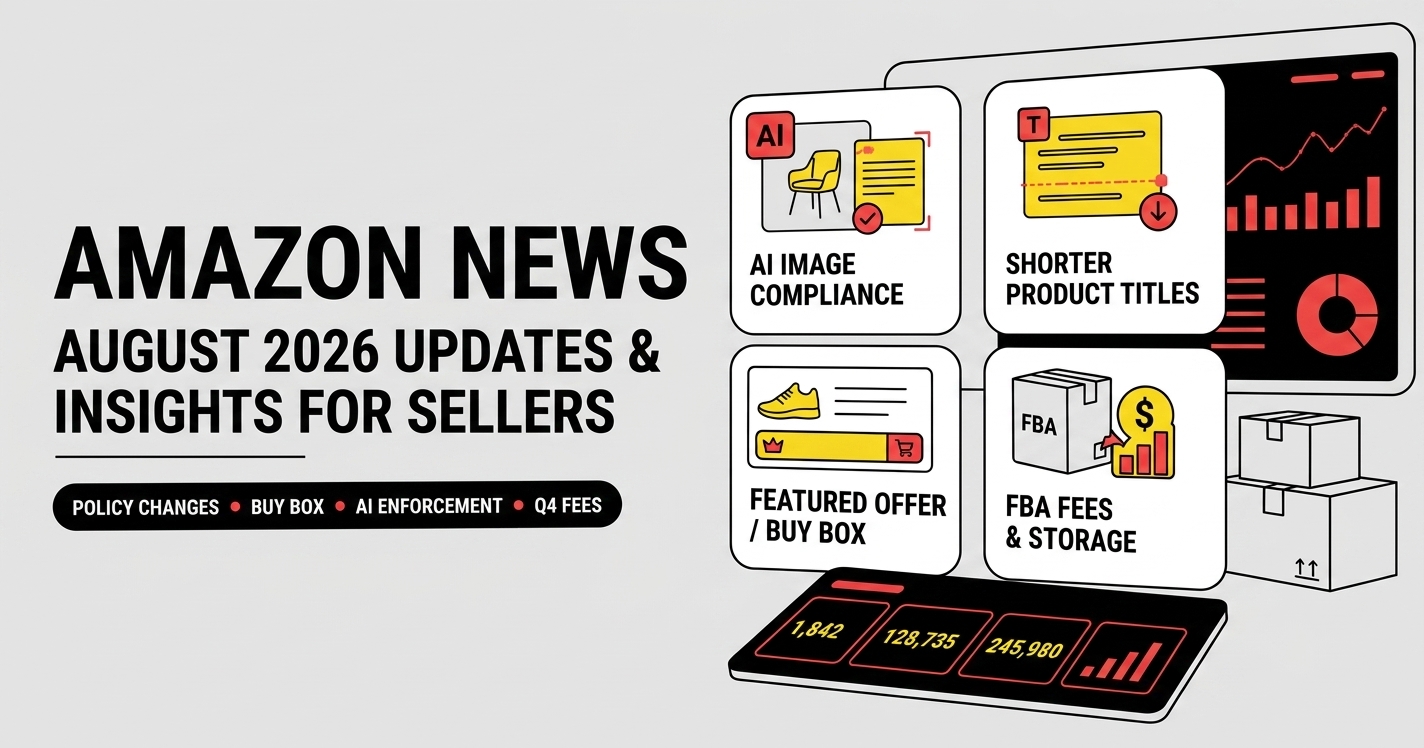
- Amazon now requires sellers to add contains-synthetic-performer metadata to AI-generated lifestyle images of people or face listing compliance violations starting July 27, 2026.
- Product titles on Amazon are capped at 75 characters as of July 27, 2026, and Amazon's AI will automatically rewrite longer titles without seller input unless Brand Registered.
- Section 3 account suspensions for related-account allegations are rising in 2026, triggered by shared IP addresses, devices, tax IDs, or even third-party service providers between accounts.
- Amazon removed the Featured Offer eligibility gate in July 2026, meaning all sellers now compete directly for the Buy Box based on ranking metrics instead of pass-fail performance thresholds.
- Peak fulfillment fees return October 15, 2026 through January 14, 2027 at $0.32 per unit, stacking on top of Amazon's 3.5% fuel surcharge introduced in April 2026.
If you sell on Amazon and blinked in July, you missed a lot.
The last six weeks have brought one of the heaviest waves of policy updates we've seen in years. A rewritten Business Solutions Agreement. A hard 75-character cap on product titles. The Buy Box eligibility gate quietly disappearing. Peak fulfillment fees returning for Q4. And behind all of it, the steady drumbeat of AI-driven enforcement that keeps pushing our suspension caseload up week over week.
This article walks through the six most important changes from July and August 2026, what they actually mean for your business, and where the real risk sits.
Amazon Policy and Compliance News
Amazon Requires Sellers to Label AI-Generated People in Listing Images
On July 27, 2026, Amazon updated its content compliance rules to require sellers to add specific metadata to product images and A+ Content that feature photorealistic AI-generated people. The official announcement was posted in Amazon's Seller News center and applies to sellers worldwide.
Here's how it works: sellers must use an IPTC-compatible metadata editor to add the keyword "contains-synthetic-performer" to the dc:subject (XMP) field before uploading eligible files. Amazon will then display a disclosure indicator to shoppers when applicable. The requirement does not apply to images containing only real people (even if edited with AI tools), non-photorealistic people, characters from movies or games, or images with no people at all.
Why this matters: AI-generated lifestyle imagery has become a standard cost-cutting move for sellers looking to avoid photo shoots. This policy adds an extra compliance layer, and getting the metadata wrong (or missing it entirely) puts your listing at risk. XMP metadata can also be stripped during file exports or asset management, meaning a compliant master file can become noncompliant by the time it reaches Seller Central.
Seller Tip: Audit your existing catalog for AI-generated lifestyle imagery, then build metadata verification into your content production workflow. Assign clear ownership across teams for who checks metadata before upload, and verify it is intact at the final publication step, every time.
Product Title Character Limit Cut to 75 Characters
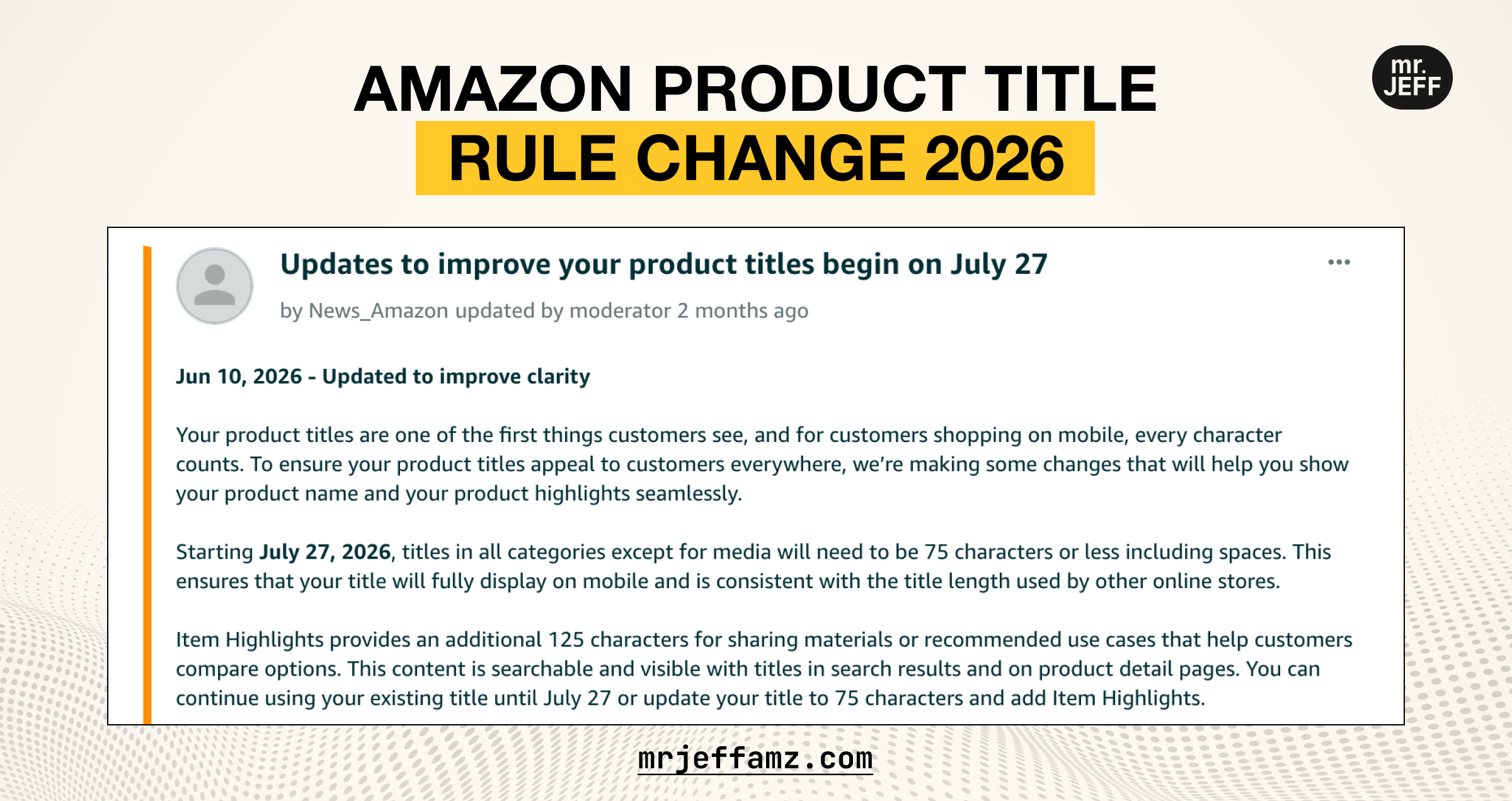
On June 10, 2026, Amazon posted a short announcement in Seller Central under a plain title: Updates to improve your product titles begin on July 27.
Starting July 27, 2026, product titles in every category except media (books, music, video) must be 75 characters or fewer, including spaces. The old working limit was around 200. Alongside the cap, Amazon introduced a new field called Item Highlights, a 125-character searchable container that sits below the title.
Amazon's stated reason is mobile display. Long titles get cut off on phone screens, and Amazon wants shopper-facing text that fits fully across devices.
The part most sellers missed
If you leave a title over 75 characters after July 27, Amazon's AI will rewrite it for you. Gradually, on Amazon's schedule, using Amazon's model rather than your keyword strategy. Only Brand Registered sellers get a 14-day review window on the AI suggestion.
That means the keyword you spent months getting to rank in position 3 of your title? Amazon's model can drop it without warning on your top-revenue ASINs.
Seller Tip: Audit your top-revenue ASINs first and rework titles to lead with brand, product type, and the strongest converting keyword. Move secondary details into Item Highlights before Amazon's AI decides what stays and what goes.
Account Health and Suspension Trends
AI-Driven Enforcement Reaches New Intensity in 2026
Amazon's monitoring systems have shifted decisively toward AI-driven enforcement, and the numbers back it up. Amazon's own 2024 Brand Protection Report confirms the company invested more than $1 billion in AI-powered detection systems, and its proactive controls now block over 99% of suspected infringing listings before brands report them. A separate SmartScout survey of 325 sellers found that 35% have experienced an account suspension, with mid-sized businesses in the $100K to $1M monthly sales range hit hardest.
What's different in 2026: violations that once took weeks to identify are now flagged within days. Machine learning models catch subtler pattern violations that a human reviewer would miss, and Amazon's automated systems act before a human ever looks at your case. Even honest sellers with clean intentions get caught in the sweep, because the algorithm doesn't distinguish between "gray area" and "grey area with a reasonable explanation."
Order Defect Rate above 1%, IP complaints, authenticity claims, and review manipulation flags are the most common triggers, but authenticity and sourcing complaints have become the single largest cause of full account deactivation this year.
Seller Tip: Treat account health as a monthly discipline, not a quarterly one. Log into your Account Health dashboard weekly, respond to every performance notification within 24 hours, and keep supplier invoices, tracking data, and compliance certificates organized so you can produce them without scrambling.
Section 3 Suspensions for "Related Accounts" Are on the Rise
Reinstatement experts handling Amazon suspensions are documenting a sharp rise in Section 3 cases in 2026, particularly involving related-account allegations. A common pattern: a seller gets suspended on Amazon UK for an unrelated issue, and Amazon's detection system flags a separate US account as linked. The US account, which had no direct violation, gets Section 3 suspended alongside it.
Amazon now scans for device fingerprint overlaps, IP address patterns, business address or tax ID matches, and even personnel overlaps like a VA who managed two accounts. Any of these can pull the trigger, even when the accounts belong to different legitimate businesses that share only a service provider.
Section 3 carries the lowest reinstatement rate on the platform. Generic Plans of Action get rejected faster than ever, and multi-account cases usually need to be resolved in a specific sequence to unlock either account.
Note: If your account has been deactivated, Mr. Jeff AMZ provides free case diagnosis within 24 hours. Since 2021, our team has reinstated 700+ Amazon seller accounts across US, Canadian, and UK marketplaces, using a proprietary 3-level escalation strategy and backed by a signed contract with a 50% refund guarantee. Learn more
Amazon Marketplace and Category Trends
Featured Offer (Buy Box) Eligibility Requirements Removed
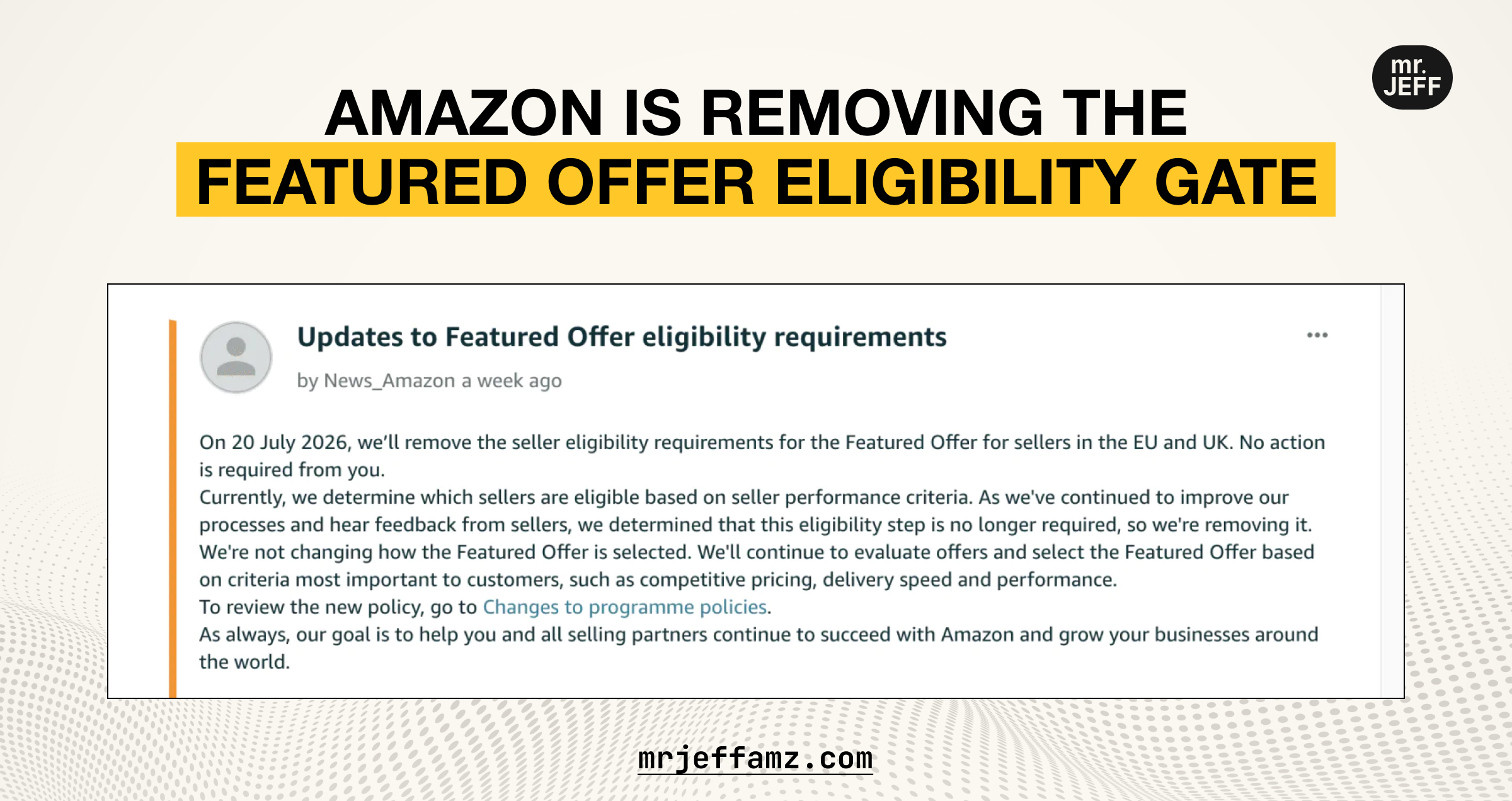
On July 8, 2026, Amazon confirmed a structural change to how the Featured Offer (Buy Box) works: seller performance is no longer a standalone eligibility requirement.
Before this change, Amazon ran a two-step process. First, a pass or fail check on your seller performance. If you failed, none of your offers competed for the Buy Box no matter how competitive your pricing was. Then, among eligible sellers, Amazon ranked the offers. That first gate is gone. Every offer now enters the ranking directly. The rollout started July 20 in the EU and UK and reaches the US and remaining stores through the end of 2026.
This is not "performance stopped mattering." Order Defect Rate, late shipment rate, valid tracking rate, and cancellation rate still weight the ranking. They just no longer gate the entrance. That means sellers who were locked out of the Buy Box for months due to a metric dip are re-entering the pool, and competition on shared listings is intensifying.
Seller Tip: Pull your 30-day Featured Offer share from Business Reports now and save it as a pre-change baseline. A drop without an obvious price or stock reason tells you the ranking pool around your ASIN just shifted.
FBA Fees and Storage Cost Updates
Holiday Peak Fulfillment Fees Confirmed for Q4 2026
Amazon has confirmed that Peak Fulfillment Fees return from October 15, 2026 through January 14, 2027, covering FBA, Remote Fulfillment with FBA, Multi-Channel Fulfillment, and Buy with Prime. The per-unit peak surcharge averages $0.32, matching last year, and Amazon's 3.5% fuel and logistics surcharge (introduced in April 2026) stacks on top.
The fee numbers themselves are not the headline. The stacking is. Sellers who planned Q4 deals on 2025 fee math without factoring in the fuel surcharge will find deals that looked profitable now run margin-negative once peak fees activate. Deal submission windows are open now: Prime Big Deal Days closes September 8, Black Friday Week and Cyber Monday closes October 20. Early submissions (by August 5 and September 5 respectively) save $50 per deal.
Seller Tip: Rerun every planned Q4 deal on 2026 fee math before you opt in. Ship inventory in earlier than usual — warehouse capacity gets tight in September and October, and late arrivals can miss peak shopping windows entirely.
Final Thoughts
August 2026 is a month of enforcement, not announcement. The Business Solutions Agreement update, the 75-character title cap, the Featured Offer eligibility change, and the peak fee schedule are all landing within weeks of each other, and each one requires action, not just awareness.
The bigger picture is that Amazon is building a marketplace where the entity on the contract is the entity operating the account, product content fits a stricter mobile-first format, and AI enforcement flags problems before humans review them. Stacked together, these changes reshape how the business runs day to day.
Sellers who audit their setup before August 24, front-load their Q4 planning, and treat listing and account health compliance as monthly disciplines will come out of 2026 stronger than they went in. Sellers who don't will find out the hard way in November, when peak inventory is in the warehouse and the account is not the one holding the cash.

Author
Helen
Head of Client Success at Mr. Jeff AMZ
Helen leads Sales & Client Success at Mr. Jeff AMZ, guiding Amazon sellers from their first suspension panic to a fully recovered account. With years of frontline experience managing reinstatement cases, she translates Amazon's dense policy language into clear, actionable next steps and keeps sellers informed at every stage of the appeal.
Connect on LinkedInFrequently Asked Questions
What is the new Amazon product title character limit and when did it take effect?
As of July 27, 2026, Amazon product titles must be 75 characters or fewer (including spaces) across all categories except media (books, music, video). The previous limit was around 200 characters. If you don't update your titles, Amazon's AI will automatically rewrite them for you.
How do I properly label AI-generated people in my Amazon listing images?
You must add the keyword "contains-synthetic-performer" to the dc:subject (XMP) field using an IPTC-compatible metadata editor before uploading images. This applies to photorealistic AI-generated people in product images and A+ Content. Be aware that metadata can be stripped during file exports, so verify it's intact at every step before final upload.
What is Amazon's new Item Highlights field and how should I use it?
Item Highlights is a new 125-character searchable field that appears below your product title. It was introduced alongside the 75-character title limit to give sellers additional space for important keywords and product details that no longer fit in shortened titles. Use this field strategically to maintain search visibility.
Do I need to label all AI-edited images on Amazon?
No, the labeling requirement only applies to photorealistic AI-generated people. You don't need to label images that contain only real people (even if AI-edited), non-photorealistic characters, characters from movies or games, or images with no people at all.
What happens if my product titles exceed 75 characters after the deadline?
If your titles remain over 75 characters, Amazon's AI will automatically rewrite them for you. This means you lose control over how your product is presented to shoppers. It's strongly recommended to proactively update your titles to maintain control over your branding and keyword strategy.
Are there Q4 fee changes Amazon sellers should prepare for in 2026?
Yes, peak fulfillment fees are returning for Q4 2026. While the article mentions this as one of the major updates, sellers should review their FBA cost projections and pricing strategies now to account for increased fulfillment costs during the holiday season.
How is AI enforcement affecting Amazon seller accounts in 2026?
Amazon's AI-driven enforcement is intensifying, leading to a steady increase in seller suspension cases. This automated enforcement is being applied across policy compliance areas, making it more important than ever to stay current with policy updates and ensure your listings, images, and account practices are fully compliant.