
News
Amazon Seller Updates: 7 Changes You May Have Missed in November 2026
November 4, 2026
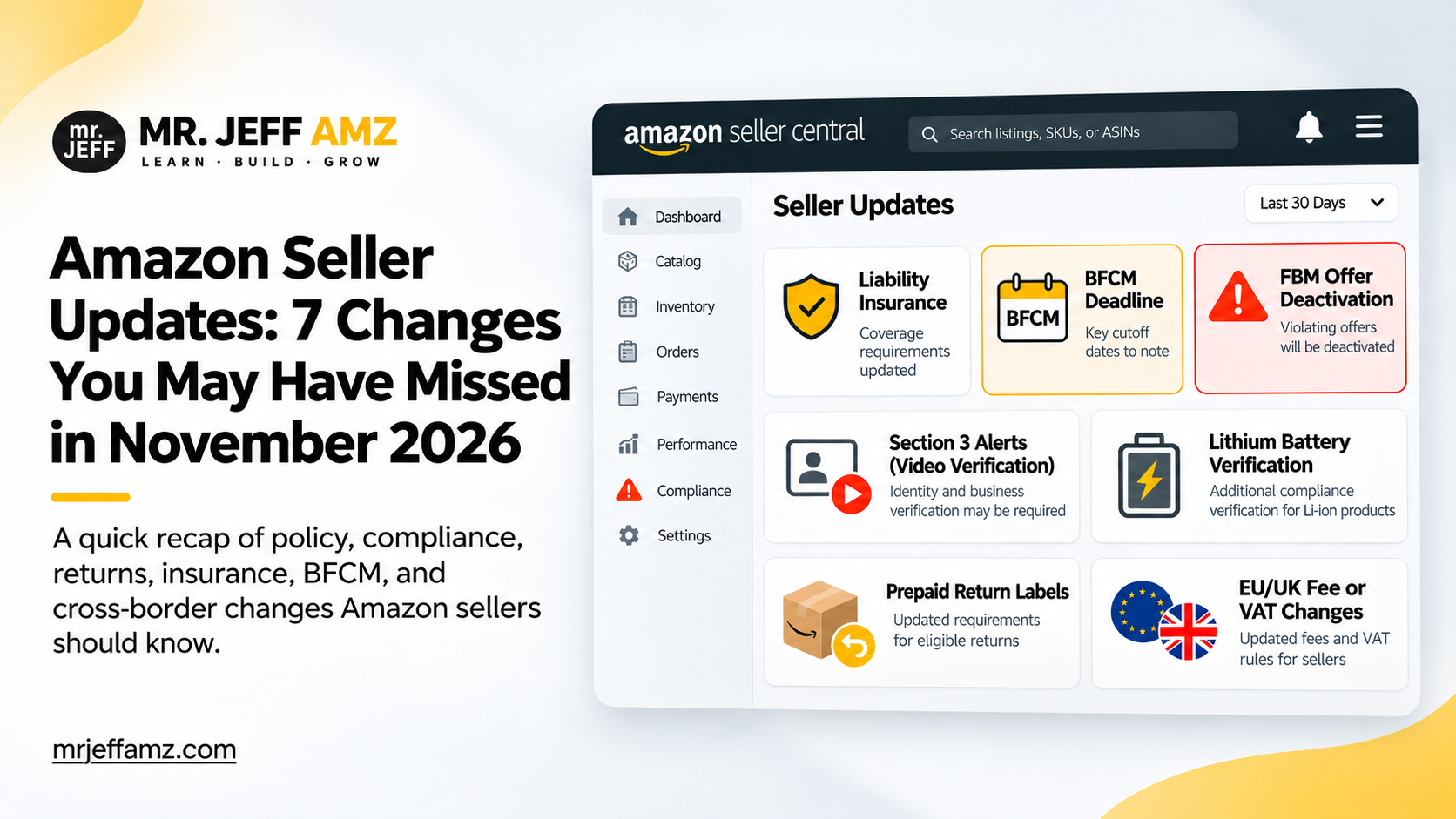
Key Takeaways
- Amazon now requires $1 million liability insurance from any seller in enhanced-safety categories, including children's products and lithium batteries, regardless of sales volume.
- Starting December 18, 2026, US seller-fulfilled returns require prepaid shipping labels within seven days of request, ending the address-only return option.
- Amazon deactivates individual underperforming FBM offers since August 31, 2026, based on cancellation rate, late shipment rate, and on-time delivery metrics.
- Section 3 account deactivations are spiking before peak season 2026, with video verification interviews becoming standard in the reinstatement process.
- Rechargeable lithium battery electronics on Amazon require third-party lab verification starting September 30, 2026, with notifications sent through November 16.
Amazon doesn't announce rule changes in one clear place, and this month shows why that matters. A rarely sold toy can now require $1M in liability insurance. A single failing FBM offer can be switched off on its own. And a fresh wave of Section 3 deactivations is hitting accounts right before peak season. Most of it first appears in Seller Forums posts, seller emails, and help-page edits that are easy to miss in a busy Q4.
Below are 7 changes that affect compliance, account health, and peak-season readiness, plus one hot Seller Forums discussion about AI-generated images.
Read on to catch up on the latest Amazon trends, so you know how to protect your account and stay compliant with Amazon's policies.
.png "Amazon seller calendar November 2026 key dates and sales events for FBA sellers and e-commerce businesses")
Amazon Moved the BFCM Deal Deadline to November 13: What Sellers Should Check Now
Amazon extended the deadline for Black Friday and Cyber Monday deals, so sellers have extra time to get promotions in before Black Friday on November 27. Cyber Monday follows on November 30.
What Happened: Amazon announced on the Seller Forums that the deal sourcing window for both events now closes on November 13. The post reminds sellers of three things. FBA inventory has to reach fulfillment centers before each event's inventory cutoff. Prime Exclusive Discounts are created in Seller Central under Advertising, then Price Discounts, then Create a price discount, then Events. And advertising should start early so deal ASINs are indexed and gaining traction before the events.
The post does not describe penalties for missing the deadline or the cutoffs.
What This Means for Sellers: The extension gives you room to fix what would have blocked a deal, but it doesn't change the logic of the event. A deal only works if the offer is live and the inventory is in the building on time.
This is also the moment to look at Account Health. An open policy issue or a deactivated listing on a deal ASIN costs you more during BFCM than at any other time of the year.
What To Do Now:
Check the inventory cutoff for each event and confirm your FBA units will arrive before it.
Create your Prime Exclusive Discounts before November 13 rather than on the last day.
Review Account Health and Performance Notifications for every ASIN you plan to put on deal, and resolve open issues first.
Start ads on deal ASINs early.
Amazon Now Requires $1M Liability Insurance From Small Sellers in Safety Categories
Starting November 2, 2026, Amazon requires $1M in commercial liability insurance from any seller with a product in an enhanced-safety category, no matter how little that product sells. Even a rarely sold ASIN now counts.
What Happened: In a Seller Forums notice, Amazon said sellers with products in categories that have enhanced safety listing requirements must carry a policy covering those products. Coverage must be at least $1M per occurrence and in aggregate. The usual $10,000 monthly-sales trigger no longer applies to these categories, and the rule covers new and existing listings. Amazon's examples include children's products, cosmetic and ingestible products, and lithium battery products, and it says the list is not exhaustive.
A second change hits sellers based in Mainland China. From November 2, Amazon rejects newly submitted policies that were not bought through the Amazon Insurance Accelerator (AIA). A valid third-party policy submitted before that date can be used until it expires.
What This Means for Sellers: Until now, insurance became a requirement only after a month above $10,000 in sales. Now the trigger is the category, not your revenue. A seller moving a few units a month of a toy, a supplement, or a rechargeable gadget is in scope.
Amazon's notice does not describe penalties for missing coverage, so we can't say how it will enforce the rule. Our advice is to treat any uncovered listing in these categories as at risk.
What To Do Now:
Check your catalog against Amazon's list of enhanced-safety categories, including low-volume and older ASINs.
If you have products in scope, confirm your policy covers them at $1M per occurrence and in aggregate.
If your business is based in Mainland China, plan to buy your next policy through AIA, and note when your current third-party policy expires.
Amazon Now Deactivates Failing FBM Offers Instead of Whole Accounts
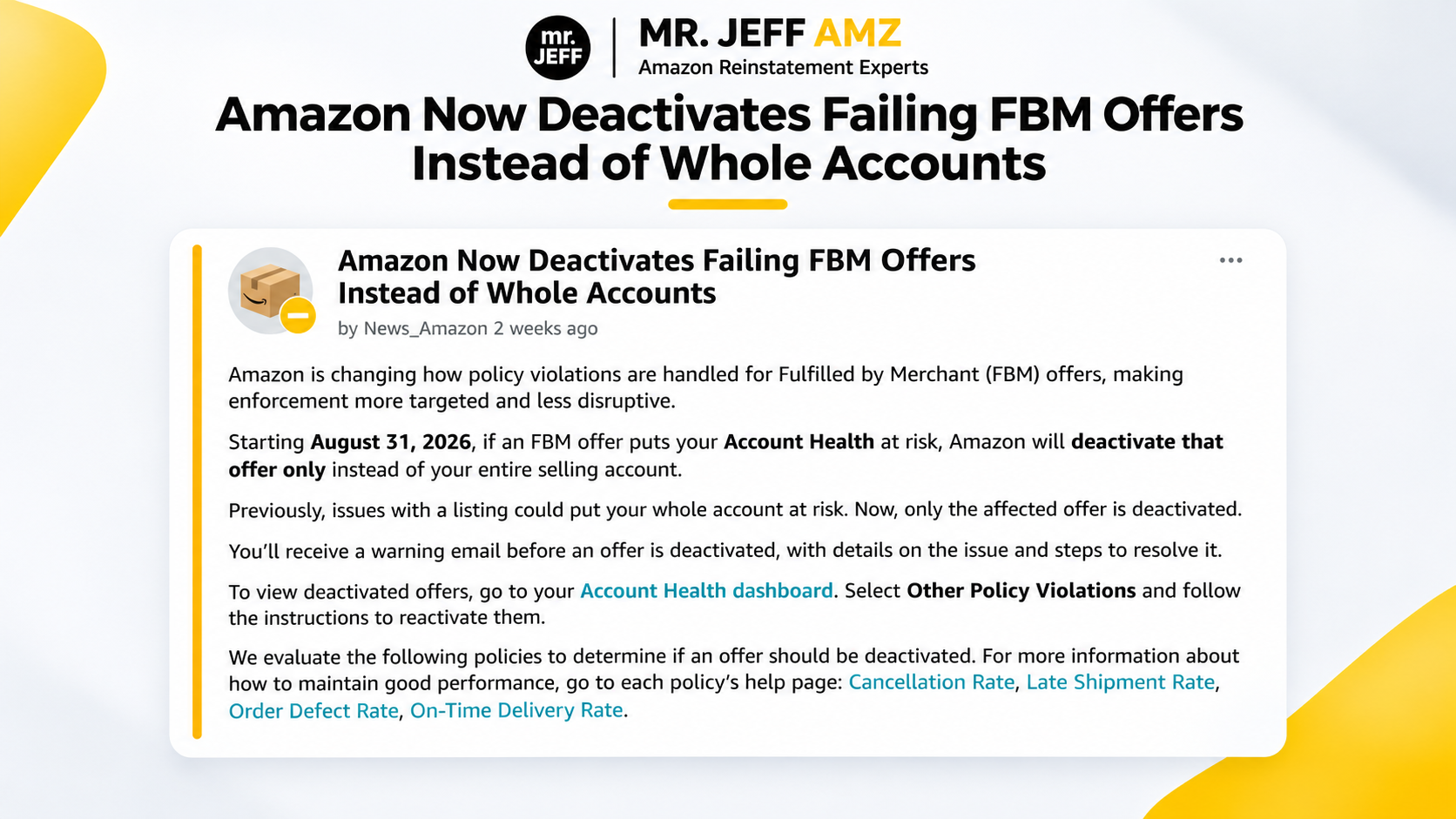
Since August 31, a single failing FBM offer can be switched off on its own, without putting the whole account at risk.
What Happened: In an Account Health announcement, Amazon said that from August 31, 2026, an FBM offer that puts Account Health at risk is temporarily deactivated, while your other listings and overall Account Health are not affected. Amazon sends a warning email first, and the offer appears in Account Health under Other Policy Violations. It evaluates four metrics: Cancellation Rate, Late Shipment Rate, Order Defect Rate, and On-Time Delivery Rate.
What This Means for Sellers: Offer-level enforcement is good news for catalogs with a few weak SKUs, because one late-shipping product no longer drags everything down. But the offer stays offline until you fix the problem.
What To Do Now:
Check Account Health for deactivated offers under Other Policy Violations, and look for warning emails.
Find the offers pulling your four metrics down.
If an offer is already deactivated, fix the cause before you follow the reactivation steps.
Amazon Section 3 Deactivations Are Spiking Before Peak Season, and Video Verification Is Getting More Common
Ahead of peak sales season, Amazon has stepped up its Section 3 checks, and many sellers have already received deactivation letters. Video verification interviews are showing up more often along the way.
What Happened: Before the peak season, Amazon tightened enforcement of Section 3 of the Business Solutions Agreement. Many sellers have already received a letter saying their account is deactivated. More of these cases now include a video verification interview, so sellers need to be ready for that check.
What This Means for Sellers: In our experience, a wave of Section 3 deactivations hits Amazon sellers every year before Q4 and peak sales, so this is not a surprise. What matters is how you react. Don't rush. Starting with the right appeal increases your chances of a quick reinstatement.
What To Do Now:
Prepare for a video verification. Have your identity documents and business details at hand, and make sure they match what is in your account.
Take the time to understand what Amazon is asking for before you respond.
If your account is already deactivated, talk to specialists before you send the first appeal.
Recently, the Mr. Jeff AMZ team reinstated a client's account after a Section 3 deactivation over a genuine product bought straight from the rights owner. A video verification interview was part of the process.
Find out how we reinstated this seller account.
At Mr. Jeff AMZ, we help Amazon sellers appeal Amazon's decisions and get their accounts reinstated after deactivation. We analyze your case, build a tailored reinstatement strategy, and can take over the entire appeal process. Start with a free consultation:fill out the contact form.
4,000 Amazon Sellers Have Already Used the Suspension Analyzer by Mr. Jeff AMZ and Got an Account Reinstatement Plan
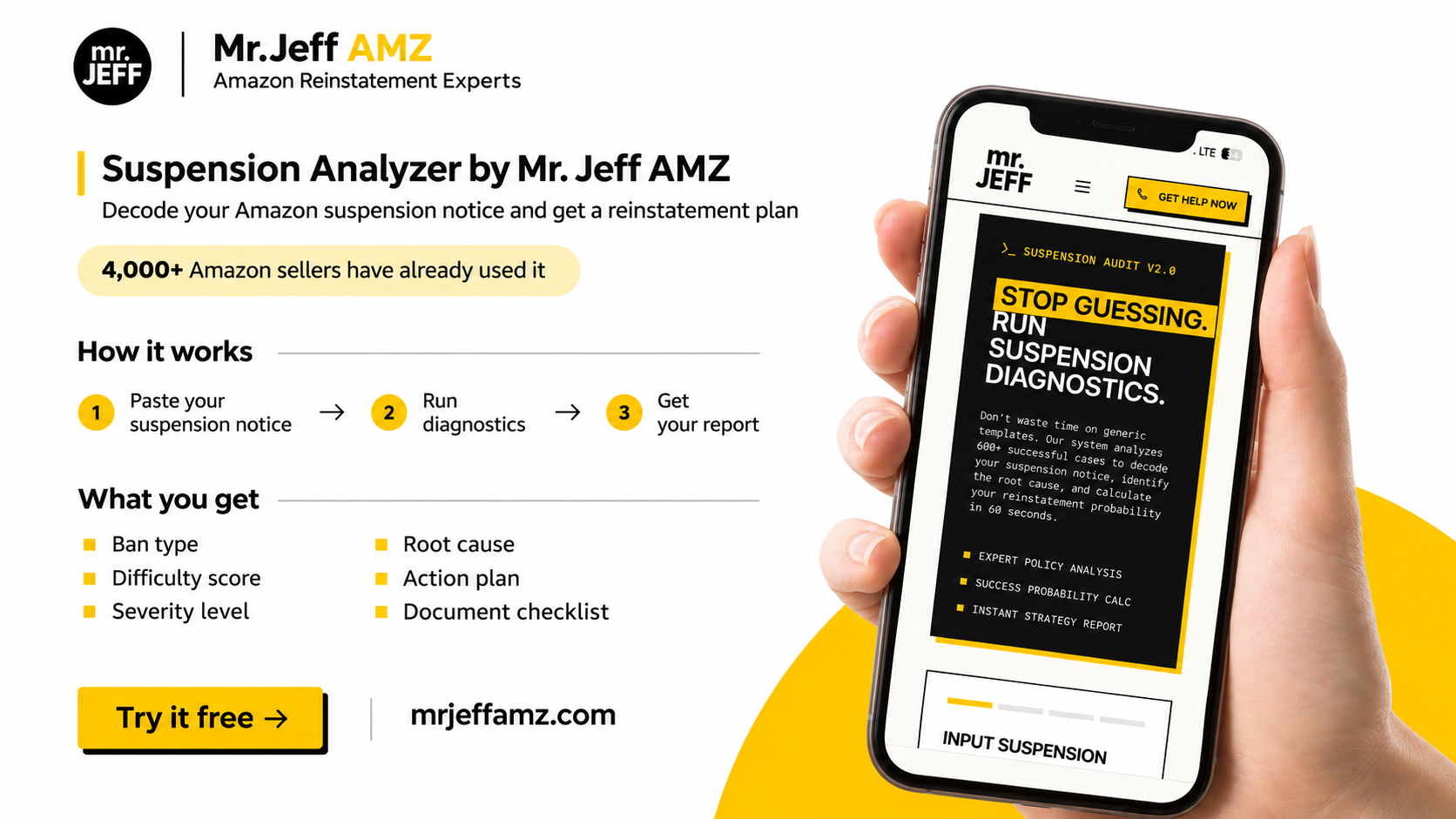
The Suspension Analyzer by Mr. Jeff AMZ is a free online diagnostic that reads an Amazon seller account suspension notice and returns the ban type, the root cause, and a recommended action plan. More than 4,000 Amazon sellers have already used it.
How does the Suspension Analyzer work?
Paste your Amazon suspension notice, or describe your situation if you don't have the notice.
Run the diagnostics.
Get your report.
What does the report include?
Ban type
Difficulty score and severity level
Root cause of the suspension
Action plan for your appeal
Document checklist
Who is it for? Amazon sellers with a suspended or deactivated account who want to understand the notice before they send an appeal.
Try the Suspension Analyzer by Mr. Jeff AMZ
Amazon Moves Lithium Battery Verification to Third-Party Labs, and Non-Compliant Listings May Be Deactivated
Starting September 30, 2026, sellers of rechargeable lithium battery electronics, from security cameras to earbuds, no longer send compliance documents to Amazon. An authorized third-party testing provider has to verify them, with notifications reaching sellers in phases through November 16.
What Happened: In a Seller Forums post, Amazon said smart home devices and consumer electronics on Amazon.com powered by rechargeable lithium batteries (Li-Ion, LiPo, or LiFePO4), such as security cameras, smart locks, tablets, and earbuds, must be verified through an Amazon-authorized testing, inspection, and certification (TIC) provider. You can send existing test documents for review or have the provider run the tests. Notifications arrive in Account Health through November 16, and non-compliant listings may be deactivated until they pass the TIC process.
Separately, since October 26, Amazon asks required dangerous-goods questions when you create or edit listings for refrigerators, freezers, and air conditioners; shock absorbers and suspension lift supports; markers and writing instruments; and pool and spa chemicals.
What This Means for Sellers: If you sell rechargeable lithium electronics, expect a notification by November 16. A deactivated listing stays offline until TIC is complete, which is a bad place to be right before peak season. These products also fall under the $1M insurance rule from the first change.
What To Do Now:
Check Account Health for lithium battery notifications.
List your affected ASINs and find a provider through Amazon's TIC page.
Send your existing test reports to the provider, add a model number and brand name to the detail pages, and keep your Certificate of Insurance current.
Before editing listings in the four dangerous-goods groups, collect the technical details Amazon asks about.
Address-Only Return Labels Are Ending: Amazon Requires Prepaid Labels on FBM Returns From December 18
Starting December 18, 2026, giving a buyer a return address and letting them pay the postage no longer meets Amazon's requirement on most US seller-fulfilled orders. You'll have seven calendar days from the return request to upload a prepaid label or refund in full.
What Happened:PPC Land reported on an email from the Amazon Services team saying that from December 18, 2026, all US returns for seller-fulfilled orders require a prepaid return shipping label. Heavy and bulky items are excluded. Address-only labels no longer count. Within seven calendar days of a return request, you must either upload a prepaid label in the Manage seller-fulfilled returns workflow or issue a full refund without requiring the item back.
What This Means for Sellers: Amazon already enrolls US sellers in prepaid returns by default and provides labels through Buy Shipping, according to its Manage seller-fulfilled returns page. If Amazon already generates your labels, the new rule may not change much for those returns. The exposure is for sellers who handle returns with their own address or instructions.
When the email first circulated, Amazon's public help pages did not mention December 18 or the seven-day window, so treat the email as the rule until the pages catch up.
Timing matters too. Holiday orders can be returned through January 31, so a large share of peak-season returns will land under the new rule.
What To Do Now:
Open Manage seller-fulfilled returns and check how returns are handled for each SKU today.
Find SKUs where you rely on a return address or your own instructions, and move them to prepaid labels.
Upload labels in the Manage seller-fulfilled returns workflow, not by message.
Assign someone to check the queue every day. Seven calendar days include weekends and holidays.
Add label costs to your peak-season return budget.
Hot on Seller Forums: Amazon Warns That Misleading AI-Generated Images Can Get Your Listing Removed
A post from an Amazon account on the Seller Forums has sellers arguing about who carries the risk of AI product images. Its message is blunt: you are responsible for everything on your listing, including content AI generated.
What Happened: The thread, titled "Your Product Was Removed After a Customer Complaint — But the Image Was AI-Generated," lays out a typical scenario. A customer says the product they received does not match the listing, and an AI-generated image set the wrong expectations. The product is removed and Account Health suffers.
The post points to Amazon's misleading detail page policies. Listings can be hidden until a compliant image is submitted, and appeals may need invoices and a plan of action. It repeats the main image standards: white background, no text, product filling 85% of the frame. It also says photorealistic AI-generated people need metadata tags, and it advises sellers to compare AI output with the real product, keep AI for secondary images, keep original photos, and audit listings quarterly.
The replies are heated. Sellers say Amazon pushed AI tools and now penalizes people for using them. Others want AI disclosure on all product images and say suppressions feel arbitrary. When we read the thread, no Amazon reply addressed those points.
What This Means for Sellers: Amazon is not banning AI images. It is making clear that a mismatch between the image and the product is your problem, and that a customer complaint can be enough to take a listing down and hit Account Health. The risk is highest for images that show setups, sizes, or features the product cannot deliver.
What To Do Now:
Audit listings that use AI images and compare each one with the real product.
Keep AI to secondary images, and keep your main image on a pure white background.
Save original product photos and supplier invoices. You may need them for an appeal.
If a listing was removed after a complaint, fix the image first, then appeal with a clear plan of action.
Final Thoughts
Most of these changes arrive quietly, and most reach Account Health before they reach a headline. A few minutes spent checking categories, offers, and return settings now is far cheaper than fixing a deactivation in the middle of Q4.
If you are dealing with an account health issue or a suspension, Mr. Jeff AMZ can help. Our team has extensive experience reinstating Amazon seller accounts and listings of any complexity. We build a tailored reinstatement strategy for each case and manage the appeal process until your account is reinstated.
Fill out the contact form to get a consultation with our expert.

Author
Helen
Head of Client Success at Mr. Jeff AMZ
Helen leads Sales & Client Success at Mr. Jeff AMZ, guiding Amazon sellers from their first suspension panic to a fully recovered account. With years of frontline experience managing reinstatement cases, she translates Amazon's dense policy language into clear, actionable next steps and keeps sellers informed at every stage of the appeal.
Connect on LinkedInFrequently Asked Questions
What is the new $1M liability insurance requirement for Amazon sellers?
Starting November 2, 2026, Amazon requires $1M in commercial liability insurance from any seller with products in enhanced-safety categories, regardless of sales volume. This means even rarely sold items now require coverage of at least $1M per occurrence and in aggregate. The previous $10,000 monthly-sales threshold no longer applies to these categories.
What is the deadline for submitting Black Friday and Cyber Monday deals on Amazon?
Amazon extended the BFCM deal sourcing deadline to November 13, 2026. However, sellers must also ensure their FBA inventory reaches fulfillment centers before each event's inventory cutoff. Black Friday falls on November 27 and Cyber Monday on November 30.
What does it mean when Amazon switches off individual FBM offers?
Amazon is now deactivating individual Fulfilled by Merchant (FBM) offers that fail to meet performance standards, rather than taking broader account-level action. This means a single underperforming listing can be switched off on its own, requiring sellers to monitor each offer's health more closely.
What is the Section 3 deactivation wave affecting Amazon sellers?
A fresh wave of Section 3 deactivations is hitting seller accounts right before peak season. Section 3 of Amazon's Business Solutions Agreement covers account violations. Sellers should immediately review their Account Health dashboard and Performance Notifications to address any open policy issues before the holidays.
When do prepaid return labels take effect for Amazon sellers?
Amazon is implementing prepaid return labels starting December 18, 2026. Sellers should prepare for this change by reviewing their return policies and understanding how this may impact their operations and costs during the post-holiday return season.
How can I prepare my Amazon account for BFCM and avoid deal disruptions?
To protect your BFCM deals, take these steps:
- Confirm FBA inventory will arrive before each event's cutoff date
- Create Prime Exclusive Discounts before November 13 (not on the last day)
- Review Account Health for every deal ASIN and resolve open issues first
- Start advertising on deal ASINs early so they're indexed and gaining traction
Where does Amazon announce seller policy changes?
Amazon does not announce rule changes in one clear place. Updates typically appear across multiple channels including Seller Forums posts, direct seller emails, and help-page edits. This makes it easy to miss important changes, especially during busy periods like Q4. Regularly checking these sources is essential for staying compliant.