Case Studies
Amazon Unsuitable Inventory Suspension: Reinstated in 3 Weeks
July 22, 2026
Key Takeaways
- Amazon Unsuitable Inventory suspensions freeze disbursements, block removal orders, and allow Amazon to dispose of inventory after 90 days if provenance is not proven.
- Genuine invoices are often rejected when the business entity name on the invoice does not match the entity registered on the Amazon seller account.
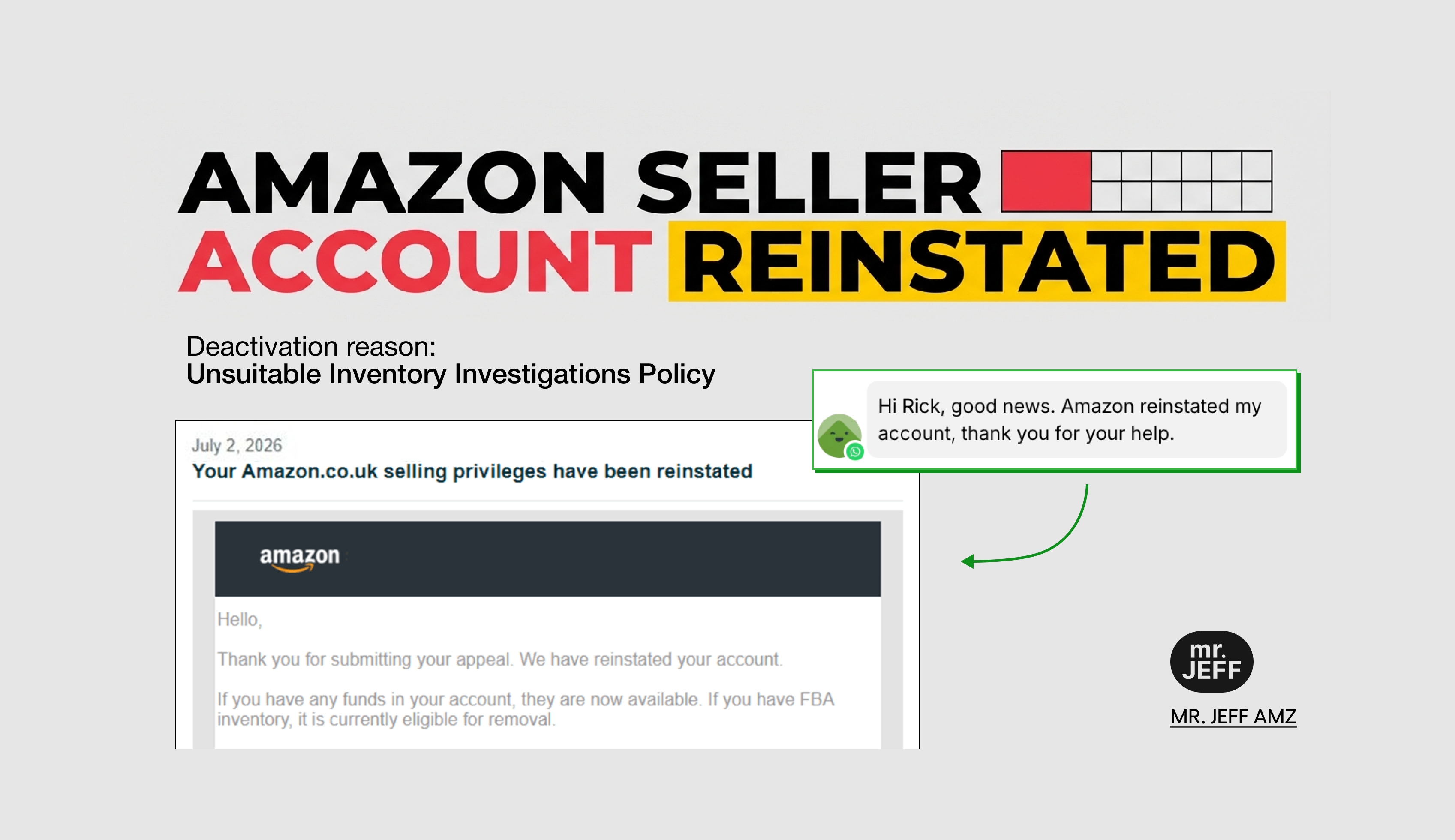
- A seller suspended for unsuitable inventory was reinstated in 3 weeks after documenting a business transfer that connected old invoices to the current account entity.
- Half of rejected Amazon appeals fail because sellers misidentify the root cause, as rejection notices cite broad policy violations rather than specific account triggers.
- During Unsuitable Inventory investigations, storage fees continue accruing on inventory that sellers cannot access, sell, or remove from Amazon fulfillment centers.
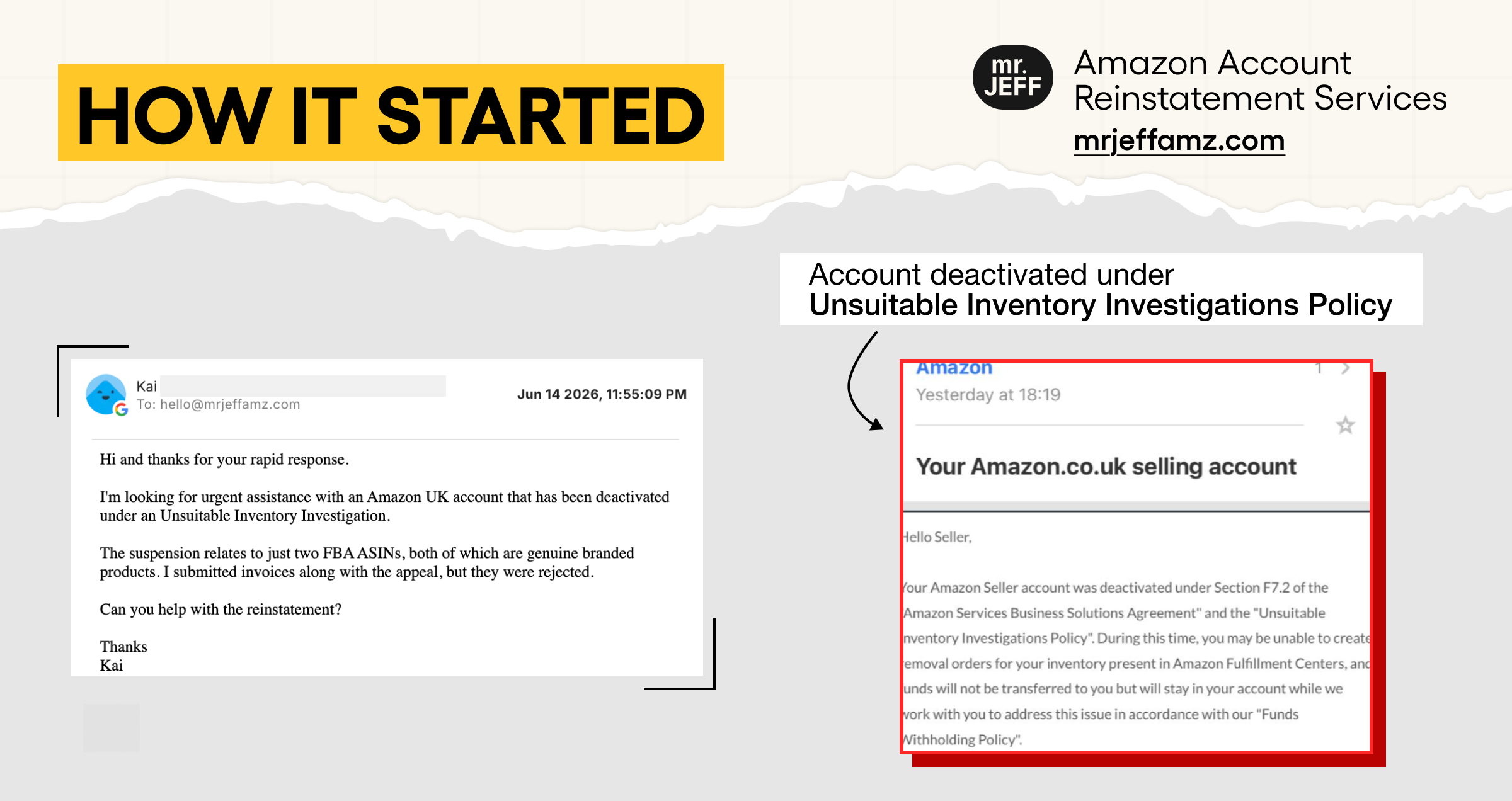
Imagine you've been selling on Amazon for over two years. Genuine products, authorized distributors, invoices for all of it. Then one morning you open Seller Central and find this:
"Hello,
Your Amazon Seller account was deactivated under Section F7.2 of the Amazon Services Business Solutions Agreement and the Unsuitable Inventory Investigations Policy. During this time, you may be unable to create removal orders for your inventory present in Amazon Fulfillment Centers, and funds will not be transferred to you but will stay in your account while we work with you to address this issue in accordance with our Funds Withholding Policy."
That was exactly the situation our client Kai woke up to. In this case study we break down his case and show all our cards: what triggered the suspension, why Amazon kept rejecting his appeals, and how we got his account reinstated in just 3 weeks.
The Challenge
Kai had been selling on Amazon for two years when his account was deactivated under an Unsuitable Inventory Investigation covering two ASINs.
The goods were genuine. He had invoices from his suppliers. From his point of view the case should have been straightforward, so he submitted his invoices through Seller Central. Amazon rejected them.
He submitted them a second time and got back the same decision:
"Hello Seller,
We have received your submission, but we cannot accept these documents. Therefore, your account will remain deactivated.
We have reached this decision because we have identified risks associated with the supplier identified in the invoices you submitted, and we will not accept invoices from this supplier.
We previously requested these documents from you to verify your supply chain. As a result, your account will not be reactivated, and we will not release the associated FBA inventory under investigation.
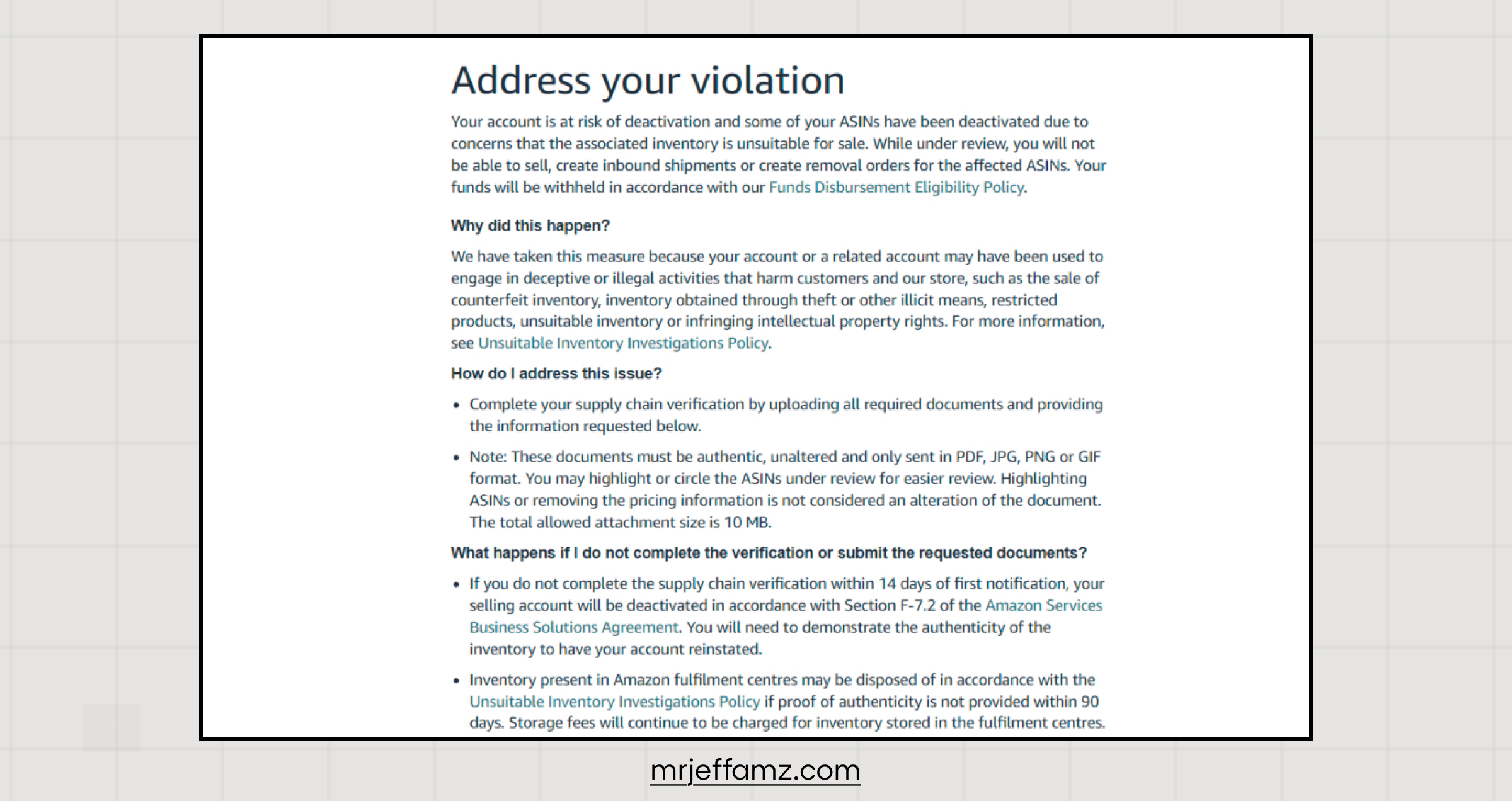
What happens now? Your Amazon selling account will remain deactivated. During this time, you'll be unable to create removal orders for your entire inventory present in Amazon fulfillment centers. Storage fees will be charged for inventory stored in the fulfillment centers. Funds won't be transferred to you but will stay in your account while we work with you to address this violation. Additionally, if within 90 days of this notification we do not receive the requested information or if you are unable to demonstrate the provenance or authenticity of your entire inventory, the inventory in the fulfillment centers may be disposed of under section F-7.2 of the Amazon Services Business Solutions Agreement and the Unsuitable Inventory Investigations Policy."
Read that carefully and you'll see how much pressure Kai was under. His disbursements were frozen. He couldn't create removal orders for any of his stock. Storage fees kept accruing on inventory he had no access to and couldn't sell. And he now had ninety days to demonstrate provenance for his entire inventory, not just the two flagged ASINs, or Amazon could dispose of all of it under section F-7.2.
Three weeks after the deactivation, Kai reached out to Mr. Jeff AMZ for help with his Amazon account reinstatement.
What Is an Amazon Unsuitable Inventory Investigation
An Unsuitable Inventory Investigation is Amazon's review of whether the products in your account are authentic and properly sourced. The wording in these notices is deliberately severe: Amazon states it believes the account is offering unsuitable items that may have been used for deceptive or illegal activity. It's usually triggered by one or two ASINs, but the consequences hit the whole account.
While the investigation runs, your listings can be restricted and you can't initiate removal requests for the affected inventory. Disbursements are held and storage fees keep accruing on stock you can neither sell nor retrieve. That's what makes these cases so expensive: every week the investigation stays open costs you money.
To close it, Amazon asks for supply chain documentation, and it's specific about what counts. Invoices must show item descriptions, quantities, and the supplier's name, phone number, address, and website. Prices can be redacted, but nothing else, and documents must be authentic and unaltered.
The trouble is that genuine invoices aren't automatically acceptable invoices. Suppliers need a verifiable online presence, and invoiced quantities have to match or exceed what you've sold. What Amazon is really testing is traceability, meaning whether your paperwork forms an unbroken chain from supplier to the exact ASINs under review. A strong submission explains any naming differences so an investigator can connect the documents to the ASINs without guessing.
By the numbers: In the reinstatement cases we handle, a significant share of rejected invoice submissions involve documents that are entirely genuine. The goods are real and the paperwork is real. What fails is some detail in how the documentation connects to the seller account, and Amazon's rejection wording almost never points to it.
Our Investigation
We started with a deep review of the case, with one goal: identifying the real trigger behind the deactivation and behind the rejections. Everything in the reinstatement strategy would be built on that answer.
We investigated every supplier Kai worked with. Each one was a reliable authorized distributor. There was nothing questionable in his sourcing.
We investigated the rights owner's resell policy. No issues there either. Nothing in the brand's policy prohibited what he was doing.
We reviewed the invoices in detail, checking them against Amazon's documentation criteria and looking for anything that might read as a red flag to a reviewer. The invoices themselves were fine.
So everything Kai believed about his case turned out to be correct. The goods were authentic, the suppliers were authorized, the brand's policy was satisfied, and the paperwork met Amazon's standards. And that is exactly where we found the problem.
The Mismatch
The seller information on the invoices didn't match the information on his Amazon seller account.
Earlier that year Kai had transferred his business from Company A to Company B, and his Amazon account reflected the change. Most of his invoices, though, had been issued to Company A, because that was the business at the time he bought the stock.
To a reviewer, that gap matters. The invoices show goods purchased by one entity while the account claiming them belongs to another, and with nothing connecting the two, the documents don't prove this seller owns this inventory. That is almost certainly why both submissions were rejected.
Kai had no way of spotting it. Nothing in either rejection notice mentioned company names, business entities, or ownership. Amazon pointed at his supplier instead, which sent him looking in precisely the wrong direction.
Mr. Jeff Expert Insight: In our experience, half of all rejected appeals fail because the seller identified the wrong root cause. Amazon's deactivation notices are written in broad policy language, so sellers read them literally and start fixing whatever the notice names. But the notice tells you which policy you tripped, not which detail in your account triggered it, and those are rarely the same thing.
Reinstatement Strategy
Once we knew what Amazon was actually seeing, the objective changed. Our main focus was to provide Amazon with all the details about the rights owner’s resell policy, the authorization of the suppliers we had gathered, and to show that the invoices belonged to the seller and that the inventory was fully authentic and not the problem.
Step 1: Documenting the Rights Owner's Resell Policy
We compiled full details of the rights owner's resell policy and presented it as part of the case, establishing that Kai was permitted to resell the products in question.
Step 2: Proving Supplier Authorization
We gathered authorization evidence for every supplier in the chain, showing that each was a legitimate authorized distributor rather than a grey market source. This also answered Amazon's stated reason for the rejections directly, since the supplier it had flagged as a risk was verifiably authorized.
Step 3: Connecting the Invoices to the Seller
This was the part that decided the case. We documented the business transfer from Company A to Company B and demonstrated that the invoices issued under the former entity belonged to the same seller now operating the account. The chain of ownership was spelled out rather than left for a reviewer to work out.
Step 4: Appeal Submission
We assembled everything into a single, coherent account of the supply chain: where the goods came from, who was authorized to sell them, who bought them, and how that buyer became the entity running the Amazon account. Every point connected to the next, with nothing left for Amazon to assume. Then we submitted the appeal through Seller Central.
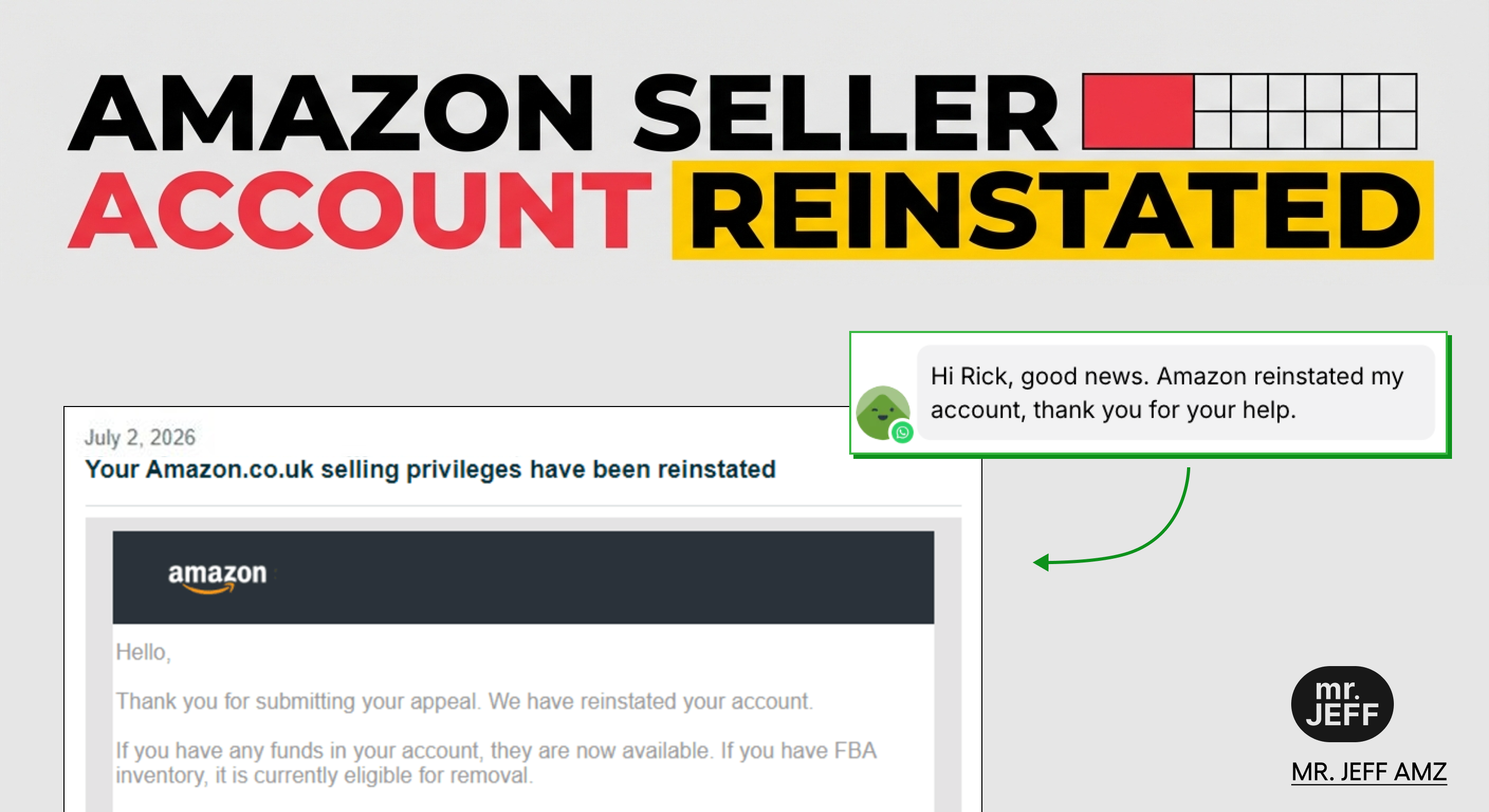
The Result
Account successfully reinstated after the third submission.
The seller's disbursements were released, his inventory was accessible again, and he was back to selling.
Resolution time: 3 weeks.
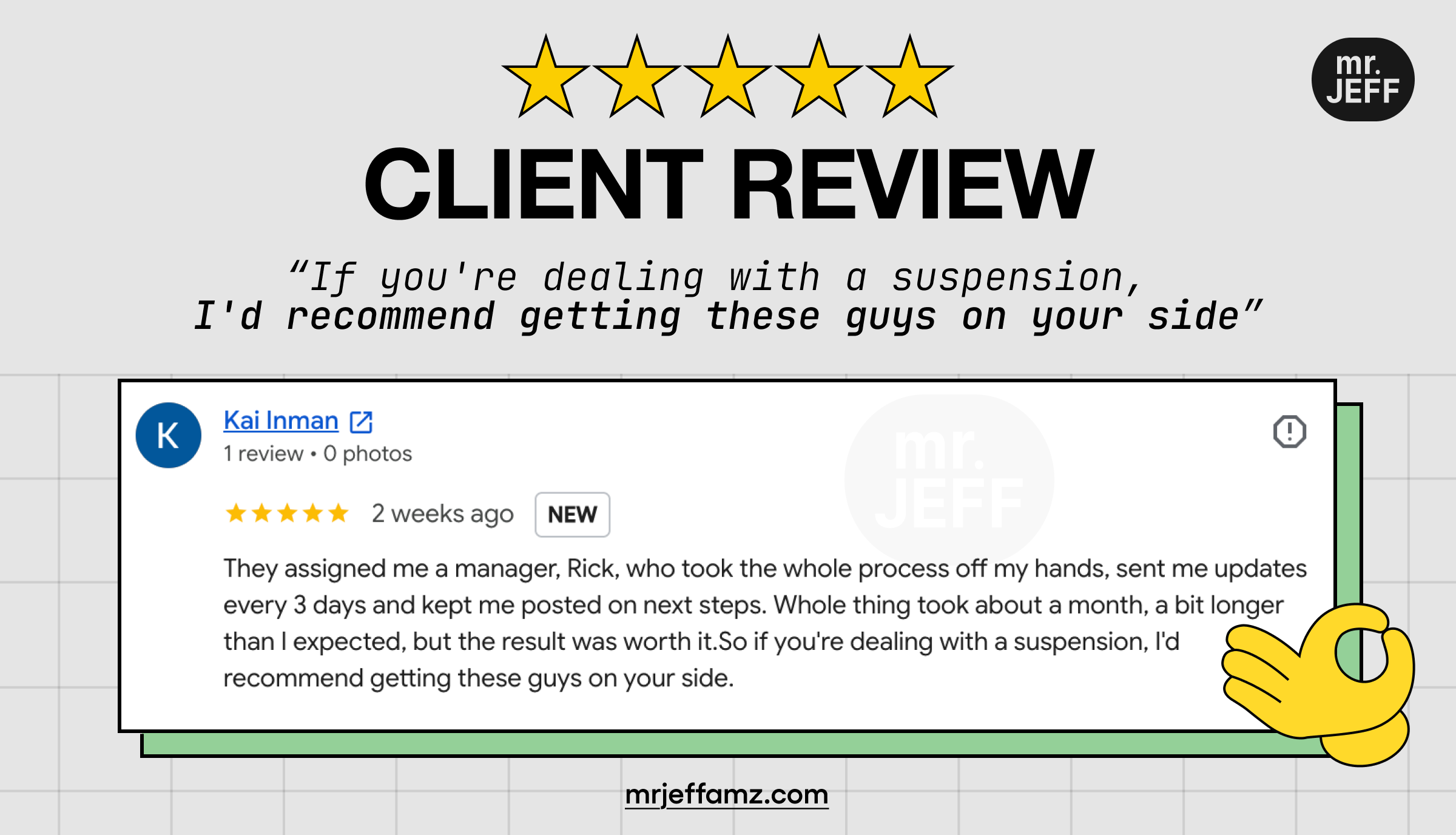
Kai got his business back, and he left us a great review afterwards.
Key Lessons for Amazon Sellers
Genuine invoices are not automatically sufficient invoices.
Amazon isn't only verifying that your documents are real. It's verifying that they belong to you. If the entity named on the invoice doesn't match the entity on the account, the paperwork can be rejected no matter how legitimate the purchase was.
Business restructuring creates an invisible risk.
Changing your legal entity, rebranding, or transferring the business leaves you with historical invoices under the old name. Those invoices remain valid, but they'll need an explanation the next time Amazon asks for supply chain documentation. Prepare that explanation before you need it.
An identical second rejection means the same issue is still there.
Word for word repetition tells you the second submission hit the same obstacle as the first. Sending the documents a third time without finding that obstacle produces a third identical rejection.
The rejection notice rarely names the real problem.
Nothing in Amazon's messages to this seller mentioned company names or entity mismatches. Sellers are left to work out the cause themselves, which is why so many appeal repeatedly without ever addressing what's actually blocking the case.
Frozen funds and blocked removals make speed matter.
With disbursements held and removal orders unavailable, every week of a stalled investigation has a direct cost. Diagnosing the case correctly the first time is worth considerably more than getting another submission in quickly.
Need Help With Amazon Account Reinstatement?
If your account has been deactivated under an Unsuitable Inventory Investigation and your invoices keep getting rejected, submitting them again is unlikely to change the outcome. Something in your documentation isn't satisfying Amazon, and the rejection notice probably won't tell you what it is.
At Mr. Jeff AMZ, we specialize in reinstating suspended Amazon seller accounts, even in the most complex cases. Our team has successfully helped 650+ sellers get their accounts back and return to selling.
Here's what you get when you work with Mr. Jeff AMZ:
Insider Expertise — Our specialists include ex-Amazon staff and top Amazon sellers who understand exactly how Amazon reviews appeals behind the scenes.
Custom Plans — No Templates — Every submission is built from scratch, fully tailored to your specific violation type and account history.
Unlimited Revisions — We work on your case until reinstatement. No revision limits, no hidden fees.
Dedicated 1-on-1 Support — You'll have a personal senior reinstatement manager guiding you through every step of the process.
Fast-Track for Urgent Cases — If your business is on pause and time matters, we offer priority handling for urgent reinstatement cases.
Honest Case Review — If reinstatement isn't realistically possible, we'll tell you upfront. No false promises. No wasted time.
Get a Free Expert Case Review
If your Amazon seller account has been suspended, don't spend another submission on documents that have already been rejected twice.
Fill out the form and get a free expert consultation with a detailed review of your Amazon suspension case.

Author
Rick
Senior Reinstatement Consultant at Mr. Jeff AMZ
Rick is a Senior Reinstatement Consultant at Mr. Jeff AMZ with 6 years of experience appealing Amazon suspensions. He specializes in solving complex Amazon issues like Section 3, IP, and review-related enforcement, helping sellers recover deactivated accounts. His superpower is knowing Amazon's policies better than most Amazon reviewers do and building a compelling, watertight case for any position.
Connect on LinkedInFrequently Asked Questions
What is an Amazon Unsuitable Inventory Investigation and why does it lead to account suspension?
An Unsuitable Inventory Investigation occurs when Amazon identifies potential issues with your product sourcing or authenticity. Under Section F-7.2 of the Business Solutions Agreement, Amazon can deactivate your account, freeze your funds, block removal orders, and even dispose of your inventory if you cannot prove the provenance of your products within 90 days.
Why would Amazon reject genuine invoices during an appeal?
Amazon may reject legitimate invoices if they have identified risks associated with your supplier, regardless of whether your products are genuine. This can happen if other sellers using the same supplier have had authenticity issues, or if the supplier isn't on Amazon's approved list. In these cases, you'll need to provide alternative documentation or a different sourcing strategy.
What happens to my inventory and funds during an Unsuitable Inventory suspension?
During suspension, your situation becomes increasingly difficult:
- Funds are frozen and won't be disbursed to you
- You cannot create removal orders for any inventory in Amazon's fulfillment centers
- Storage fees continue to accrue on inventory you can't access or sell
- After 90 days without resolution, Amazon may dispose of your entire inventory
How long does it typically take to get reinstated from an Unsuitable Inventory suspension?
Reinstatement timelines vary depending on the complexity of your case. In this case study, the account was reinstated in 3 weeks after 3 submissions. However, attempting appeals without a proper strategy can lead to multiple rejections and extended suspension periods, as the seller experienced with their first two self-submitted appeals.
What should I do if Amazon flags more ASINs than were originally under investigation?
This is a common escalation tactic. Amazon may require you to demonstrate provenance for your entire inventory, not just the originally flagged products. You'll need to prepare documentation for all ASINs in your catalog and develop a comprehensive appeal that addresses Amazon's broader concerns about your supply chain.
Can I appeal an Unsuitable Inventory suspension myself, or do I need professional help?
You can attempt to appeal yourself, but as this case shows, even genuine invoices may be rejected if Amazon has concerns about your supplier. Professional reinstatement services understand Amazon's investigation patterns, know what documentation alternatives to provide, and can craft appeals that address the underlying concerns rather than just resubmitting the same rejected evidence.
What is Section F-7.2 of the Amazon Services Business Solutions Agreement?
Section F-7.2 is the policy governing Unsuitable Inventory Investigations. It gives Amazon authority to investigate product authenticity and sourcing, deactivate seller accounts, withhold funds, prevent inventory removal, and ultimately dispose of inventory if sellers cannot demonstrate proper provenance within the specified timeframe.