
Case Studies
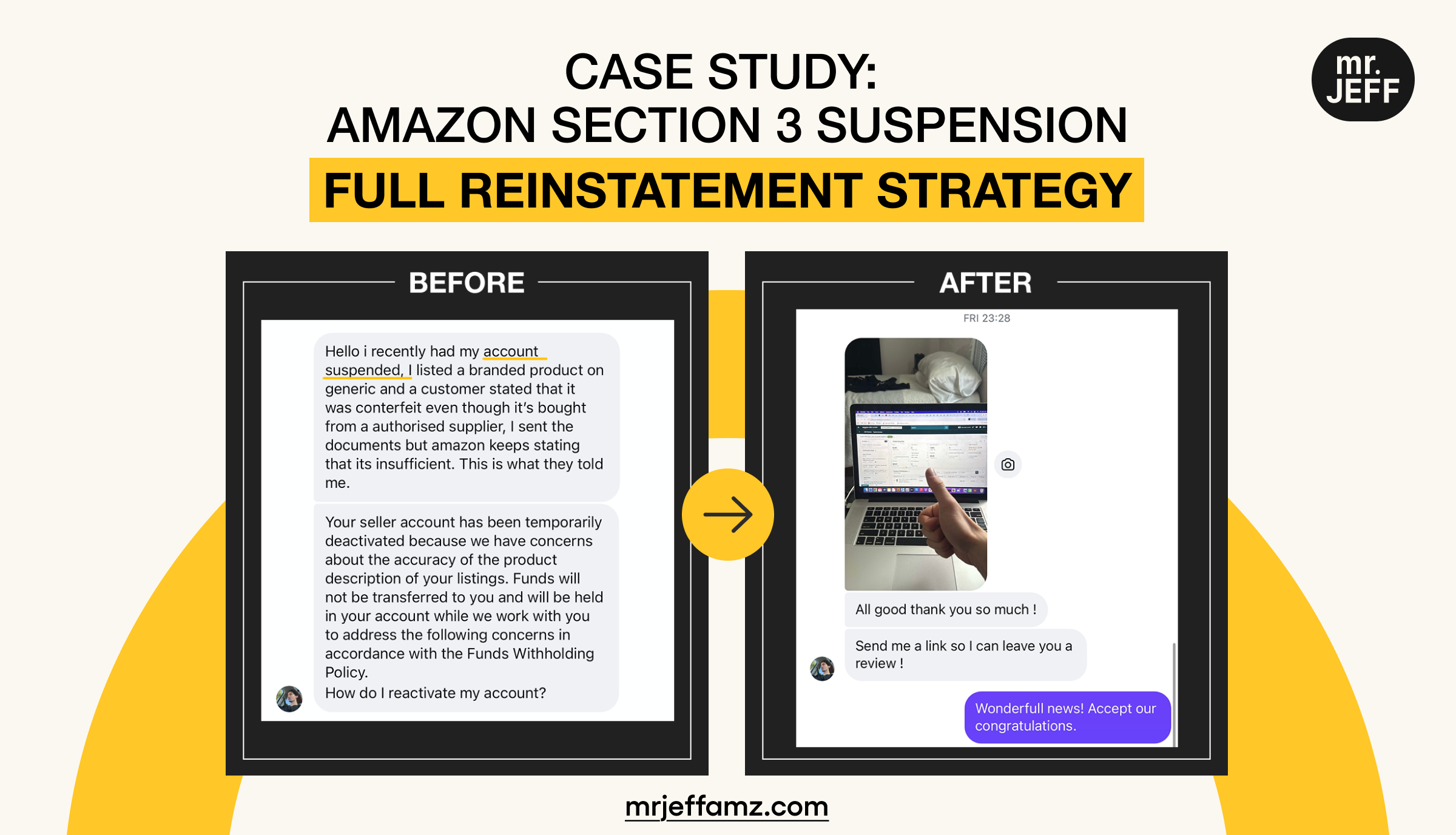
Case Study: Amazon Misbranded Listings Suspension — Reinstated With a 3-Step Escalation
June 25, 2026
Key Takeaways
- Amazon suspended a US seller in April 2026 for misbranded listings showing branded products as Generic, then rejected appeals claiming submitted documents were fabricated.
- Misbranded listing suspensions are dangerous because they trigger Amazon's product authenticity reviews, where even legitimate documents can be rejected based on poor presentation alone.
- After failed Seller Central appeals, filing a properly structured BBB complaint and responding to the initial rejection successfully reinstated the accused seller's full account privileges.
- Listing branded products as Generic instead of their true brand identity violates Amazon's Section 3 catalog policies and can trigger full account deactivation.
- Removing all non-compliant listings and reorganizing genuine documents with clear labeling proved more effective than submitting the same paperwork multiple times through standard channels.
Getting suspended is stressful enough. But being told by Amazon that the documents you submitted — real, legitimate documents — were fabricated? That's a different kind of gut punch.
That's exactly the situation our client was in when he came to us. His account was deactivated for misbranded listings, his own appeals had failed, and Amazon had effectively accused him of forging evidence. Here's how we turned that around and why it ultimately took an escalation outside of Seller Central to get his account back.
What Is a Misbranded Listing Suspension and Why It's So Serious in 2026
A misbranded listing suspension happens when Amazon determines that a product is listed under the wrong brand identity — most commonly when branded products are listed as "Generic" instead of being correctly attributed to the actual brand. Amazon treats this as a violation of its Section 3 and product detail page policies, because misbranding undermines catalog accuracy and buyer trust.
These cases are dangerous for one specific reason: they sit at the intersection of listing accuracy and product authenticity. When Amazon suspects a brand is being misrepresented, the case can quickly escalate into questions about invoices, supplier authorization, and document authenticity — which is exactly where this case ended up.
📊 By the numbers: Across the hundreds of reinstatement cases we've handled, listing and brand-related violations are consistently among the most common triggers for account deactivation — and a significant share of the toughest cases involve sellers whose documents were genuine but were rejected because of how they were presented.
The Challenge
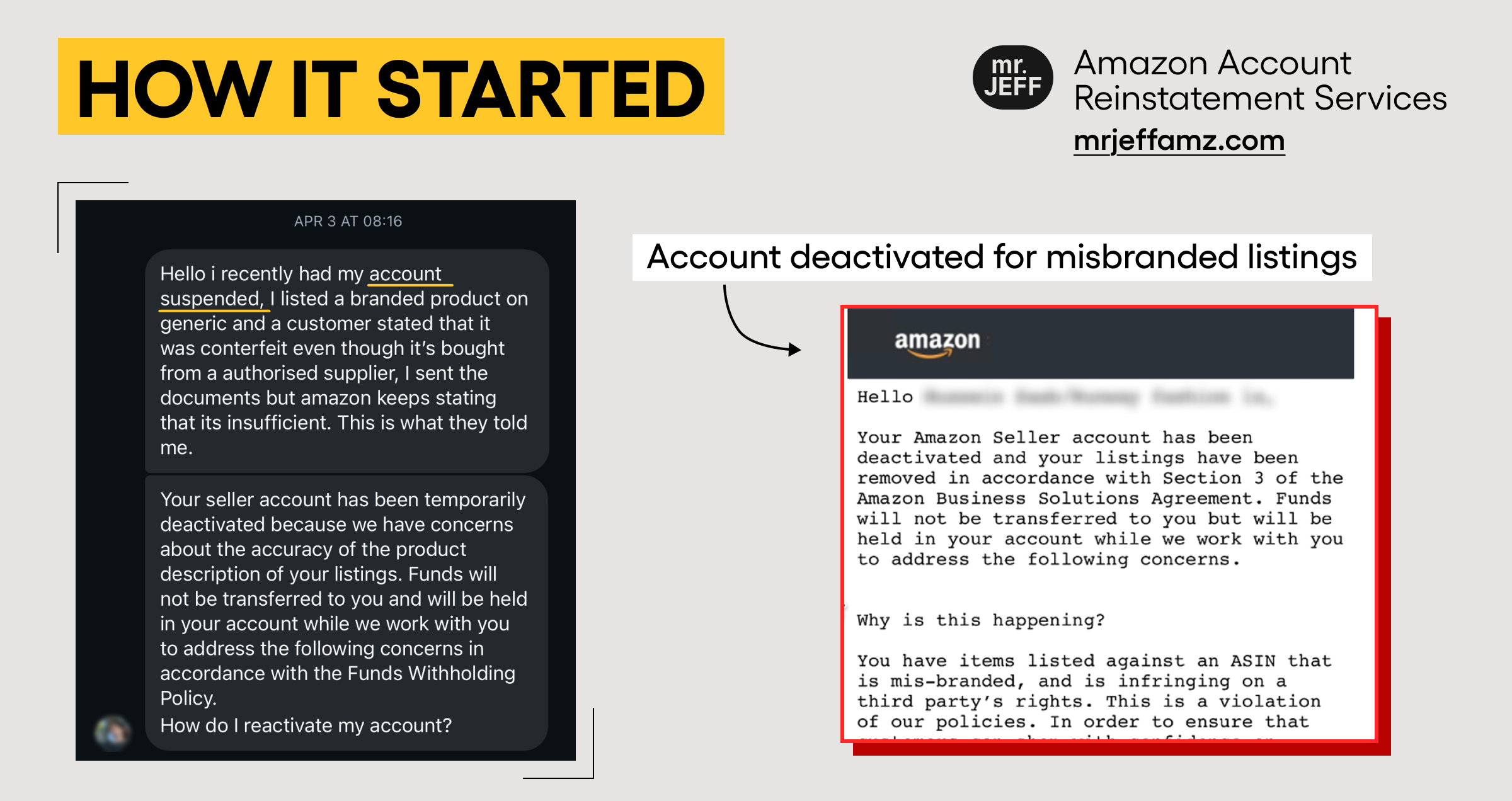
In April 2026, Abdel, an experienced Amazon seller in the US marketplace, contacted Mr. Jeff AMZ after his seller account was deactivated for misbranded listings.
The core issue was a catalog one: several of his products had been listed as "Generic" rather than being properly attributed to the correct brand. To Amazon's enforcement systems, that reads as brand misrepresentation — and it was enough to trigger a full account deactivation.
But by the time the client reached us, the case had become far more serious than a simple listing fix.
When Amazon Said the Documents Were "Fabricated"
Before working with us, the client had made several attempts to reinstate his account on his own. None of them succeeded.
The most alarming part came in one of Amazon's responses: it stated that the documents the client had submitted were fabricated.
💡 Mr. Jeff Expert Insight: "An accusation of fabricated documents is one of the hardest positions a seller can be in. Even when the documents are completely legitimate, once Amazon flags authenticity, every future appeal is read with suspicion. You're no longer just proving your listings were corrected; you're rebuilding your credibility from zero. The way you organize and present genuine documents becomes just as important as the documents themselves."
This is a critical distinction. The client wasn't lying, and his paperwork was real. But a legitimate document, submitted in a confusing or incomplete way, can read as suspicious to a reviewer processing hundreds of cases a day. Presentation wasn't a nice-to-have here — it was the entire problem.
Failed Self-Submitted Appeals
The client's situation followed a pattern we see constantly: a seller with a legitimate case who submits reasonable information and still gets rejected, again and again.
His original appeal simply did not meet Amazon's criteria. It didn't address the violation in the structure Amazon expects, it didn't connect the documents to the specific concern, and it didn't include a corrective and preventive plan credible enough to move the case forward.
After multiple failed attempts and with the "fabricated documents" flag now attached to his case — the client reached out to us.
Our Reinstatement Strategy
Step 1: Full Investigation and Document Verification
Before writing anything, we went through the entire case history — every previous submission, the original deactivation notice, and every document the client had sent to Amazon.
Because authenticity had been challenged, this step mattered more than usual. We double-checked every document the client had submitted to confirm it was genuine and verifiable. It was. The problem was never that the paperwork was fake — it was that it had been presented in a way that left room for doubt.
Step 2: Rewriting the Appeal to Meet Amazon's Criteria
The client's original appeal didn't align with what Amazon requires from a reinstatement submission. We rebuilt it from the ground up so that it directly addressed the misbranding violation, laid out the facts in a clear sequence, and connected each document explicitly to the point it supported — leaving no ambiguity for the reviewer.
Step 3: Cleaning the Inventory and Locking In Corrective and Preventive Measures
A strong appeal is only credible if the underlying problem is genuinely fixed. We made sure no listings remained in the inventory that violated Amazon's policies. Every listing found to be in violation was removed, and we confirmed the account fully met the corrective and preventive measures outlined in our Plan of Action (POA) — so that Amazon could see the issue wasn't just explained, it was resolved.
Step 4: Reorganizing the Documents and Resubmitting
Finally, we double-checked every document again, reorganized it, helped the client prepare it properly, and proceeded with submission — this time in a format built specifically to remove the authenticity doubts that had derailed the earlier appeals.
Escalation: Filing a Complaint With the Better Business Bureau (BBB)
The first round of appeals through Seller Central, along with direct communication with the Account Health team, did not result in reinstatement.
This is a decision point where many sellers give up. We didn't. We moved to the next step in our reinstatement process: filing a complaint with the Better Business Bureau (BBB).
We filed the complaint and presented the case properly and in full. The initial complaint came back rejected with the same generic response the client had been getting all along.
But we responded again — and this time it worked.
✅ The Result
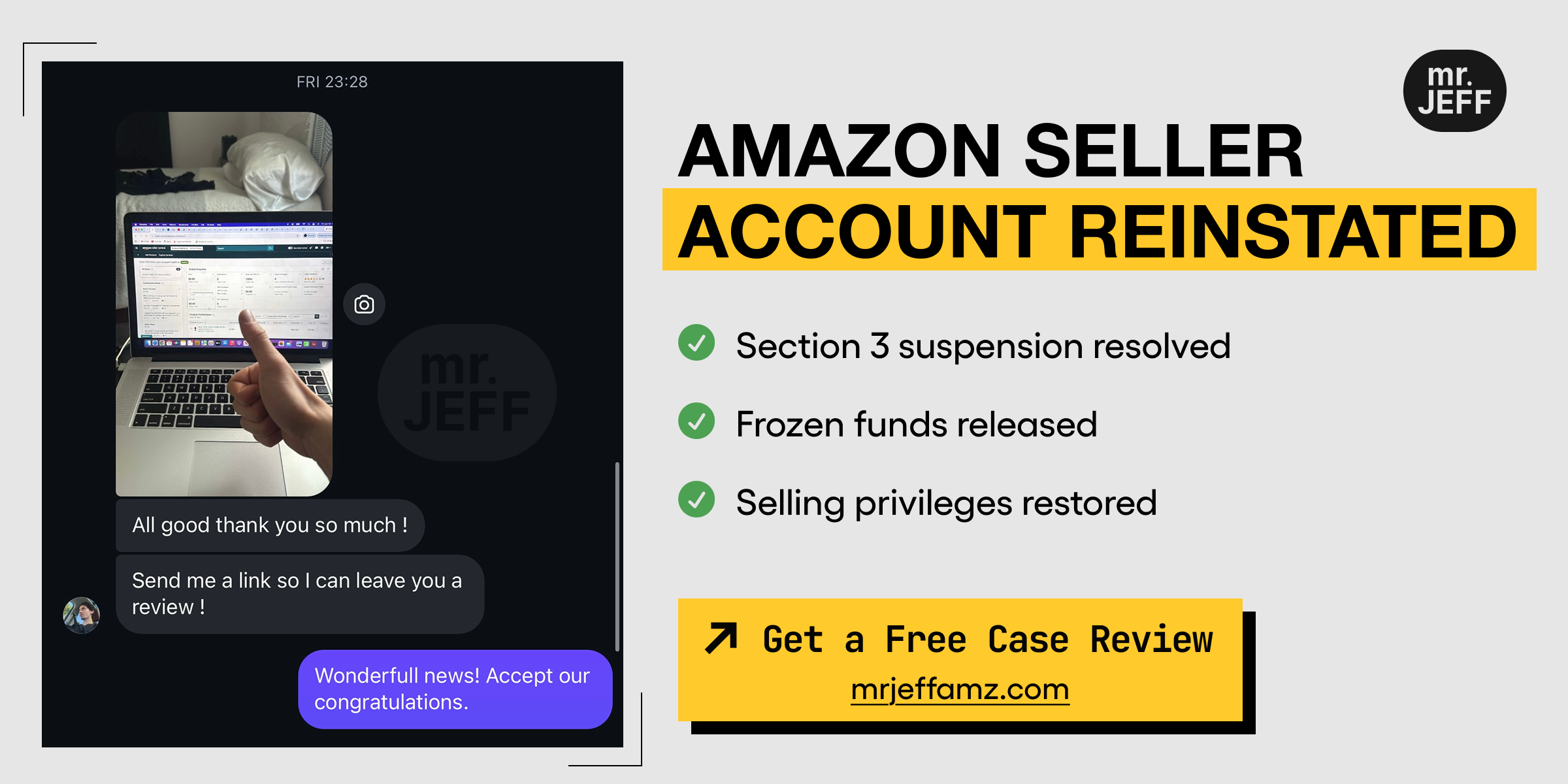
Amazon seller account fully reinstated.
Following our second response through the BBB process, the client received a performance notification confirming successful reinstatement of his account. After being accused of fabricating documents and hitting a wall through every standard channel, he regained full selling privileges and was able to resume business.
Key Lessons for Amazon Sellers
🔸 "Generic" is not a safe default.
If a product belongs to a real brand, listing it as "Generic" can be read as brand misrepresentation. Always attribute products to the correct brand, and make sure your catalog reflects the true brand identity of everything you sell.
🔸 Real documents can still get rejected.
This case is proof: the client's documents were genuine, yet Amazon called them fabricated. Authenticity isn't enough on its own — how you organize, label, and present documents determines whether a reviewer trusts them.
🔸 Fix the problem before you argue the case.
An appeal is only believable if the violation is actually resolved. Removing every non-compliant listing and meeting the corrective and preventive measures in your POA isn't optional — it's what makes the appeal credible.
🔸 A rejection through Seller Central is not the end of the road.
When Seller Central and the Account Health team don't resolve a case, there are still legitimate escalation paths. A properly filed and well-argued BBB complaint can move a case that has otherwise stalled.
🔸 Persistence with strategy beats persistence alone.
The client appealed on his own multiple times and got nowhere. The same documents, reorganized and re-presented combined with a structured escalation — got the account back. The difference wasn't effort. It was strategy.

🚨 Need Help With Amazon Account Reinstatement?
If your Amazon seller account has been suspended for misbranded listings, brand misrepresentation, or any other policy violation, it's critical to act strategically from the start. Every failed appeal makes the next one harder — and an accusation of fabricated or invalid documents makes it harder still.
At Mr. Jeff AMZ, we specialize in reinstating suspended Amazon seller accounts, even in the most complex cases. Our team has successfully helped 650+ sellers get their accounts back and return to selling.
Here's what you get when you work with Mr. Jeff AMZ:
🔍 Insider Expertise — Our specialists include ex-Amazon staff and top Amazon sellers who understand exactly how Amazon reviews appeals behind the scenes.
✍️ Custom Plans — No Templates — Every Plan of Action (POA) is written from scratch, fully tailored to your specific suspension and account history.
🔄 Unlimited Revisions — We work on your case until reinstatement. No revision limits, no hidden fees.
🤝 Dedicated 1-on-1 Support — You'll have a personal reinstatement expert guiding you through every step of the process.
⚡ Fast-Track for Urgent Cases — If your business is on pause and time matters, we offer priority handling for urgent reinstatement cases.
✅ Honest Case Review — If reinstatement isn't realistically possible, we'll tell you upfront. No false promises. No wasted time.
Get a Free Expert Case Review
If your Amazon seller account has been suspended, don't risk getting stuck in an endless appeal loop.
👉 Fill out the form and get a free expert consultation with a detailed review of your Amazon suspension case.

Author
Rick
Senior Reinstatement Consultant at Mr. Jeff AMZ
Rick is a Senior Reinstatement Consultant at Mr. Jeff AMZ with 6 years of experience appealing Amazon suspensions. He specializes in solving complex Amazon issues like Section 3, IP, and review-related enforcement, helping sellers recover deactivated accounts. His superpower is knowing Amazon's policies better than most Amazon reviewers do and building a compelling, watertight case for any position.
Connect on LinkedIn