Case Studies
Amazon Restricted Product Suspension and Evasive Behavior — The Full Reinstatement Process
July 14, 2026
Key Takeaways
- Amazon restricted product suspensions with evasive behavior flags require proof the product complied with policy from the start, not a Plan of Action.
- A missing NPN field on one Health Canada natural health product listing triggered an evasive behavior deactivation and ten rejected appeals.
- After ten failed self-submitted appeals over three months, professional escalation through BBB and compliance documentation achieved reinstatement in six weeks.
- Amazon systems cannot distinguish honest data-entry errors from deliberate evasion when regulated products lack required compliance identifiers in listing fields.
- Restricted product violation appeals fail when sellers explain intent or corrective actions instead of submitting verifiable licensing and regulatory compliance evidence.
Of all the things Amazon can say in a deactivation notice, "evasive behavior" is one of the worst.
It means Amazon doesn't believe you made a mistake. It believes you listed a restricted item in a manner designed to avoid detection — deliberately. And once that label is on your account, Amazon's own position is that there is no path to reinstatement unless you can prove your product complied with policy all along.
That's exactly where this client landed. Over one listing field he forgot to fill in.
He submitted more than ten appeals on his own. None of it worked — and there was a very specific reason why. Here's what finally got his account back, and the policy nuance that most sellers get wrong..
The Challenge
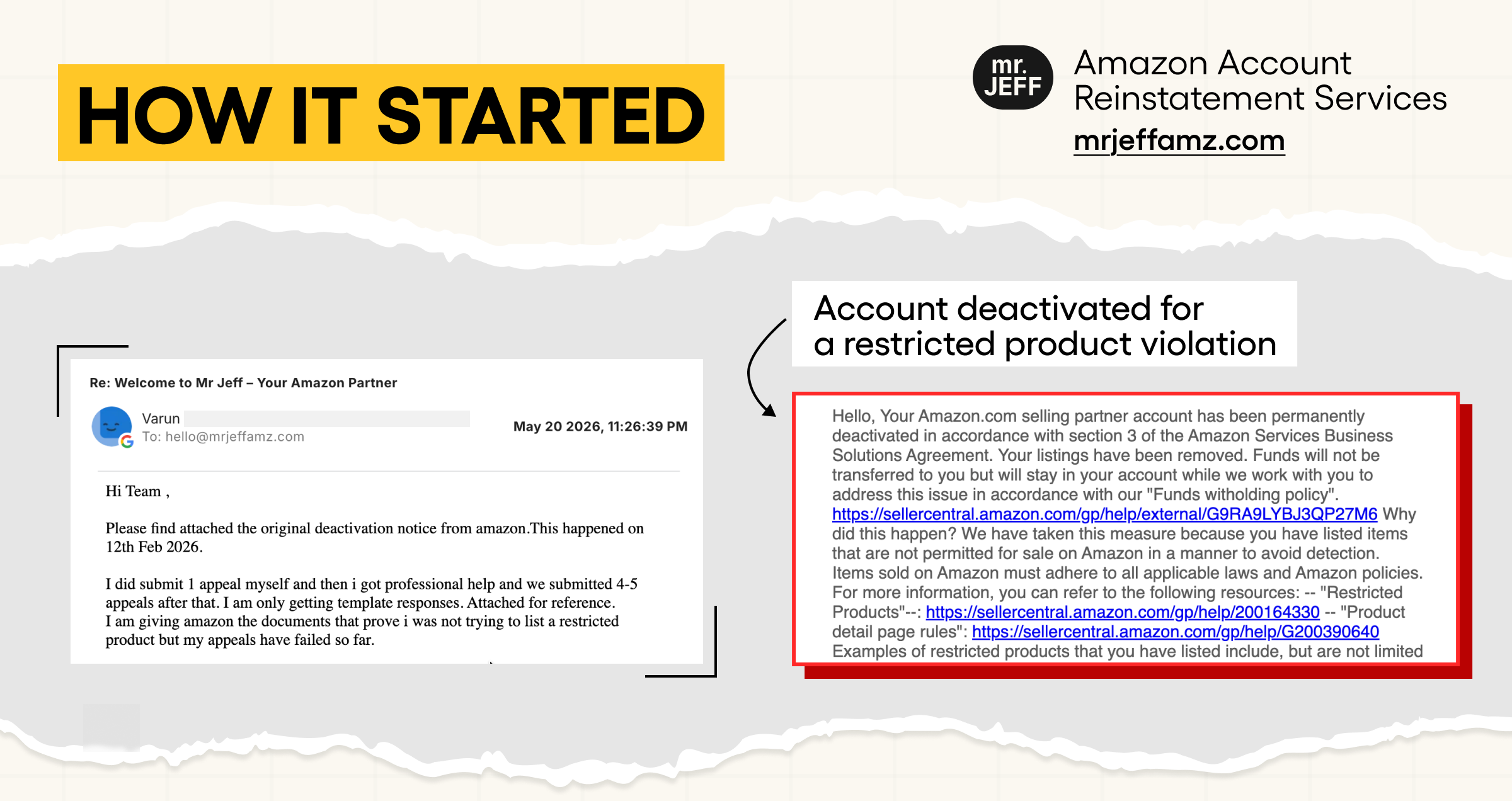
On February 12, 2026, Varun's Amazon.ca seller account was deactivated for violating Amazon's Restricted Products policy. The notice cited evasive behavior.
The trigger was small. While creating a listing for a natural health product, Varun hadn't entered the NPN (Natural Product Number), the eight-digit identifier Health Canada issues to licensed natural health products. Amazon.ca requires it on the listing as proof the product is legally approved for sale in Canada.
What made the case so frustrating is that the product was entirely legitimate and did have a valid NPN. The licence existed. The number existed. Varun had just never typed it into the listing.
To Amazon's compliance systems, though, a regulated product listed without its required identifier looks exactly like a product someone is trying to hide. So that's how it was treated.
What Is an Amazon Restricted Product Suspension
A restricted product suspension happens when Amazon decides you've listed something it prohibits, or something that needs an approval, certification, or regulatory identifier your listing didn't have. Amazon doesn't always stop at pulling the listing. It can suspend your selling privileges and deactivate the whole account.
The reason this category is so unforgiving comes down to what Amazon asks of you. With most violations, it wants to know what you'll do differently. With restricted products, it wants you to prove the product was never in violation to begin with. Add an evasive behavior flag, which is Amazon's term for listing a restricted item in a manner intended to avoid detection, and the bar goes higher still: there is no route back without valid proof that you adhered to the applicable laws and Amazon's policies.
By the numbers: Across the hundreds of reinstatement cases we've handled, restricted product violations combined with an evasive behavior flag are some of the hardest to reverse. Usually the seller did nothing deliberate. The problem is that Amazon's systems can't tell an honest data-entry slip apart from a calculated one.
This is the part most sellers never find out, and it's why so many submissions in this category fail before a reviewer finishes reading them.
For most Amazon violations, you write a Plan of Action (POA). You identify the root cause, set out your corrective actions, and explain the preventive measures you've put in place. It's an argument about what went wrong and how you've fixed it.
Restricted product deactivations don't run on that logic. Amazon won't accept a Plan of Action or a description of corrective actions for this violation type. It accepts one thing: evidence that your product didn't violate the Restricted Products policy in the first place. That's a dispute rather than an appeal, and the difference decides the outcome.
10 Failed Self-Submitted Appeals
Over the weeks that followed, Varun submitted ten appeals on his own. All ten were rejected.
He did what most sellers would do in his position. He explained that it had been an honest oversight, apologized, and set out how he'd prevent it happening again. It was reasonable, truthful, and completely beside the point. Amazon wasn't asking whether he'd do better. It was asking him to prove the product had never been in violation, and none of his ten appeals answered that question.
Each rejection also made the next attempt harder, hardening Amazon's position and adding to a case file that was already working against him.
On May 21, 2026, two and a half months after the deactivation, Varun contacted Mr. Jeff AMZ.
How We Took On the Case
We started, as we always do, with a free consultation and a full case review. Before any money changed hands, we went through Varun's previous appeals and explained exactly why each one had been rejected — and what Amazon was actually asking for that none of them had delivered.
Varun chose to proceed with Full Account Reinstatement: our end-to-end option, where we run the case from the first submission through to complete reinstatement.
He was assigned to Rick, a senior reinstatement manager with 6 years of experience appealing Amazon suspensions.
Our Reinstatement Strategy
Step 1: Full Investigation
Rick went through the case from the beginning: the original performance notification, the exact policy Amazon had cited, the wording of the evasive behavior allegation, the current state of the account, the invoices on file, and all ten of Varun's previous appeals along with every rejection Amazon had sent back.
That investigation pinned down the trigger behind the deactivation: the missing NPN on one listing. The rejection notices turned out to be the most useful documents in the file. Read closely, they tell you what Amazon is looking for and what every previous submission failed to give it.
Step 2: Crafting an Appeal That Answered Every Concern
We built a submission that addressed every concern Amazon had raised: the Restricted Products policy, the missing NPN, and the evasive behavior allegation itself. That last one is what most sellers leave untouched, because answering an accusation about your intent is genuinely difficult if you don't know how Amazon evaluates it.
Step 3: Working the Internal Channels
We then ran our internal process, submitting around six appeals through Seller Central and engaging directly with the Account Health team.
With an evasive behavior flag on the account and ten prior rejections in the file, those exchanges confirmed what the notices had been signalling all along. Amazon wasn't going to move on argument. It wanted proof, and each response narrowed down exactly what that proof had to look like.
Step 4: Escalating to the Better Business Bureau (BBB)
We then moved to the next stage of our reinstatement process and filed a complaint with the Better Business Bureau, presenting the case in full.
Most sellers never get this far, and most services don't take this route at all. It applies pressure from outside Amazon's internal queue and puts the case in front of people who have to account for it, which kept every channel active while we assembled the compliance evidence.
Step 5: Rebuilding the Case Around Proof of Compliance
With the diagnosis settled, we changed what we were submitting.
We updated the appeal and prepared additional proofs of compliance: verifiable documentation showing the product was properly licensed, that its NPN was real and valid, and that the listing had never been for an unlicensed or prohibited product. That took intent out of the conversation entirely. There was nothing to evade, because the licence had been there the whole time.
We confirmed no non-compliant listings were left in the catalogue, organized the documentation so a reviewer could verify it quickly, and submitted.
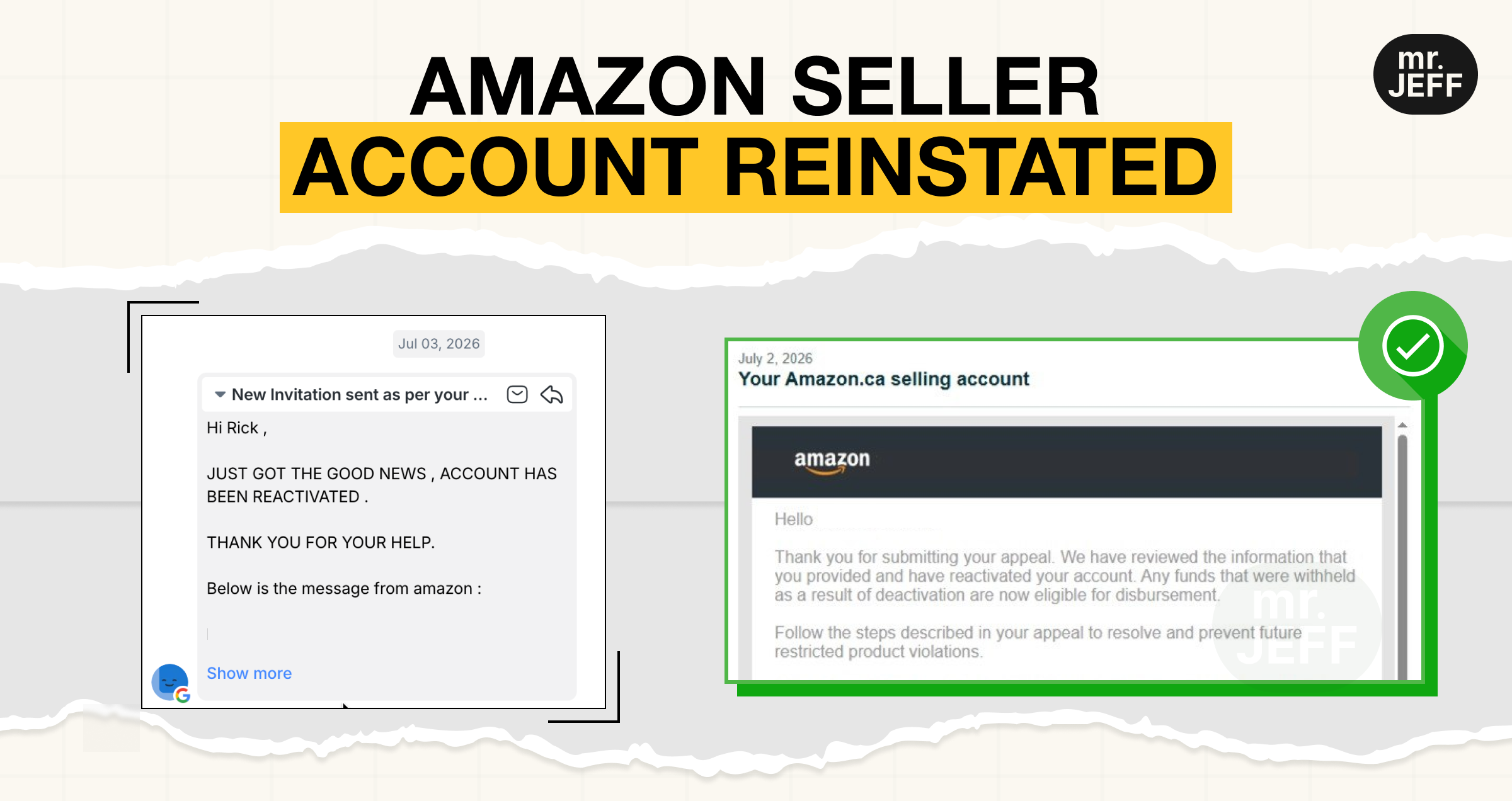
The Result
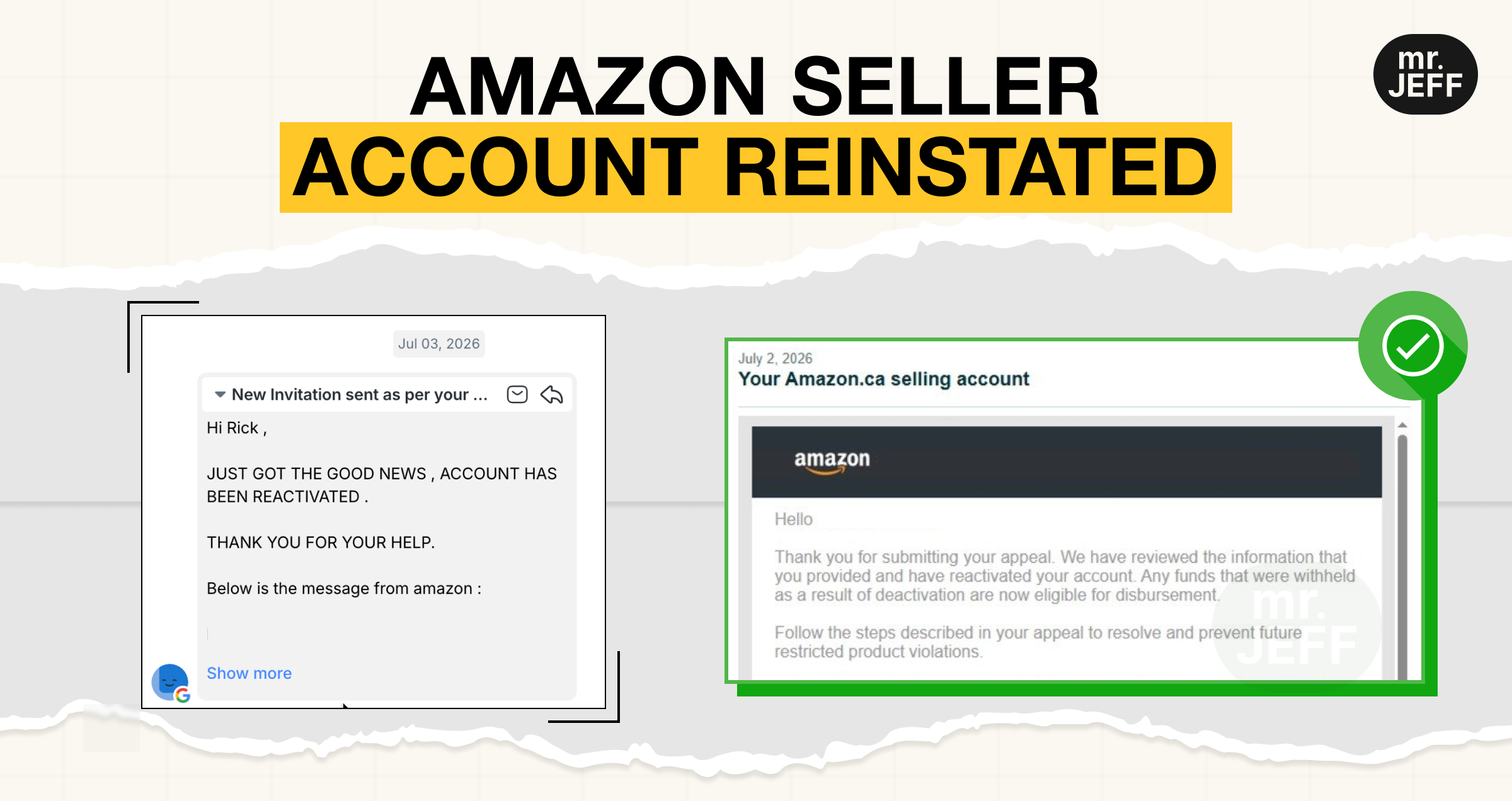
Amazon seller account fully reinstated on July 2, 2026.
Varun got his selling privileges back 6 weeks after he engaged us.
Before that, he'd spent over 3 months of his own time on appeals and collected 10 rejections for it.
So what actually made the difference? Expertise, and knowing how Amazon's policies work in practice rather than on paper: what Amazon is really asking for, and what it will never accept no matter how well you argue it.
If your Amazon seller account has been deactivated, don't lose weeks on appeals that get rejected. Bring in professionals early and resolve it faster.
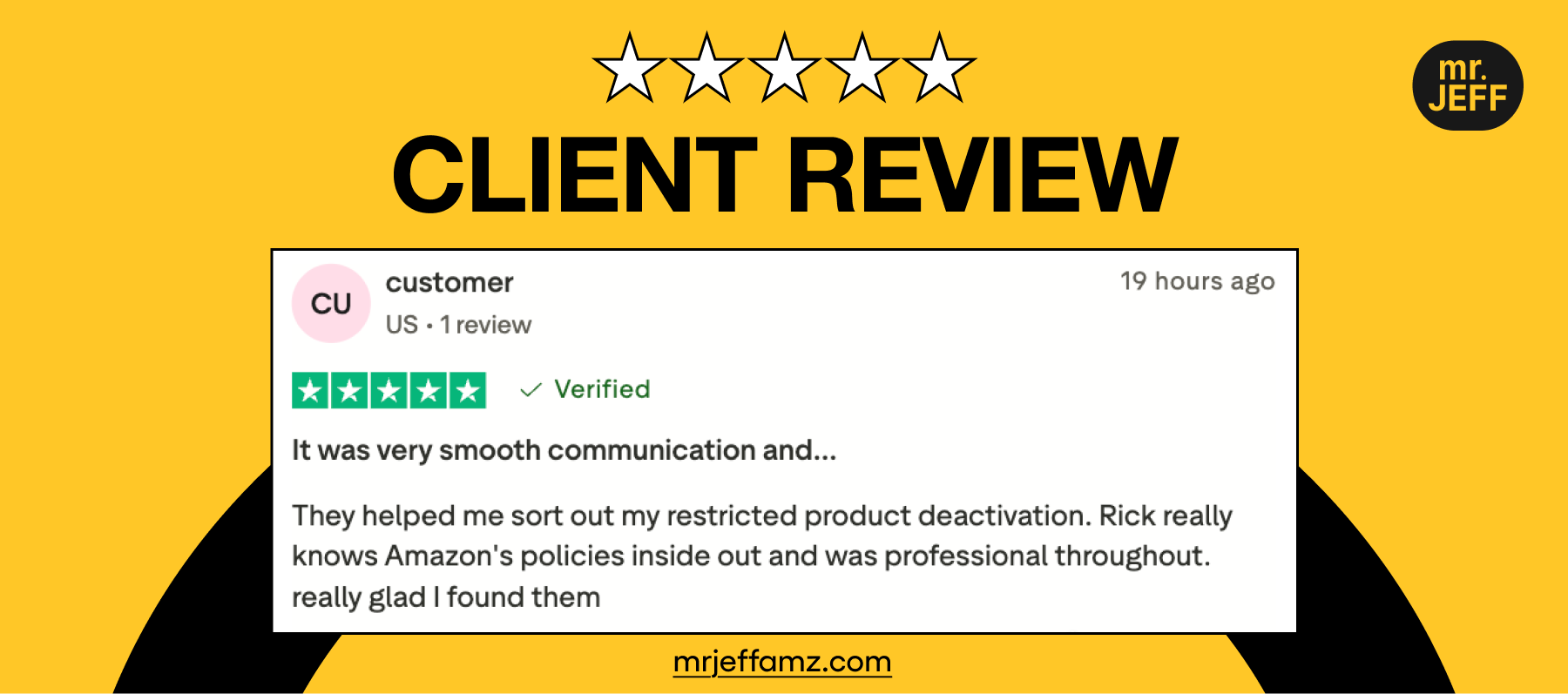
Key Lessons for Amazon Sellers
An empty field can look identical to a deliberate violation.
Varun's product had a valid NPN. He just never entered it. Amazon's systems don't see forgetfulness, they see a regulated product listed without its required identifier, and that's what an evasion attempt looks like too. If you sell regulated products, treat every compliance field as something your account depends on.
Restricted product cases call for a dispute, not an appeal.
Amazon won't accept a Plan of Action for this violation type. It only accepts evidence that the product never violated the policy. The wrong kind of submission gets rejected no matter how well written it is, and knowing the difference is often what decides whether an account comes back.
"It was an honest mistake" is a weak argument.
When Amazon alleges evasive behavior, insisting on good intent gets you nowhere, because that's what an actual violator would say as well. Documentation that makes the question of intent irrelevant is what moves these cases.
Evidence beats persistence.
This case wasn't won by making the same argument an eleventh time. It was won with proof. When you can't win on intent, win on documentation.
Need Help With Amazon Account Reinstatement?
If your Amazon seller account has been deactivated for a Restricted Products policy violation, or any other policy violation, repeated appeals won't resolve it. Every failed appeal makes the next one harder, and the wrong type of submission will fail no matter how carefully you write it.
At Mr. Jeff AMZ, we specialize in reinstating suspended Amazon seller accounts, even in the most complex cases. Our team has successfully helped 650+ sellers get their accounts reinstated and return to selling.
Here's what you get when you work with Mr. Jeff AMZ:
Insider Expertise — Our specialists include ex-Amazon staff and top Amazon sellers who understand exactly how Amazon reviews appeals behind the scenes.
Custom Plans — No Templates — Every submission is built from scratch, fully tailored to your specific violation type and account history.
Unlimited Revisions — We work on your case until reinstatement. No revision limits, no hidden fees.
Dedicated 1-on-1 Support — You'll have a personal senior reinstatement manager guiding you through every step of the process.
Fast-Track for Urgent Cases — If your business is on pause and time matters, we offer priority handling for urgent reinstatement cases.
Honest Case Review — If reinstatement isn't realistically possible, we'll tell you upfront. No false promises. No wasted time.
Get a Free Expert Case Review
If your Amazon seller account has been suspended, don't risk getting stuck in an endless appeal loop.
Fill out the form and get a free expert consultation with a detailed review of your Amazon suspension case.

Author
Helen
Head of Client Success at Mr. Jeff AMZ
Helen leads Sales & Client Success at Mr. Jeff AMZ, guiding Amazon sellers from their first suspension panic to a fully recovered account. With years of frontline experience managing reinstatement cases, she translates Amazon's dense policy language into clear, actionable next steps and keeps sellers informed at every stage of the appeal.
Connect on LinkedInFrequently Asked Questions
What does 'evasive behavior' mean on an Amazon suspension notice?
Evasive behavior is Amazon's term for listing a restricted item in a manner they believe was designed to avoid detection. Unlike other violations where Amazon assumes a mistake, this flag means Amazon thinks you acted deliberately — making reinstatement significantly harder because you must prove your product was compliant all along.
What is an NPN and why did missing it cause an account deactivation?
An NPN (Natural Product Number) is an eight-digit identifier that Health Canada issues to licensed natural health products. Amazon.ca requires this number on listings as proof the product is legally approved for sale in Canada. Without it, Amazon's compliance systems flag the listing as potentially hiding a restricted product, even if the product is completely legitimate.
Why did the seller's 10 self-submitted appeals fail?
Most sellers approach restricted product suspensions like other violations — by writing a standard Plan of Action explaining what they'll do differently. However, restricted product cases require proof that the product was never in violation, not promises of future compliance. This critical difference is why self-submitted appeals in this category frequently fail.
How is a restricted product suspension different from other Amazon violations?
With most Amazon violations, you need to explain what you'll do differently going forward. With restricted product suspensions, Amazon wants you to prove the product was compliant from the start. Add an evasive behavior flag, and you must provide valid documentation showing you adhered to applicable laws and Amazon's policies — there's no alternative path to reinstatement.
Can an honest mistake like forgetting to fill in a field really get my account deactivated?
Yes. Amazon's automated compliance systems cannot distinguish between an honest data-entry slip and a calculated attempt to avoid detection. A regulated product listed without its required identifier looks the same to Amazon whether it was intentional or accidental — and both are treated with equal severity.
How long does it take to get reinstated from a restricted product suspension with evasive behavior?
In this case study, the Mr. Jeff AMZ team achieved reinstatement in under 6 weeks. However, these cases are among the hardest to reverse, and timing depends on having the right documentation and understanding the specific policy nuances that Amazon's review team looks for.
What should I do if my Amazon account is suspended for restricted products?
First, gather all documentation proving your product's compliance — licenses, certifications, regulatory identifiers, and approval letters. Understand that standard Plans of Action won't work; you need evidence-based proof. Consider consulting with reinstatement specialists, especially if your notice includes an evasive behavior flag, as these cases have a very specific approach that differs from typical suspensions.