
Case Studies
Amazon Drop Shipping Suspension Reinstated: Full Case Study
November 11, 2026
Key Takeaways
- Amazon deactivated the seller’s account on Aug 8, 2026 under Section 3 for an alleged Drop Shipping policy violation, withholding the account’s funds.
- The most likely trigger was a 5x ad-driven sales spike that Amazon’s automated enforcement flagged as inventory the seller might not be sourcing himself.
- The Mr. Jeff AMZ reinstatement team prepared a strong appeal with a Plan of Action (POA) that directly addressed Amazon’s concerns about the Drop Shipping policy.
- After several submissions in Seller Central were rejected, we filed a Better Business Bureau (BBB) complaint to draw outside attention to the case.
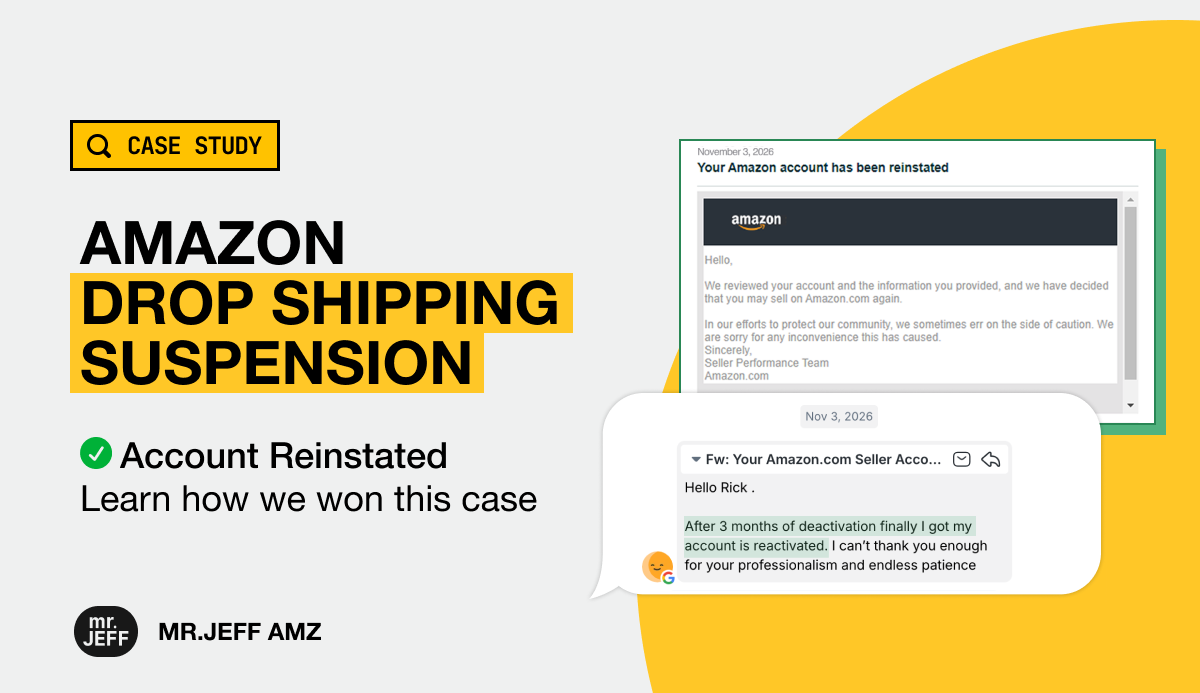
- A final appeal was accepted a few days after the BBB complaint, and the account was reinstated on Nov 3, 2026.
Throughout 2026, our team has seen a steady rise in seller deactivations for Drop Shipping policy violations. What surprises us is that some of the sellers who come to us did not break the policy at all.
The reason is how Amazon's AI enforcement works now. It looks for gaps, deactivates the account over a "violation" that may never have happened, and leaves the seller to prove that no violation took place and that the business meets every policy.
That is exactly what happened to John(client name has been changed to protect confidentiality). He is an experienced seller who worked with a reliable supplier and followed the policies. Amazon deactivated his account anyway.
In this case study, we break down what most likely triggered the Section 3 deactivation, why John's appeals failed, and how our team got the account reinstated.
Client Background: Deactivation and 5 Failed Appeals
John runs an online retail shop on Amazon.com. For years he has sold household supplies, mostly laundry products and cleaning tools.
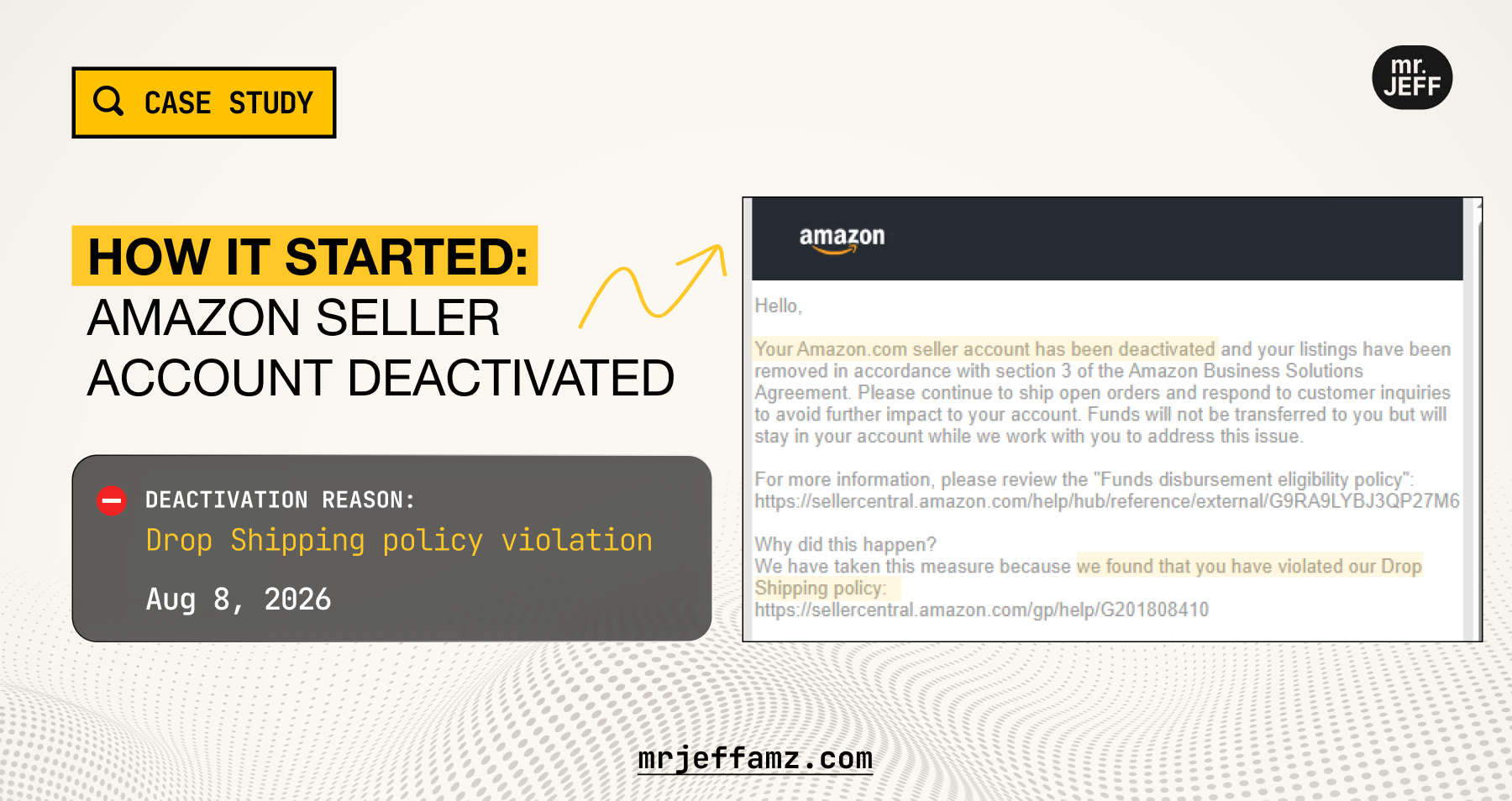
On August 8, 2026, Amazon deactivated his account and removed his listings under Section 3 of the Amazon Business Solutions Agreement. The performance notification named one reason: a Drop Shipping policy violation.
"We have taken this measure because we found that you have violated our Drop Shipping policy."
The notice also said his funds would not be transferred but would stay in the account while the issue was addressed. It asked him to keep shipping open orders and answering customer inquiries.
That put John in a difficult position. His warehouse was full of inventory he could not sell, and his funds were stuck in the account.
In the 25 days that followed, he filed five appeals with invoices for his products on his own. Amazon rejected all of them. On September 2, 2026, he turned to Mr. Jeff AMZ, and we took on his case.
Our task was clear: dispute Amazon's decision and show that no policy violation had taken place.
What Is Amazon's Drop Shipping Policy?
Amazon allows drop shipping only when the seller remains the seller of record.
Under the policy, you must:
have an agreement with your supplier that identifies you, and no one else, as the seller on all packing slips, invoices and external packaging;
remove any information identifying a third-party drop shipper before the order ships;
be responsible for accepting and processing customer returns.
The full text is in Amazon's Drop Shipping policy in Seller Central.
If your account is deactivated for a Drop Shipping violation, you can appeal through the "Reactivate your account" button on the Account Health page.
In Section 3 cases tied to this policy, Amazon typically expects:
supplier invoices or receipts that reflect your sales volume over the last 30 days;
the supplier's business details: name, phone number, address and website;
proof that you are authorized to sell the products;
documents for a third-party drop-shipping service, if you use one.
Amazon may contact the supplier to verify these documents.
If you do not respond to the deactivation, the account stays deactivated.
Mr. Jeff Expert Insight: A description of your business model is not evidence. Amazon wants documents that tie the inventory you bought to the units you sold in the period it names. If the paper trail and the sales data do not line up, an explanation alone will not carry the appeal. When the evidence is limited, the structure of your Plan of Action (POA) matters even more: answer each Amazon concern point by point and tie every claim to a specific document.
Case Investigation: Trigger Behind the Suspension
On our first call, John explained his two-step dropshipping model: products from a reliable supplier were delivered to his warehouse, packaged there, and only then shipped to customers. Our task was to dispute Amazon's decision and show that there was no policy violation.
We reviewed everything Amazon had seen and everything John had sent: the deactivation notice, five rejected appeals with invoices, Amazon's replies, and sales data around the deactivation date.
The sales data showed one anomaly. The most likely trigger was a 5x spike in sales right before the deactivation.
The spike came from advertising, and the advertising worked. Amazon's system most likely read the sudden jump in volume as suspicious activity and linked it to the Drop Shipping policy, even though the business was compliant.
That also explains the failed appeals. Amazon's notice states that supplier documents "must reflect your sales volume over the last 30 days." John's invoices showed that he buys from a supplier. In our assessment, they did not account for a month with five times higher sales or show how that inventory was sourced and handled.
His previous appeals proved that John had a supplier. Amazon was asking whether that supplier's inventory covered his sales.
Reinstatement Expert Note: The investigation step decides everything that follows. Misidentify the trigger, and you prepare the wrong appeal and get the same rejection.
If your appeal keeps coming back with the same reply, run your case through the Suspension Analyzer by Mr. Jeff AMZ before you file again. In 60 seconds, you get an analysis of your case and a list of the documents you need for the appeal.
How Did We Get the Account Reinstated?
Step 1: Prepare and Submit the Appeal in Seller Central
We gathered all the relevant documents that explained the spike in sales and crafted a detailed POA showing that the business model was fully compliant. Once John approved it, we submitted the appeal in Seller Central.
Step 2: Improve Every Submission After a Rejection
In total, we made six submissions through Seller Central. After each rejection, we studied Amazon's reply, sharpened the argument and added new evidence. The replies stayed the same: a template message citing insufficient evidence. A template reply does not say which document is missing, so each new submission had to cover more ground than the last.
Step 3: File a Complaint With the Better Business Bureau
Amazon's template replies did not say what was missing, and repeating the same channel was not moving the case. So we moved to the second level of our escalation strategy and filed a complaint with the Better Business Bureau (BBB). Unlike a Seller Central submission, a BBB complaint is formally sent to the company and puts the dispute on record outside Amazon's appeal queue.
On its own, the complaint did not change the status of the account. Its purpose was to open a second route for the case while we prepared the final appeal.
Step 4: Submit a Final Appeal
The BBB complaint drew external attention to the case. With that in place, we filed the final appeal. It answered every concern Amazon had raised, point by point, and included all the evidence we could assemble.
This time, Amazon reviewed the submission in full and accepted it a few days after the BBB complaint was sent.
We cannot say which of the two tipped the decision. The BBB complaint brought attention to the case, and the appeal gave Amazon a complete answer to its concerns.
✅ Result: Amazon Seller Account Reinstated
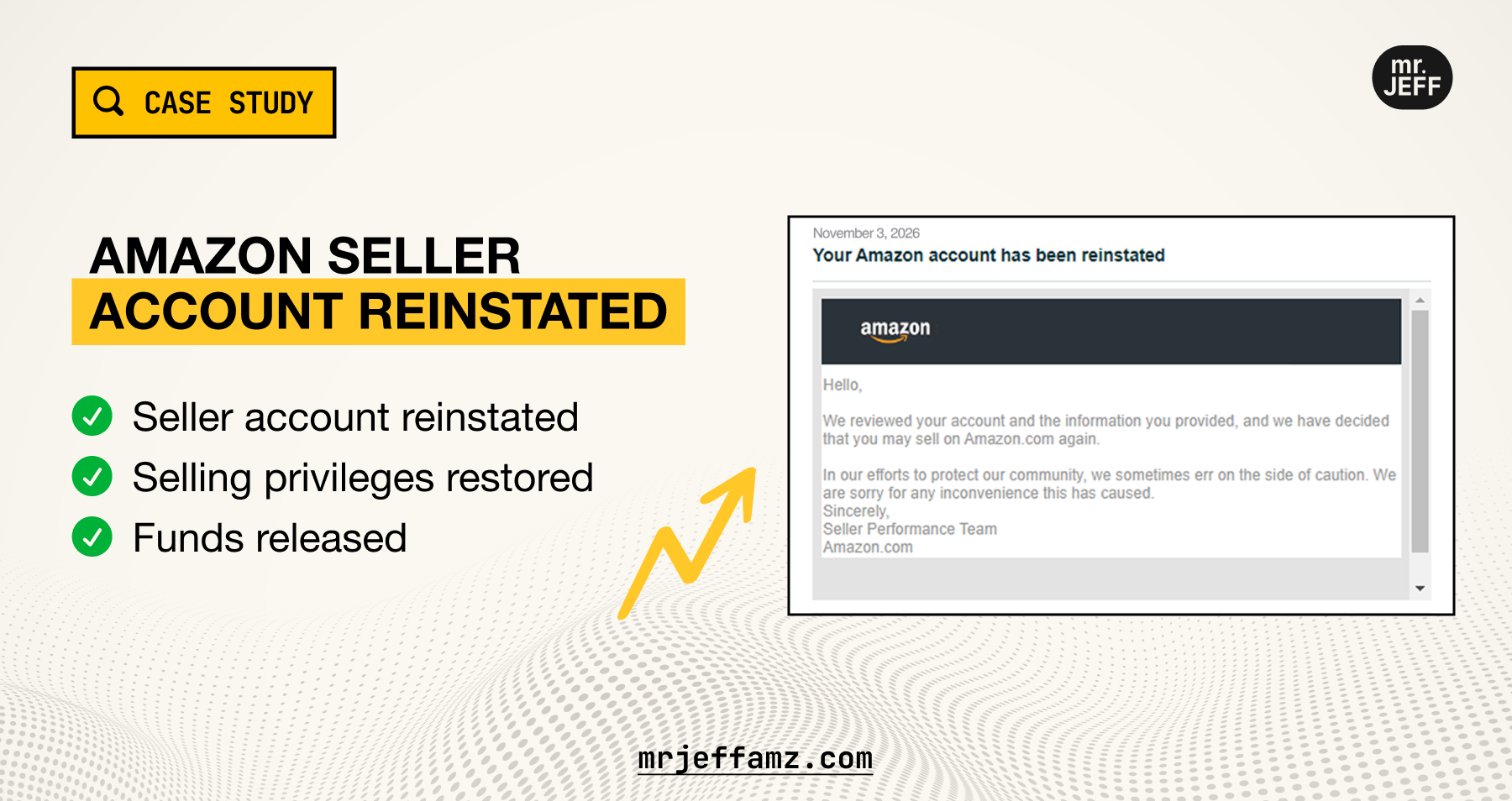
Amazon reinstated the seller account on November 3, 2026. John returned to selling and regained access to his funds.
This became possible thanks to a consistent strategy from our reinstatement team:
Correctly identifying the trigger of the deactivation.
Building a new appeal based on the case investigation.
Persistence and the use of escalation paths.
An Amazon deactivation can become a real threat to a business, but with professional reinstatement support, even complex cases can be turned around. For more than 5 years, Mr. Jeff AMZ has helped sellers overcome suspensions and recover their accounts and funds. We have reinstated 600+ accounts – yours could be next.
💬 Client Feedback
Right after the account was reinstated, the happy seller wrote us this review:

"After 3 months of deactivation finally I got my account is reactivated. I can't thank you enough for your professionalism and endless patience..."
Need Help With Amazon Account Reinstatement?
If your Amazon account was deactivated for a Drop Shipping policy violation or any other reason, the best move is to contact reinstatement professionals right away. It saves your time, nerves and money. The Mr. Jeff AMZ team has helped 650+ sellers reinstate their Amazon seller accounts. We built our own three-level escalation strategy that works even in complex deactivation cases: Section 3, Drop Shipping, Related Accounts, IP violations and more.
When you hire reinstatement professionals, you get:
A dedicated appeals manager responsible for your case
An appeal prepared on a proven structure
Full case management until the account is reinstated
Guarantees written into the contract
🔎 Get a Free Expert Case Review
Start with an expert review of your case.
Submit your case and get a free expert consultation: our team will review your suspension, identify what is preventing reinstatement and recommend the most effective next steps for your situation.
Let's get your Amazon account back!
One of the most rewarding parts of my job is helping Amazon sellers protect the businesses they spent years building. That's why we share recent reinstatement cases from our clients: so other sellers can see what actually worked and what they can do differently. You'll find more of them in our Case Studies section.
Rick Hudson

Author
Rick
Senior Reinstatement Consultant at Mr. Jeff AMZ
Rick is a Senior Reinstatement Consultant at Mr. Jeff AMZ with 6 years of experience appealing Amazon suspensions. He specializes in solving complex Amazon issues like Section 3, IP, and review-related enforcement, helping sellers recover deactivated accounts. His superpower is knowing Amazon's policies better than most Amazon reviewers do and building a compelling, watertight case for any position.
Connect on LinkedInFrequently Asked Questions
What is Amazon's Drop Shipping policy and what are the main requirements?
Amazon allows drop shipping only when you remain the seller of record. Key requirements include:
- Having a supplier agreement that identifies you (not the supplier) on all packing slips, invoices, and external packaging
- Removing any third-party drop shipper information before shipping
- Being responsible for accepting and processing all customer returns
Why was the seller's account deactivated if they didn't actually violate the Drop Shipping policy?
Amazon's AI enforcement system can flag accounts for violations that may not have actually occurred. The system looks for gaps or patterns and deactivates accounts preemptively, leaving sellers to prove their innocence. In this case, the seller followed all policies but was still flagged, likely due to how the AI interpreted certain signals in their account.
What documents does Amazon require when appealing a Drop Shipping policy violation?
For Section 3 deactivations related to Drop Shipping violations, Amazon typically expects:
- Supplier invoices or receipts reflecting your sales volume over the last 30 days
- Supplier's business details (name, phone number, address, and website)
- Proof of authorization to sell the products
- Documentation for any third-party drop-shipping service used
Why do self-filed appeals for Drop Shipping violations often get rejected?
Self-filed appeals frequently fail because sellers may not understand exactly what Amazon is looking for or how to present their documentation effectively. In this case, the seller submitted five appeals with invoices that were all rejected. Professional appeal services often succeed by identifying the specific triggers and crafting responses that directly address Amazon's concerns.
What happens to my funds and inventory when Amazon deactivates my account for a Drop Shipping violation?
When your account is deactivated, your funds are frozen and will not be transferred until the issue is resolved. Your listings are removed, meaning you cannot sell existing inventory. However, Amazon still expects you to continue shipping open orders and responding to customer inquiries during this period.
How do I submit an appeal for an Amazon Drop Shipping policy violation?
You can appeal a Drop Shipping violation by clicking the "Reactivate your account" button on your Account Health page in Seller Central. Your appeal should include all required documentation, a clear explanation of your business model, and evidence that you comply with Amazon's Drop Shipping policy requirements.
How long does it typically take to get an Amazon account reinstated after a Drop Shipping suspension?
Timeline varies significantly based on the complexity of your case and quality of your appeal. In this case study, the seller spent 25 days filing five unsuccessful appeals before seeking professional help. Working with experienced appeal specialists can often expedite the process by submitting a properly structured appeal that addresses Amazon's specific concerns.