
Case Studies
Amazon Section 3 Inauthentic Suspension & Retail Sourcing: Account Reinstated After Multiple Rejected Appeals
October 29, 2026
Key Takeaways
- An Amazon UK cosmetics seller's account was reinstated after eight months of Section 3 inauthentic suspension caused by retail sourcing documentation that failed Amazon's supply chain verification requirements.
- Amazon rejected multiple appeals because retail receipts lacked commercial invoice details required to trace products back to manufacturers, even though the cosmetics were genuine.
- Reinstatement required a multi-level escalation strategy including Seller Central appeals, Account Health internal reviews, BBB complaints, and executive-level escalation over several months.
- Eight of the seller's twelve suppliers did not meet Amazon's Responsible Sourcing documentation requirements, which demand verifiable supply chain traceability to original manufacturers.
- The final successful reinstatement came after persistent Account Health team communication presenting corrective measures and case history, not from submitting a single new document.
Selling genuine products doesn't always protect Amazon sellers from an inauthentic product suspension. If Amazon cannot verify where the inventory came from, even legitimate products can lead to a Section 3 account deactivation.
That's exactly what happened to Kyle(name changed for confidentiality), an Amazon UK seller in the cosmetics category. His account was deactivated under Section 3 after Amazon raised concerns about product authenticity. Although his products were genuine, his inventory came from multiple wholesalers and retail stores, and much of his sourcing documentation failed to meet Amazon's verification requirements.
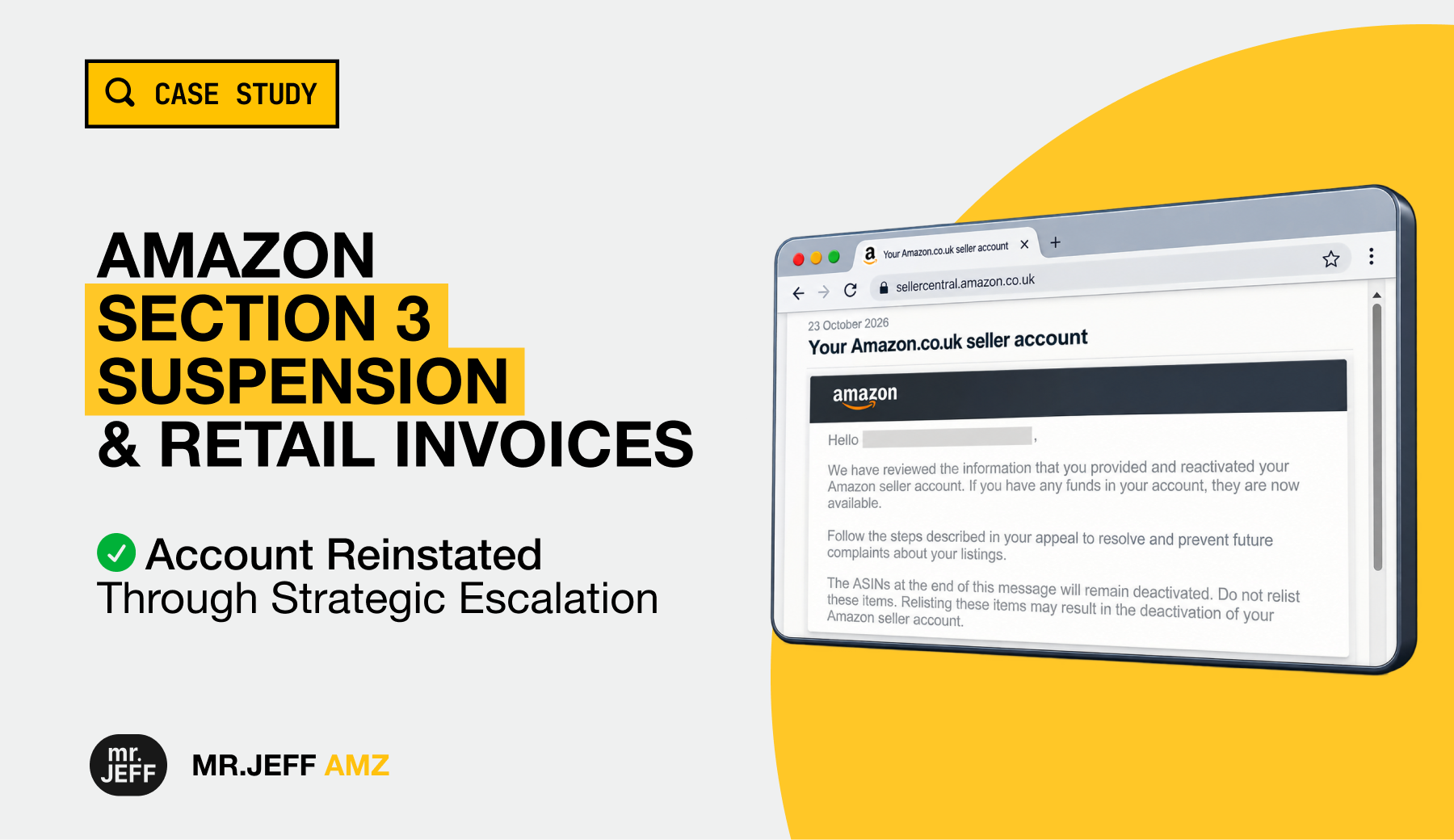
The Mr. Jeff AMZ reinstatement team successfully restored Kyle's seller account, helping him return to selling on Amazon after more than eight months of suspension.
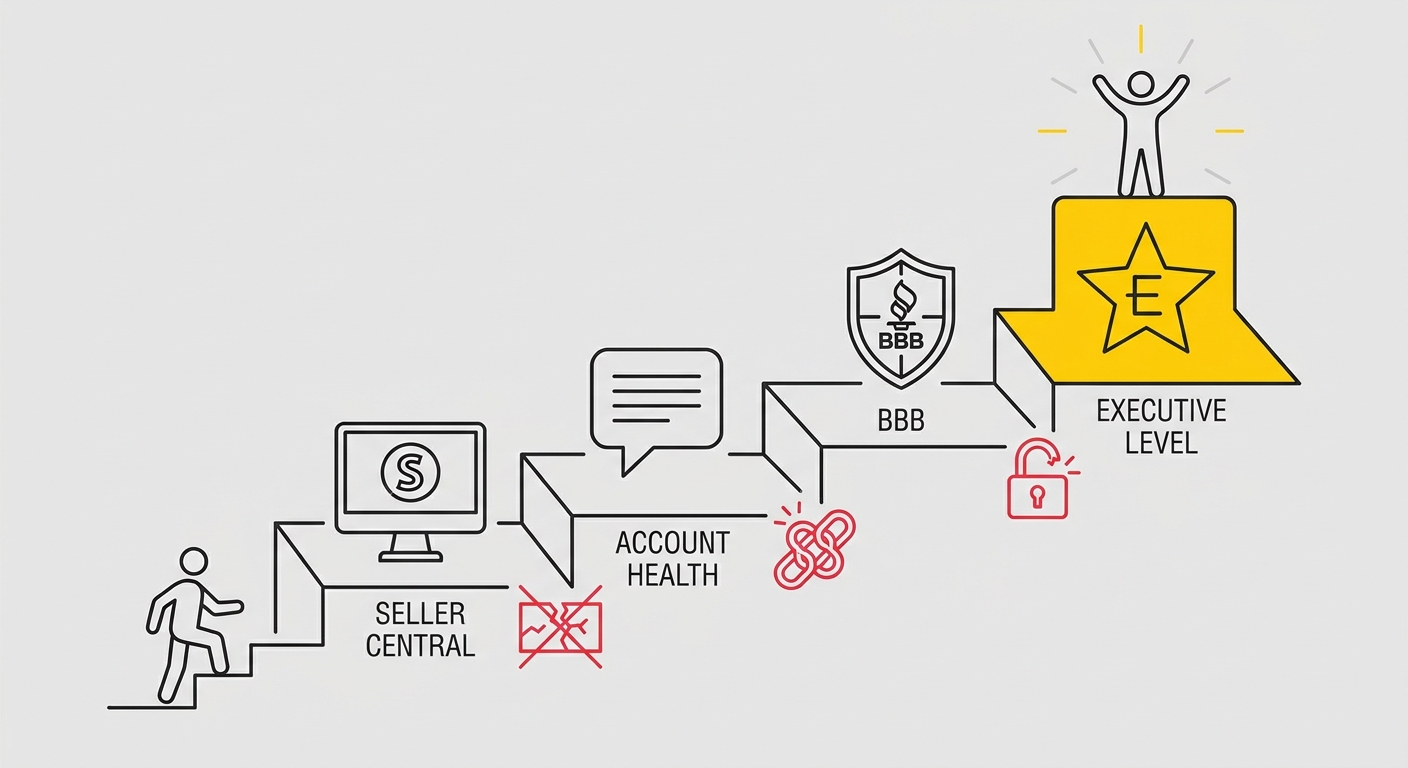
To achieve this result, we applied our Multi-Level Escalation Strategy, combining Seller Central appeals, direct communication with Amazon's Account Health Team, Better Business Bureau (BBB) complaints, and Executive-Level Escalation.
In this case study, we'll walk you through the challenges we uncovered, explain why several appeal and escalation attempts failed, and reveal what ultimately led to the successful reinstatement of Kyle's Amazon seller account.
⚠️ The Challenge
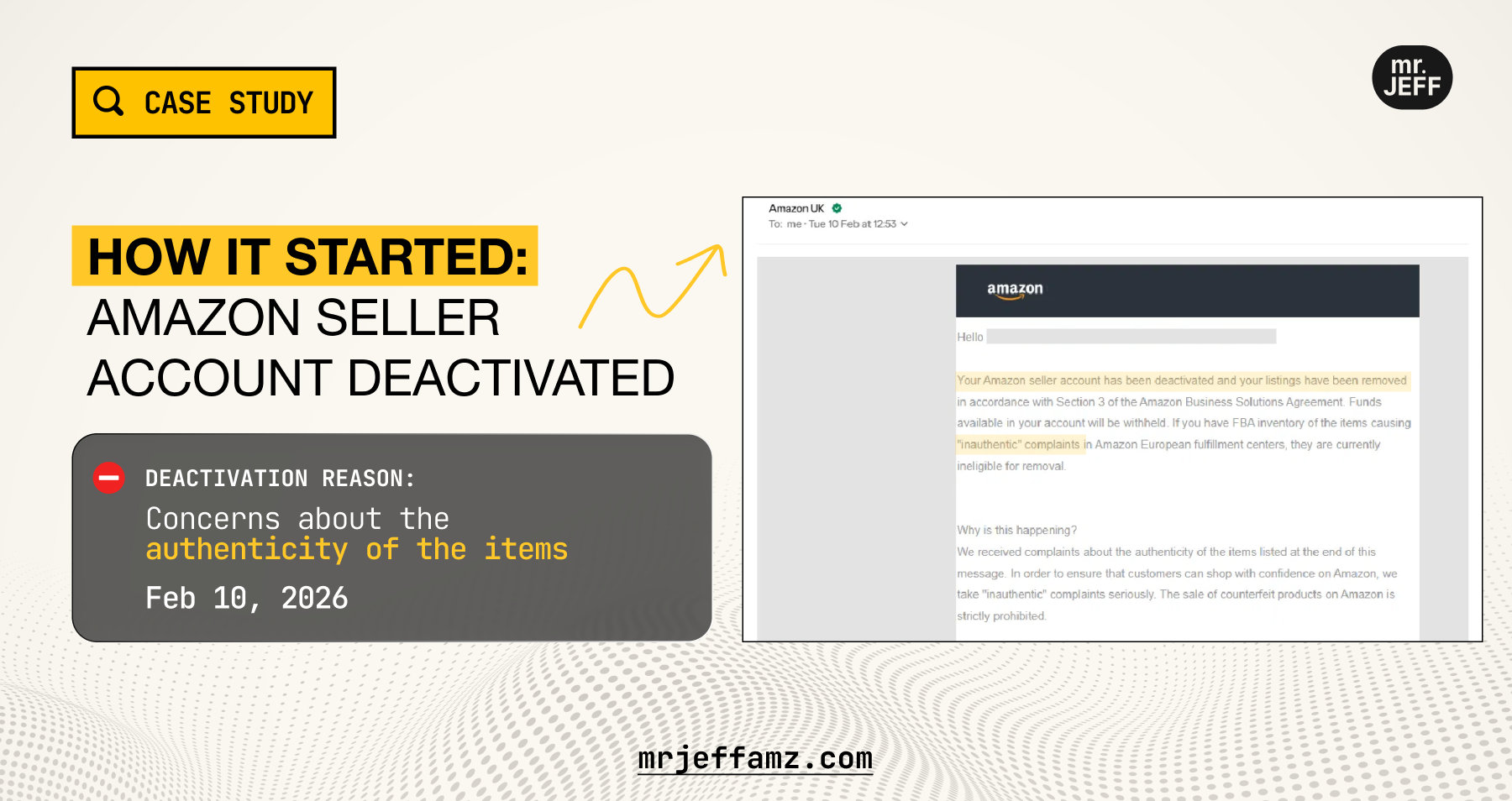
On February 10, 2026, Kyle received a deactivation notice from Amazon UK stating:
“Your Amazon seller account has been deactivated and your listings have been removed in accordance with Section 3 of the Amazon Business Solutions Agreement. Funds available in your account will be withheld.”
The notice explained that Amazon had received complaints about the authenticity of products sold through his account. It also stated that the affected FBA inventory was ineligible for removal at that time.
Kyle was selling genuine cosmetics purchased from legitimate retail sources. However, Amazon's concern was not limited to whether the products were physically authentic. The platform also needed documentation that could establish their origin and allow the supply chain to be verified.
This was the central problem.
Kyle had purchased his inventory from retailers, and the documents available from those transactions did not meet the standards Amazon expected during its authenticity investigation.
In an inauthentic product review, Amazon may require commercial invoices and supporting records that identify the supplier, buyer, products, quantities, and the origin of the inventory. Retail receipts and order confirmations often cannot establish that information to the required standard.
Kyle had already attempted to appeal, but Amazon continued rejecting his submissions.
In June 2026, he turned to Mr. Jeff AMZ, and our reinstatement team started working on his case.
🔎 Our Investigation: Why the Previous Appeals Failed
We began by reviewing everything Kyle had previously submitted to Amazon, including his appeals, purchase documentation, and supplier information, to identify what was preventing reinstatement.
Our investigation focused on 4 key areas:
Supplier verification: Assessing whether each supplier could be verified and provide acceptable documentation.
Invoice compliance: Checking purchase records against Amazon's documentation requirements.
Supply chain traceability: Determining whether the inventory could be traced back to the original manufacturers.
Appeal history: Reviewing previous submissions and Amazon's responses to identify unresolved concerns.
What We Discovered
Kyle had sourced cosmetics from multiple suppliers, including both wholesalers and retail stores. After reviewing all 12 suppliers, we found that 8 did not meet Amazon's sourcing and documentation requirements.
Those requirements are set out in Amazon's Responsible Sourcing documentation request requirements. In short, the documents you provide must demonstrate the product's full supply chain, include contact details for the suppliers and the original manufacturer so Amazon can verify them, and make it possible to trace the products back to the original manufacturer, even when you did not buy from the manufacturer directly.
This explained the repeated appeal rejections: Kyle's documentation could establish that he had purchased genuine products, but it was insufficient to verify the supply chain for much of his inventory.
Our next step was to address these sourcing and documentation gaps directly, rather than continue submitting appeals based solely on product authenticity.
Why Amazon Rejects Authenticity Appeals With Retail Receipts
One of the most common mistakes sellers make in inauthentic product cases is assuming that proof of purchase is equivalent to proof of authenticity.
Amazon evaluates the documentation behind the inventory, not just the seller's claim that the product is genuine. Retail receipts may demonstrate that a purchase occurred, but they often lack the information needed to trace products through a verifiable supply chain.
Amazon's authenticity documentation requirements may include:
Commercial invoices identifying the buyer and supplier.
Product descriptions and quantities corresponding to the inventory under review.
Supplier contact details that Amazon can independently verify.
Documentation showing the origin of the products and, where requested, their supply chain back to the manufacturer.
This is why repeatedly submitting the same retail receipts can lead to further rejections. The documents may be legitimate, but they still may not answer Amazon's verification questions.
When qualifying invoices are unavailable, the appeal must accurately explain the documentation limitations and address the underlying sourcing practices through credible corrective and preventive measures. Such an approach does not guarantee reinstatement, but it is more substantive than simply repeating that the products are authentic.
🛠 Our Reinstatement Strategy
Step 1: Building the Strongest Possible Appeal
Based on the findings of our investigation, we prepared a new appeal specifically addressing the sourcing issue.
Instead of focusing exclusively on the authenticity of the cosmetics, we developed a structured explanation of the circumstances behind the suspension and the actions required to improve the seller's compliance procedures.
The appeal covered 3 essential areas:
Root cause: Explaining the sourcing practices behind the affected inventory and why the available documentation did not adequately satisfy Amazon's verification requirements.
Corrective measures: Addressing the identified sourcing and documentation weaknesses and presenting the actions taken to resolve them.
Preventive measures: Establishing stronger supplier verification, inventory documentation, and purchasing procedures to reduce the risk of future authenticity complaints.
We also reviewed and organized an extensive package of supporting evidence to present the seller's circumstances as clearly and consistently as possible.
The challenge was to demonstrate that Kyle understood the compliance problem and had a credible approach to preventing it from recurring, without making claims that the available evidence could not support.
Expert insight: Many sellers spend their whole appeal defending the product. In a sourcing case, Amazon is not questioning the product. It is questioning where the product came from. An appeal that argues the wrong point gets rejected quickly, however well it is written.
Step 2: Seller Central Appeals
We began by appealing through Seller Central. We made a few submissions and adjusted the appeal along the way.
None of them were accepted.
Each rejection was reviewed before the next submission. Instead of resending the same document set, we adjusted the appeal and the supporting evidence each time, so that every new submission added something Amazon had not yet seen.
Why didn't the revised appeals work?
The most likely obstacle remained the original sourcing documentation. Although the appeal explained the circumstances and proposed corrective measures, it could not replace historical supplier records that were unavailable.
In Section 3 authenticity cases, Amazon may continue rejecting appeals when its reviewers cannot verify the supply chain, even if the seller provides a detailed Plan of Action. A stronger written explanation does not automatically resolve a documentation deficiency.
After several unsuccessful attempts, we determined that continuing through Seller Central alone was not producing sufficient progress. We needed to pursue additional review channels.
Step 3: Better Business Bureau Complaint
Our next step was to file a complaint through the Better Business Bureau (BBB).
We presented Amazon with the history of the suspension, the previous attempts to resolve it, and the corrective measures prepared by our team. The purpose was to obtain another review of the case outside the standard appeal submissions.
A Better Business Bureau complaint is an external escalation route. It puts the case in front of Amazon through a different channel than Seller Central, and it can take several rounds of back-and-forth before there is a result.
In this case it did not lead to reinstatement, but it was a necessary part of building the documented history of the case.
Step 5: Further Appeals and Account Health Internal Reviews
We did not stop there. We submitted more appeals through Seller Central, this time using different approaches. We updated the appeals, worked on additional evidence we could provide, and communicated with the Account Health team multiple times.
On a few occasions, managers sent our case for internal review. The account still was not reinstated.
At this stage the work became more personal to the case. Each new appeal approached the situation from a different angle, we prepared additional evidence that had not been part of earlier submissions, and we kept a record of every conversation with the Account Health team so the case history stayed consistent and complete.
Expert insight: When a manager sends a case for internal review, it means the case is being looked at beyond the first line of support. That is a good sign, but it is not a decision in your favor. The right response is to keep building the file, not to wait.
Step 6: Executive Escalation
After multiple unsuccessful Seller Central submissions and Account Health reviews, we escalated the matter through Amazon's executive channels.
Our team prepared several detailed letters explaining:
The circumstances of the Section 3 deactivation.
The documentation issues identified during our investigation.
The corrective and preventive measures presented by the seller.
The history of previous appeals and internal reviews.
The reasons the case warranted further consideration.
The purpose was to bring the complete case history to another level of review after the standard channels had failed to produce a resolution.
Step 7: The Final Account Health Escalation
This is the point where many sellers stop. We did not.
We kept working on the appeal and went back to Seller Central. We made a few more appeals, and none of them were accepted either. After some time and several more submissions and resubmissions, we made another attempt to communicate the case to the Account Health team, once again presenting it from the strongest possible position.
A manager from the Account Health team escalated our case for internal review once more. Three days later, after a few months of work, the account was finally reinstated.
What made the difference at the end was not a single new document. It was the combination of everything built over the previous months: a clear, consistent case, a detailed set of corrective and preventive measures, and a fresh, well-positioned approach to the Account Health team at the right moment.
Expert insight: Persistence only works when each attempt brings something new. Sending the same appeal a tenth time is not persistence. Rethinking the angle, strengthening the evidence and choosing the right channel is.
✅ Result: Amazon Seller Account Reinstated
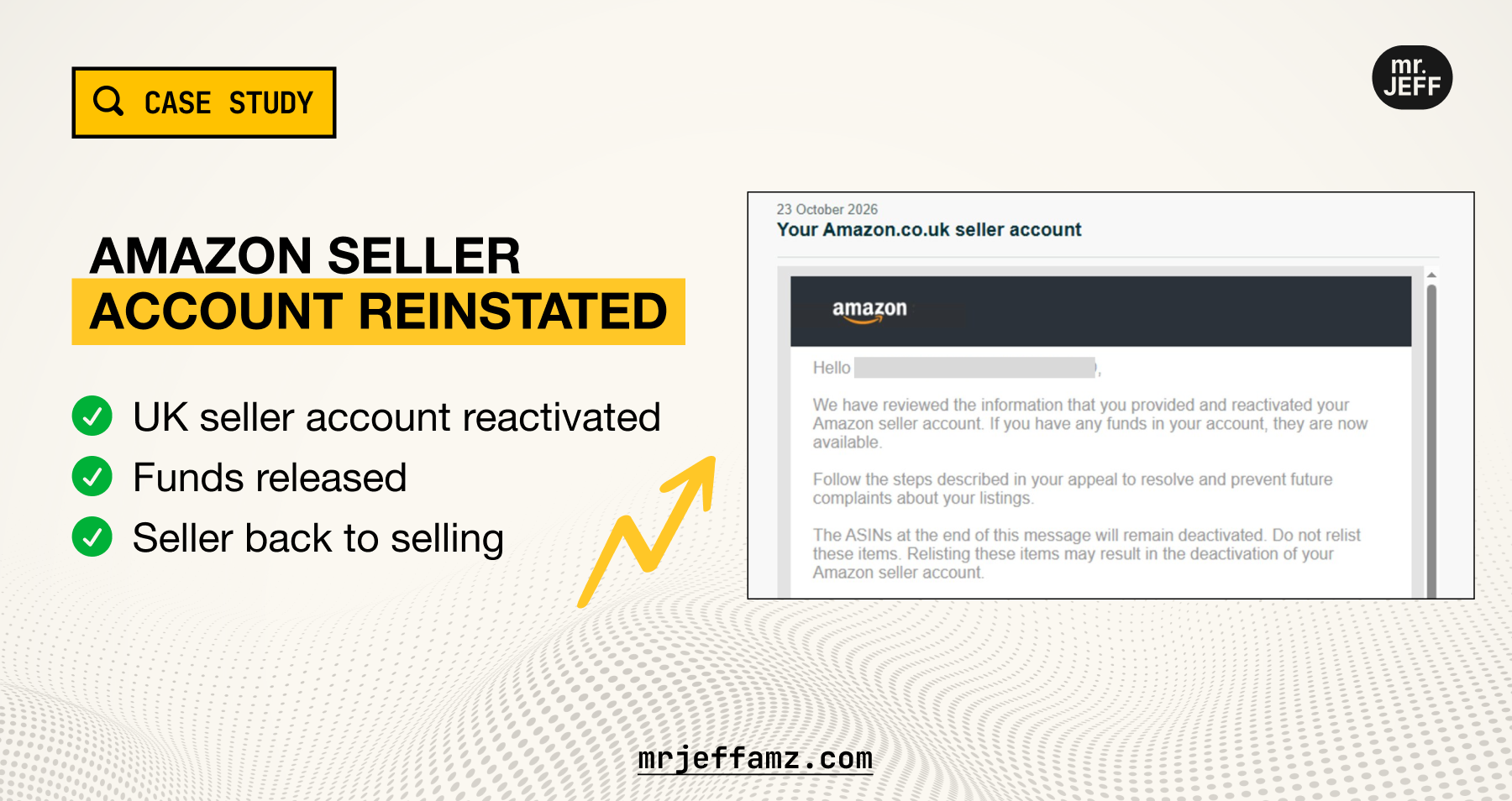
On October 24, 2026, Amazon reinstated the client's account, more than eight months after the deactivation.
The case shows what it takes when the products are real but the sourcing is the obstacle. There was no single document or single appeal that solved it. What worked was a clear understanding of Amazon's concern, a strong appeal with corrective and preventive measures, and persistence across every available channel: Seller Central, the Better Business Bureau, the Account Health team and executive escalation.
If Amazon has deactivated your account over inauthentic items and every appeal keeps coming back rejected, the problem is often not your product. It is the sourcing, the angle of the appeal, or the channel it is sent through. Our Amazon account reinstatement service can help you build the right strategy for your specific situation.
Client Feedback
After the successful reinstatement, Kyle shared his experience with Mr. Jeff AMZ in a five-star Google review.
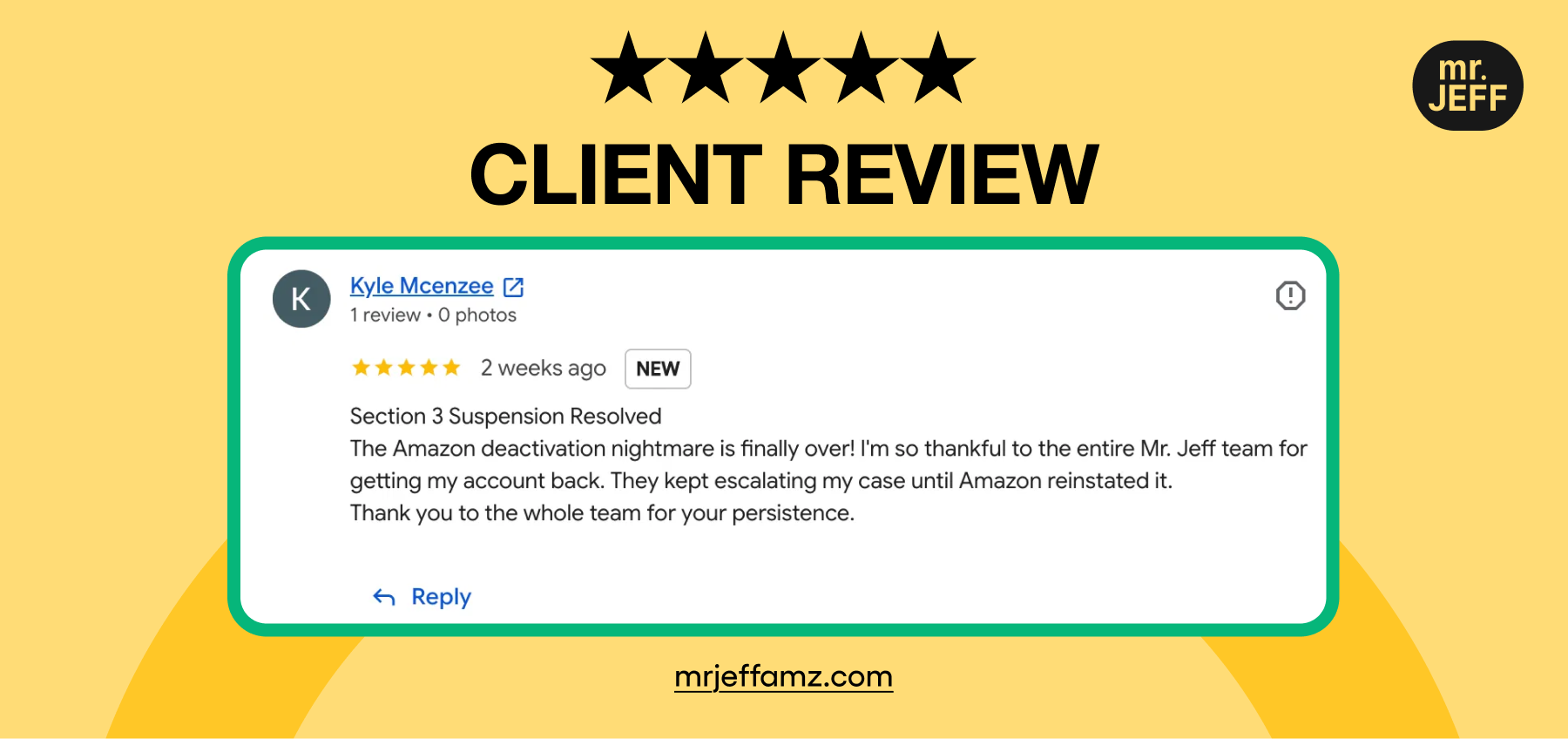
"Section 3 Suspension Resolved. The Amazon deactivation nightmare is finally over! I'm so thankful to the entire Mr. Jeff team for getting my account back. They kept escalating my case until Amazon reinstated it. Thank you to the whole team for your persistence."
— Kyle, Amazon UK Seller
📌 Need Help With Amazon Account Reinstatement?
If your Amazon seller account has been deactivated for an Inauthentic Item Concern and your appeals keep getting rejected, reinstatement may still be possible. As this case demonstrates, a well-prepared appeal combined with a strategic escalation process can make the difference.
At Mr. Jeff AMZ, we specialize in reinstating suspended Amazon seller accounts, including complex Section 3 cases and accounts with multiple rejected appeals. Our team has helped 650+ Amazon sellers regain access to their accounts and return to selling.
Here's what you can expect when working with Mr. Jeff AMZ:
Insider Expertise: Our team includes former Amazon employees and experienced sellers who understand Amazon's policies, appeal requirements, and reinstatement procedures.
Custom Reinstatement Strategy: No generic templates. Every appeal is tailored to your suspension reason, account history, and supporting evidence.
Multi-Level Escalation: When standard appeals aren't enough, we pursue additional channels, including Account Health, BBB complaints, and executive-level escalation.
Unlimited Appeal Revisions: We continue refining and resubmitting your appeal as needed throughout the reinstatement process, without additional revision fees.
Dedicated Case Manager: A personal reinstatement specialist manages your case and guides you through each stage.
Honest Case Assessment: We evaluate your chances before starting and explain the challenges involved. No unrealistic guarantees.
💬 Get a Free Expert Case Review
Don't let repeated appeal rejections keep your Amazon business on hold.
Submit your case for a free expert consultation. Our team will review your suspension, identify what's preventing reinstatement, and recommend the most effective next steps for your situation.
Let's get your Amazon business back on track!

Author
Rick
Senior Reinstatement Consultant at Mr. Jeff AMZ
Rick is a Senior Reinstatement Consultant at Mr. Jeff AMZ with 6 years of experience appealing Amazon suspensions. He specializes in solving complex Amazon issues like Section 3, IP, and review-related enforcement, helping sellers recover deactivated accounts. His superpower is knowing Amazon's policies better than most Amazon reviewers do and building a compelling, watertight case for any position.
Connect on LinkedInFrequently Asked Questions
What is an Amazon Section 3 inauthentic suspension?
A Section 3 suspension occurs when Amazon deactivates a seller's account under Section 3 of the Amazon Business Solutions Agreement due to concerns about product authenticity. Even if your products are genuine, Amazon may suspend your account if they cannot verify the supply chain or if your documentation fails to meet their verification requirements.
Why do retail invoices often get rejected in Amazon authenticity appeals?
Retail receipts and order confirmations typically lack the detailed information Amazon requires during an authenticity investigation. Amazon expects commercial invoices that clearly identify the supplier, buyer, product details, quantities, and the origin of inventory. Retail receipts often cannot establish this supply chain information to Amazon's required standard.
Can I sell genuine products on Amazon using retail arbitrage or retail sourcing?
While selling genuine products through retail sourcing is technically possible, it carries significant risk. If Amazon questions your product authenticity, retail receipts may not meet their documentation requirements, potentially leading to account suspension—even when your products are 100% authentic.
What is a Multi-Level Escalation Strategy for Amazon reinstatement?
A Multi-Level Escalation Strategy involves pursuing reinstatement through multiple channels simultaneously, including:
- Seller Central appeals
- Direct communication with Amazon's Account Health Team
- Better Business Bureau (BBB) complaints
- Executive-Level Escalation
This approach increases the chances of reaching a decision-maker who can properly review your case.
How long does it take to get reinstated after an Amazon Section 3 suspension?
Reinstatement timelines vary significantly based on case complexity. In this case study, the seller's account was suspended for more than eight months before successful reinstatement. Cases involving retail sourcing and multiple rejected appeals typically require extensive documentation work and multiple escalation attempts.
What documentation does Amazon require to verify product authenticity?
Amazon typically requires commercial invoices that include: supplier business information, buyer details, product names and quantities, invoice dates, and evidence of a verifiable supply chain. Supporting records may also include letters of authorization from brands or distributors and proof of supplier legitimacy.
What should I do if Amazon keeps rejecting my appeal for an inauthentic suspension?
If your appeals are repeatedly rejected, you should: review your documentation to identify gaps, consider whether your suppliers can provide stronger verification documents, and explore escalation options beyond Seller Central. Many sellers benefit from working with experienced reinstatement professionals who understand Amazon's verification requirements and escalation pathways.