
Amazon Tips
Rising Counterfeit Suspensions on Amazon: Why They Happen and How to Reinstate Your Account
April 1, 2026
Key Takeaways
- Amazon counterfeit suspensions can escalate from a single complaint to account-level deactivation, frozen inventory, withheld funds, and Section 3 enforcement without test-buy verification.
- Counterfeit allegations are more severe than standard IP complaints because they suggest falsely branded products, triggering full account trust reviews instead of single-listing enforcement.
- Rising counterfeit suspensions stem from Amazon's AI-driven proactive enforcement, stronger Brand Registry tools, and stricter supply-chain documentation standards across wholesale and resale categories.
- Successful counterfeit reinstatement appeals require proving sourcing authenticity with invoices and purchase orders, or removing risky ASINs and demonstrating preventive controls if documentation is weak.
- Amazon can suspend sellers for counterfeit concerns before completing authenticity investigations, prioritizing marketplace protection and requiring sellers to prove account safety for reinstatement.
Amazon counterfeit suspensions are becoming a bigger risk for established sellers, especially in wholesale, online arbitrage, branded resale, and distribution-sensitive categories. What often starts as a counterfeit claim can quickly escalate into a much more serious problem: listing removals, ASIN restrictions, frozen inventory, withheld funds, Section 3 enforcement, and full account suspension.
That is why sellers should not treat counterfeit-related enforcement like a routine listing issue. Once Amazon sees a potential authenticity risk, the focus shifts from one product to the overall safety of the account. At that point, the real problem is no longer just the complaint itself. It is Amazon’s loss of trust in the seller’s sourcing controls, documentation, and compliance process. For that reason, a counterfeit suspension requires a structured reinstatement strategy from the very beginning.

Counterfeit Goods Allegations on Amazon
A counterfeit allegation on Amazon is one of the most serious complaints a seller can face. It means a brand or rights owner is claiming that you are selling goods that unlawfully use their protected intellectual property and are being presented as genuine branded products. Unlike a standard IP complaint, a counterfeit claim goes further. It suggests not just unauthorized use, but imitation of a brand’s identity itself.
That is why Amazon treats counterfeit complaints so aggressively. From Amazon’s perspective, these cases create legal, reputational, and marketplace-trust risk. If Amazon believes a seller may be offering counterfeit goods, it may act quickly to protect buyers and reduce its own exposure. In practice, this can lead to listing removals, ASIN-level restrictions, account suspensions, frozen inventory, and withheld disbursements. In many cases, Amazon will enforce first and expect the seller to prove later why the account is safe to restore.
Why Counterfeit Suspensions Are So Severe
Counterfeit suspensions are more severe than many other Amazon enforcement actions because they go directly to product authenticity and buyer trust. A standard intellectual property issue may sometimes stay limited to one listing. A counterfeit suspension can expand into a full account-level review.
That is also why these cases are often harder to reverse. Amazon is not simply asking whether one ASIN should remain active. It is asking whether the seller account itself is safe to keep on the marketplace. Once the case reaches that stage, a generic appeal is rarely enough.
False Counterfeit Allegations Can Still Lead to Suspension
Not every counterfeit suspension means the product is actually fake. In some cases, brands use Amazon’s reporting tools aggressively to remove independent sellers from a listing, limit unauthorized distribution, or pressure resellers out of a product space. This is especially risky for sellers working with branded inventory, where the goods may be authentic but the supply chain is not documented clearly enough to satisfy Amazon.
That is an important point: being suspended over counterfeit concerns does not automatically mean you are guilty of selling fake products. It means Amazon sees a trust and authenticity issue and now expects the seller to prove that the account is safe to restore.
Can Amazon suspend you without a test buy?
Yes. Unfortunately, Amazon can suspend a seller before a test buy is completed or before product authenticity is fully verified. Because Amazon’s enforcement systems are designed to prioritize buyer trust and brand protection, sellers may face immediate action based on the complaint itself, even while the underlying facts are still unclear.
This is one of the main reasons counterfeit suspensions are so difficult. Sellers often expect Amazon to investigate fully before taking action, but that is not always how enforcement works in practice. By the time the seller begins responding, the account may already be under a full trust review. That is why the first appeal strategy matters so much. A weak or generic response can make the case harder to reverse, while a structured, evidence-based appeal can significantly improve the chances of reinstatement.
Why Counterfeit Suspensions Are Rising on Amazon
Counterfeit suspensions are rising on Amazon because the marketplace has become far more aggressive in how it detects, reviews, and enforces authenticity risk. Amazon has invested heavily in brand protection, proactive enforcement, and anti-counterfeit systems. As a result, more listings and seller accounts are being flagged earlier in the enforcement cycle.
The most likely reasons include:
Amazon is using stricter proactive enforcement.
Amazon now relies heavily on automated detection, AI-driven monitoring, and proactive blocking systems. As enforcement becomes broader and faster, more sellers get pulled into counterfeit and authenticity-related suspension reviews.Brands have stronger reporting tools.
Through Amazon’s infringement-reporting systems and Brand Registry ecosystem, rights owners can report suspected violations more efficiently than before. The easier it becomes for brands to file complaints, the more sellers face counterfeit-related account risk.More brands are using Amazon Transparency and similar anti-counterfeit controls.
These programs raise the standard for sellers offering branded goods. If the product origin, serialization, or documentation is unclear, the risk of suspension increases.Amazon acts faster, often before a full authenticity review is completed.
In today’s enforcement environment, Amazon often prioritizes marketplace protection first. That means sellers may face listing restrictions or account-level action before all facts are fully verified. This makes counterfeit claims feel more common and more severe.Weak documentation triggers more authenticity concerns.
Many counterfeit-related issues do not start with obviously fake goods. They start with incomplete invoices, inconsistent business records, unclear distributor chains, missing purchase orders, or poor-quality document scans. When Amazon cannot clearly verify the supply chain, the account may be treated as high-risk.Unauthorized resale disputes are increasingly framed as counterfeit risk.
Even when goods are genuine, sellers may still face counterfeit-related enforcement if they cannot prove a clean and traceable sourcing path.Amazon is under pressure to show tough anti-counterfeit action.
Amazon publicly emphasizes lawsuits, criminal referrals, and large-scale anti-counterfeit operations. That pressure pushes the platform toward faster and stricter enforcement, which increases the number of counterfeit-related actions affecting third-party sellers.
In practice, counterfeit suspensions are rising not because every case involves fake products, but because Amazon’s enforcement systems are stricter, brands have more tools, and sellers are being held to a higher proof standard when it comes to sourcing and authenticity.
Why counterfeit claims are more serious than standard IP complaints
A counterfeit allegation is more severe than a typical intellectual property complaint because it suggests the product is not just unauthorized, but falsely presented as a genuine branded item. That creates a higher level of legal and marketplace risk. Recent industry analysis notes that Amazon can respond very aggressively to these complaints because they go directly to buyer trust and product authenticity. ([source article provided by user])
For sellers, this distinction matters. A standard IP issue may sometimes stay at the listing level. A counterfeit complaint can easily expand into an account-level trust review. That is why sellers often see a much stronger enforcement response, including Section 3 deactivation, inventory restrictions, or disbursement holds.
What Amazon Usually Reviews in a Counterfeit Suspension
In most counterfeit suspension cases, Amazon is looking at a combination of authenticity risk and seller-control risk. That usually includes questions like these:
Can the seller prove where the goods came from?
Do the invoices clearly connect to the products under review?
Does the business information match across the account and supporting documents?
Is there a traceable and credible supply chain?
Has the seller shown real preventive controls?
This is why many counterfeit suspension appeals fail. Sellers often focus only on saying the goods are real. Amazon, however, wants to understand why the suspension happened, what the seller has already fixed, and what controls now exist to prevent the same problem from happening again.
How to Appeal an Amazon Counterfeit Suspension
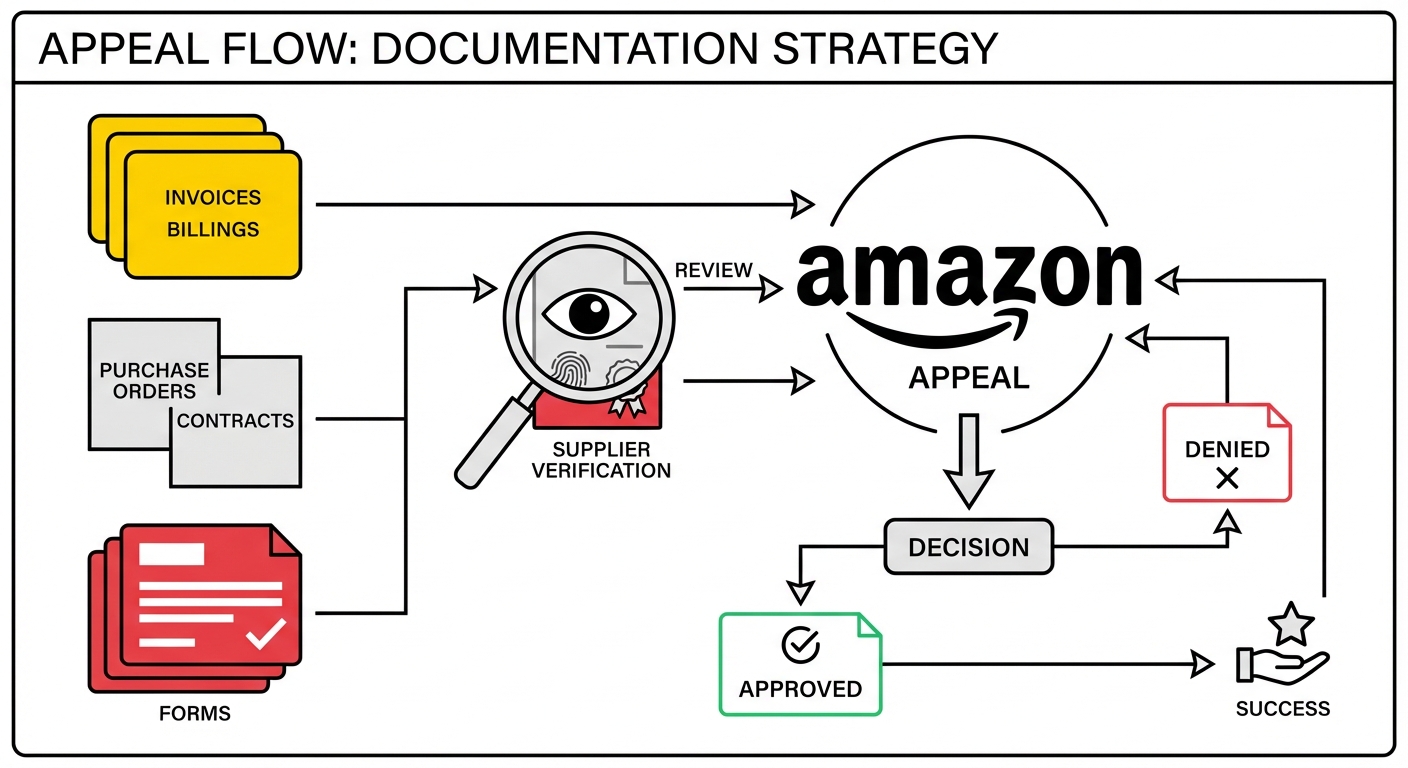
When appealing an Amazon counterfeit suspension, sellers usually face two scenarios: either the allegation is false, or Amazon may view the complaint as at least partially valid. The right reinstatement strategy depends on which situation applies to your account. In both cases, however, Amazon will usually expect the same foundation: a clear record of your supply chain, supporting purchase orders or invoices, and a well-structured Plan of Action explaining the root cause, corrective actions, and preventive measures.
1. The allegation is false, and authenticity can be proven
This is the best-case scenario, but it still requires a structured response. If your goods are authentic and your supply chain is legitimate, the goal is to prove that clearly and fast.
That usually means:
collecting invoices and purchase orders tied to the affected ASINs
showing supplier identity and contact information
proving the chain of custody from supplier to sale
checking that all business details align across documents
building a strong Plan of Action around the real root cause
contacting the complainant carefully if a retraction is realistic
In false-allegation cases, a retraction from the complainant can sometimes be one of the fastest ways to support reinstatement. But even with a retraction, the appeal still needs to show Amazon why the account should now be trusted again.
2. Authenticity cannot be fully proven
This is the harder path, but it is not always hopeless. In some cases, the stronger strategy is not to force an authenticity defense that your documents cannot support. Instead, it may be better to remove the affected listings, stop sourcing the risky products, and position the appeal around risk removal, account cleanup, and prevention.
That approach is often more effective than submitting weak invoices and repeating the same explanation. Amazon cares about future marketplace safety. If you can show that the risk has been removed and that stronger sourcing controls are now in place, reinstatement may still be possible.
At Mr.Jeff AMZ, this is one of the most important points we explain to sellers: not every counterfeit suspension should be appealed with the same narrative. The right strategy depends on the strength of the proof and the real reason Amazon no longer trusts the account.
What matters most in both scenarios
Whether the claim is false or partially valid, Amazon will usually focus on the same question: Is this seller now safe to keep on the marketplace?
That is why a strong counterfeit suspension appeal should not only defend the past. It should also explain how the issue was investigated, what was corrected, and what preventive steps now exist to stop similar problems in the future.
At Mr.Jeff AMZ, we approach counterfeit suspensions by first identifying which path the case truly belongs to. A false allegation requires one strategy. A weak-authenticity case requires another. One of the biggest mistakes sellers make is using the same appeal structure for both.
What Amazon usually expects in a successful reinstatement appeal
A strong counterfeit-related appeal usually needs four elements.
Clear evidence of sourcing and authenticity
Amazon wants invoices, purchase orders, supplier details, and any supporting records that connect directly to the products under review.
A real root-cause analysis
You need to explain why the complaint happened. Weak supplier vetting, incomplete records, branded products from hard-to-verify channels, invoice mismatches, and listing-level documentation gaps are all common root causes.
Corrective actions already taken
This may include removing risky ASINs, auditing all branded listings, reviewing suppliers, stopping certain sourcing methods, or cleaning up account-level documentation.
Preventive measures for the future
Amazon wants to see that your account will not return with the same problem. That can include approved-supplier rules, invoice-verification SOPs, brand-risk screening, ASIN-level compliance checks, and stronger internal recordkeeping.
This is where many appeals break down. Sellers submit documents without strategy, or strategy without evidence.
Common mistakes that make counterfeit suspensions worse
In our reinstatement work, we repeatedly see the same appeal errors:
sending a generic POA that could apply to any suspension
submitting incomplete or mismatched invoices
focusing on emotions instead of risk removal
repeating “my products are authentic” without proving it
contacting the complainant too aggressively
leaving other risky branded ASINs active during the review
using AI-generated appeal language that sounds templated and weak
A counterfeit suspension is not just a writing problem. It is a compliance and trust problem. Amazon needs a reason to restore confidence in the account.
Case Studies: Amazon Account Reinstatement by Mr.Jeff AMZ
Many counterfeit suspensions we handle are not always about fake products. In practice, they are often tied to inauthentic product complaints, where Amazon cannot clearly verify the supply chain. From Amazon’s perspective, both scenarios carry the same risk: the platform cannot trust the authenticity of the inventory. Below are two real case examples that reflect how these issues develop and how they can be resolved with the right strategy.
Case 1: Inauthentic Product Suspension for an ASIN with No Sales
The seller’s Amazon account was suspended due to an inauthentic product complaint, even though the flagged ASIN had no sales history. Amazon still required invoices and proof of authenticity for the product, creating confusion for the seller.
Core Issue:
The root problem was not product authenticity, but Amazon’s inability to verify the supply chain:
the seller did not have direct invoices for the flagged ASIN
documentation did not clearly connect to the product under review
Amazon continued requesting proof for a product that had never been sold
previous responses did not address how Amazon evaluates authenticity across related listings
What We Did:
We approached the case strategically, focusing on Amazon’s internal logic rather than the seller’s assumptions:
identified that Amazon could accept invoices from related ASINs of the same brand with actual sales
rebuilt the documentation strategy around verifiable sales history and supplier proof
clarified the supply chain across the brand, not just a single listing
restructured the Plan of Action to explain the real root cause: documentation gaps and misunderstanding of requirements
aligned the appeal with Amazon’s expectations for authenticity verification
Result:
After submitting a structured, evidence-based appeal, the seller’s account was successfully reinstated.
This case highlights an important insight: Amazon may request proof of authenticity even for products that were never sold and the key is understanding how to present valid alternative evidence.
👉 Read the full case study
Case 2: Inauthentic Suspension Reinstated Using a 3-Level Escalation Strategy
The seller’s Amazon account was suspended due to an inauthentic product complaint, which escalated into a broader account-level risk. Despite multiple appeal attempts, the seller was stuck in a rejection loop, with Amazon repeatedly requesting additional documentation.
Core Issue:
The problem was not necessarily product authenticity, but lack of clear and consistent supply chain verification:
invoices did not fully match Amazon’s expectations
documentation lacked clarity and traceability
previous appeals were too generic and did not address the real root cause
What We Did:
We approached the case as a full compliance investigation rather than a simple appeal:
conducted a full audit of the seller’s documentation and ASIN-level risks
identified gaps in supplier verification and invoice structure
removed high-risk listings to reduce account-level exposure
rebuilt the Plan of Action with a clear focus on root cause, corrective actions, and prevention
aligned the appeal with Amazon’s internal review logic
Result:
After restructuring the case and submitting a targeted, evidence-based appeal, the seller’s account was successfully reinstated.
👉 Read the full case study
Need Help With Your Amazon Account Suspension?
If your Amazon seller account has been suspended, it's important to approach the Amazon account reinstatement process strategically.
Whether the issue involves inauthentic product claims, identity verification failure, policy violations, related accounts, dropshipping violations, or intellectual property complaints, submitting the wrong appeal can lead to repeated rejections and long delays.
At Mr. Jeff AMZ, our specialists have helped reinstate hundreds of Amazon seller accounts by preparing strong, Amazon-compliant appeals and guiding sellers through the entire Amazon account reinstatement process — from case investigation and documentation review to structured communication with Amazon's Seller Performance and Account Health teams.
📌 Get a Free Expert Case Review
If your Amazon seller account has been suspended, don't risk getting stuck in an endless appeal rejection loop.
Request a Free Expert Case Review, and our reinstatement specialists will analyze your suspension case and prepare a professional strategy to restore your Amazon selling privileges as quickly and safely as possible.
How it works:
Fill out the form on our website.
Tell us about your Amazon suspension case.
Get a personal consultation with an Amazon reinstatement expert.
Explore our other case studies to see more real examples of successful Amazon seller account reinstatements.
👉 More Case Studies
— The Mr. Jeff AMZ Team

Author
Helen
Head of Client Success at Mr. Jeff AMZ
Helen leads Sales & Client Success at Mr. Jeff AMZ, guiding Amazon sellers from their first suspension panic to a fully recovered account. With years of frontline experience managing reinstatement cases, she translates Amazon's dense policy language into clear, actionable next steps and keeps sellers informed at every stage of the appeal.
Connect on LinkedInFrequently Asked Questions
What exactly is a counterfeit suspension on Amazon and how is it different from other IP complaints?
A counterfeit suspension occurs when a brand claims you're selling fake goods that unlawfully use their intellectual property. Unlike standard IP complaints, counterfeit allegations suggest you're imitating the brand's identity itself, not just unauthorized use. This makes Amazon treat these cases much more aggressively, often leading to account-level reviews rather than just listing removals.
Can I get a counterfeit suspension even if my products are genuine?
Yes, false counterfeit allegations are common, especially when brands aggressively use Amazon's reporting tools to remove unauthorized sellers or limit distribution. Even with authentic products, you can face suspension if your supply chain documentation isn't clear or if brands want to control who sells their products on Amazon.
What immediate consequences can I expect from a counterfeit suspension?
Counterfeit suspensions can quickly escalate beyond a single listing issue. You may face:
- Listing removals and ASIN restrictions
- Full account suspension
- Frozen inventory you can't access
- Withheld funds and disbursements
- Section 3 enforcement actions
Why does Amazon treat counterfeit complaints so severely compared to other violations?
Amazon views counterfeit complaints as threats to legal liability, marketplace reputation, and buyer trust. Unlike other issues that may stay limited to one listing, counterfeit cases trigger account-level reviews because Amazon questions whether your entire business is safe for their marketplace. The focus shifts from the specific complaint to your overall sourcing controls and compliance processes.
What types of sellers are most at risk for counterfeit suspensions?
Sellers in wholesale, online arbitrage, branded resale, and distribution-sensitive categories face the highest risk. These business models often involve selling branded products without direct authorization from manufacturers, making them vulnerable to counterfeit claims even when selling authentic goods.
What should I do immediately if I receive a counterfeit suspension?
Don't treat it like a routine listing issue – you need a structured reinstatement strategy from the very beginning. Generic appeals rarely work because Amazon is evaluating your entire account's safety, not just one product. Focus on proving your sourcing controls, documentation, and compliance processes are legitimate and reliable.
How does Amazon decide whether to reinstate my account after a counterfeit suspension?
Amazon evaluates whether they can trust your sourcing controls, documentation, and compliance processes. They're not just looking at whether one product is authentic – they're assessing if your entire account is safe for their marketplace. Your reinstatement strategy must address Amazon's loss of trust in your business practices, not just dispute the specific complaint.