
Case Studies
Amazon Section 3 Suspension After a Supplier Dispute: The Full Reinstatement Case Study
August 5, 2026
Key Takeaways
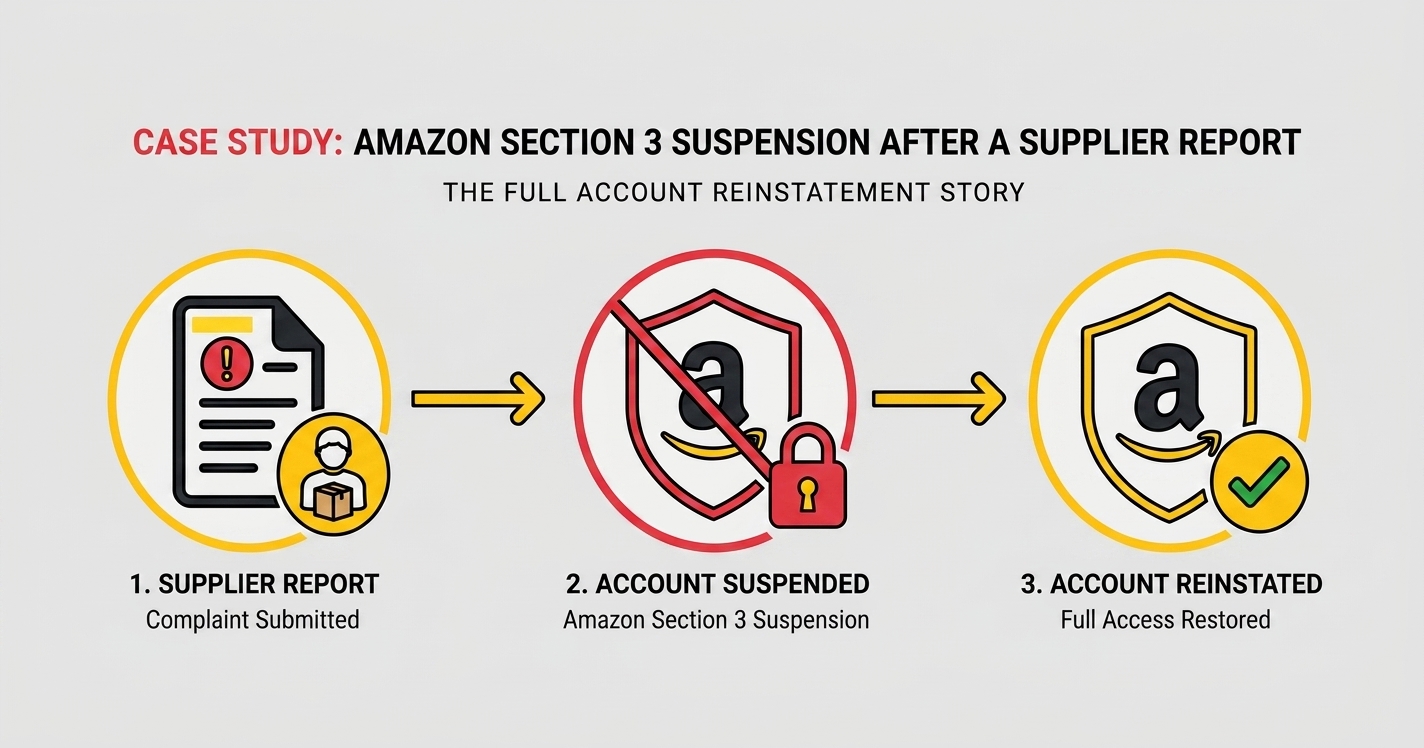
- A Canadian seller's entire Amazon account was deactivated under Section 3 after his supplier, competing on Amazon, reported his listing for authenticity violations following a supply termination.
- Creating a replacement listing during an open violation triggered a merge and full account deactivation, even though the seller acted in good faith to fix perceived content issues.
- Successful reinstatement required both authenticity documentation covering 1000+ units with invoices and safety data sheets, plus a corrective plan explaining the unauthorized listing creation.
- The account was reinstated after the third appeal submission within one month by addressing both product authenticity and the complete timeline of listing changes and supplier disputes.
- Amazon Section 3 authenticity suspensions evaluate recent account activity alongside product documentation, making timeline explanations critical even when products are genuinely authentic and properly sourced.
Imagine your supplier decides your Amazon sales are cutting into their own, and quietly reports your listing to get you out of the way. That's not a hypothetical. It's exactly what happened to John (сlient name has been changed to protect confidentiality), an Amazon.ca seller whose private label isopropyl alcohol product got caught in a dispute he didn't start and couldn't see coming.
By the time it was over, his original listing had been shut down, his good-faith replacement listing had been merged and closed, and his entire account had been deactivated under Section 3 of the Amazon Business Solutions Agreement for a product authenticity violation. In this case study, we walk through how a routine supplier disagreement turned into a full deactivation, and how we got the account back.
The Challenge
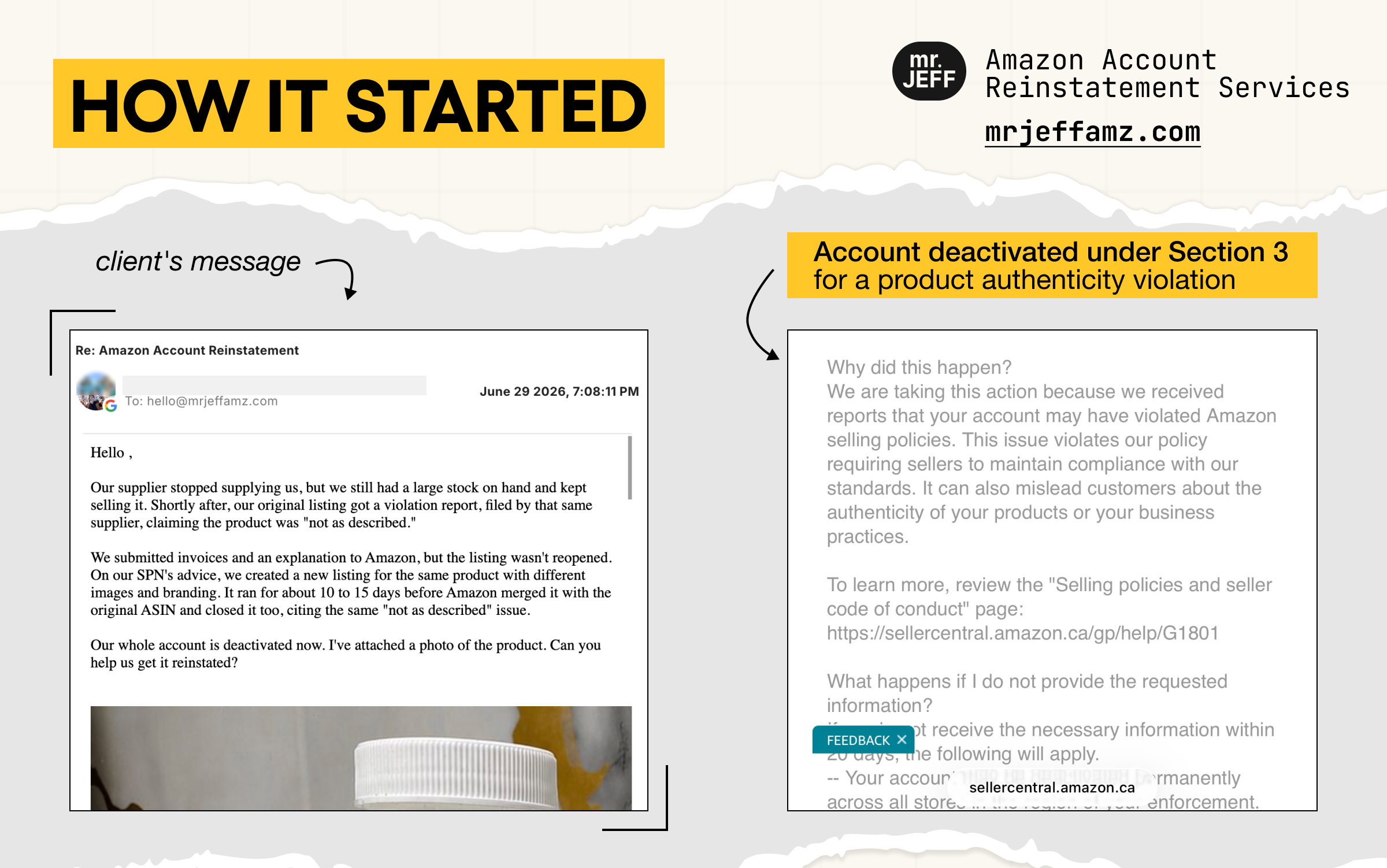
John had been sourcing his product from a Canadian supplier and manufacturer for several months. The relationship was straightforward until the supplier told him they'd no longer supply the product, because John's Amazon sales were cutting into the supplier's own listings on the platform.
Shortly after that conversation, the original listing was hit with a policy violation report, filed by that same supplier. John responded the way most sellers would: he submitted his invoices along with an explanation of the situation. Amazon didn't reinstate the listing.
Believing the real issue was a product description mismatch caused by confusion with the supplier's own similar listing, John created a new listing for the identical, genuine product, with updated images and content. It seemed like a reasonable fix for what looked like a content problem.
Amazon didn't see it that way. It merged the new ASIN into the original one and closed it roughly 10-15 days later. Not long after that, an authenticity complaint landed on the account, and this time Amazon deactivated the entire account under Section 3 of the Business Solutions Agreement, covering both ASINs.
The amazon deactivation notice didn't leave much room for interpretation:
"Why did this happen?
We are taking this action because we received reports that your account may have violated Amazon selling policies. This issue violates our policy requiring sellers to maintain compliance with our standards. It can also mislead customers about the authenticity of your products or your business practices."
John came to Mr. Jeff AMZ once the full Amazon account was deactivated.
What Is an Amazon Section 3 Authenticity Suspension
Section 3 of the Amazon Business Solutions Agreement covers seller conduct and compliance, and authenticity complaints are one of the most common reasons Amazon invokes it. When Amazon receives a report that a product may not be genuine, whether from a customer, a rights owner, or in this case a supplier, it can act on that report first and ask questions later. The account gets deactivated while the seller is left to prove, after the fact, that the products were legitimate all along.
What makes these cases hard is that the trigger is rarely the actual problem. Amazon's notice will point to an authenticity concern on specific ASINs, but it won't mention the listing merge, the supplier dispute, or any of the account activity that led up to it. A seller who only responds to the words in the notice ends up defending the product, when the account's recent history is just as much a part of what Amazon is evaluating.
By the numbers: In authenticity cases involving a supplier dispute, we consistently see the same pattern: the products are genuine and the paperwork exists, but the appeal fails because it only addresses the product and ignores the account activity, like a listing change or a merge, that likely raised the flag in the first place.
Our Investigation
We started by mapping the full timeline, not just the deactivation notice. That meant going back to the original listing, the supplier relationship, the first rejected appeal, the new listing, and the merge, in the order they actually happened.
Two problems came into focus.
First, the authenticity concern needed to be addressed head-on with proper documentation. The products were genuine — manufactured specifically for the seller, covered by invoices for over a thousand units across two recent purchase batches, supported by safety data sheets and product photographs, and sold under a legitimately registered brand name.
Second, the decision to create a new listing after the original was removed had never been properly addressed. John made that call in good faith, trying to fix what he believed was a content issue. But from Amazon's side, a new listing appearing for the same product right after a policy violation report, followed by a merge, reads as exactly the kind of pattern an authenticity review is designed to catch. That decision needed to be acknowledged and properly explained, with clear corrective measures in place to prevent any similar action in the future.
Mr. Jeff Expert Insight: When a seller creates a replacement listing while a violation is still open, even with the best intentions, we always address it head-on in the appeal. Ignoring it and hoping Amazon doesn't connect the dots almost never works. Amazon already has the timeline. The appeal needs to explain it before Amazon fills in the gaps itself.
Reinstatement Strategy
Once we understood both halves of the problem, the appeal needed to do two things at once: prove the product was genuine, and account for every decision John made along the way.
Step 1: Documenting Product Authenticity
We compiled the full authenticity package: invoices covering more than a thousand units across two purchase batches, safety data sheets, product photographs, and confirmation of the registered brand name behind the private label. This established, beyond the specific complaint, that the product itself was never the issue.
Step 2: Explaining the Supplier Dispute and the Listing Change
We laid out the full sequence for Amazon: the supplier ending the relationship over competing Amazon sales, the violation report that followed, the first appeal, and John's decision to create a new listing after concluding the issue was a content mismatch. We explained the reasoning behind that decision plainly, rather than leaving Amazon to guess at intent from the account history alone.
Step 3: Building a Corrective and Preventive Action Plan
Since the listing decision needed more than an explanation, we paired the authenticity documentation with a corrective and preventive action plan covering listing compliance procedures, supplier verification steps for any future sourcing changes, internal access controls over listing creation, and a policy review to make sure the same situation couldn't repeat itself.
Step 4: Appeal Submission
We combined both parts into a single, connected narrative: the supplier dispute, the reasoning behind the listing change, and the documentation proving the product's authenticity at every stage. Nothing was left for Amazon to piece together on its own. Then we submitted the appeal.
The Result
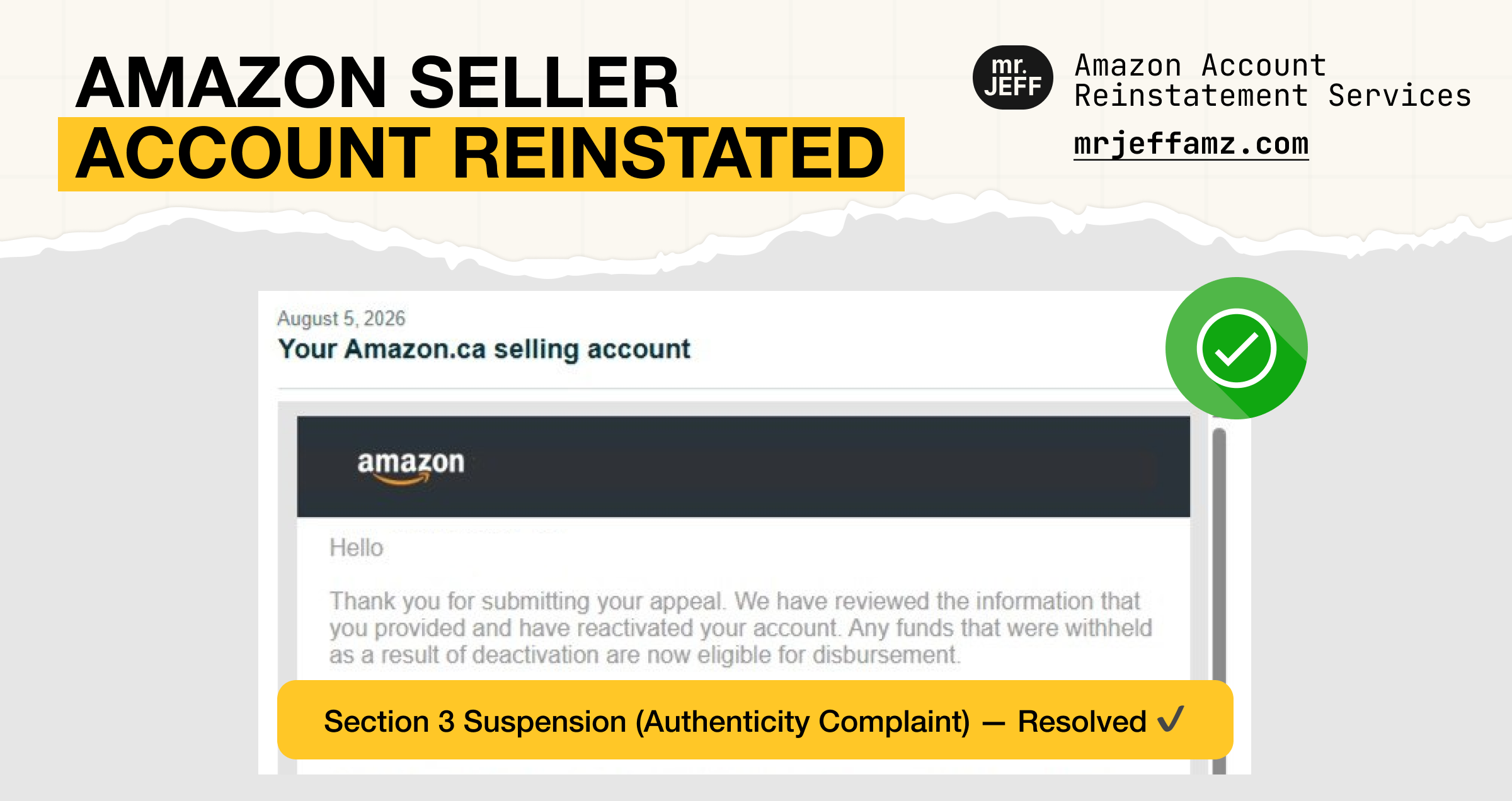
On August 5, 2026, the account was successfully reinstated after the third submission.
John's account was restored, both ASINs were reinstated, and he was back to selling.
Resolution time: 1 month.

Key Lessons for Amazon Sellers
A supplier relationship ending isn't just a sourcing problem.
When a supplier cuts you off, especially one who also sells on Amazon, treat it as a potential account risk, not just a logistics headache. Document the change and be ready to explain it if a complaint follows.
Creating a new listing during an open violation carries real risk.
It's a natural instinct to fix what looks like a content problem by starting fresh. But a new listing appearing right after a violation report, especially one that gets merged with the original, can read as evasive to Amazon even when the intent was entirely reasonable. If you're in this situation, get advice before creating a replacement listing.
Genuine products still need a documented chain of custody.
Invoices, safety data sheets, and a registered brand name are exactly what Amazon asks for in authenticity cases, but they only work if they're organized to answer the specific complaint. Scattered documentation submitted without context is easy for a reviewer to reject.
The account's recent activity is part of the case, not separate from it.
Amazon's authenticity notices talk about the product, but reviewers are also weighing what happened on the account around the same time. An appeal that only defends the product and ignores the listing history is answering half the question.
Acknowledging a mistake honestly is often stronger than avoiding it.
John's decision to create a new listing was made in good faith, but it still needed to be addressed directly, with a clear plan to prevent it from happening again. Appeals that own a decision and explain it tend to land better than ones that hope Amazon won't notice.
Need Help With Amazon Account Reinstatement?
If your Amazon seller account has been deactivated under Section 3 for a product authenticity violation, or any other policy violation, submitting the same explanation again is unlikely to change the outcome. Amazon is often weighing more than the specific complaint in the notice.
At Mr. Jeff AMZ, we specialize in reinstating suspended Amazon seller accounts, even in the most complex cases. Our team has successfully helped 650+ sellers get their accounts reinstated and return to selling.
Here's what you get when you work with Mr. Jeff AMZ:
Insider Expertise — Our specialists include ex-Amazon staff and top Amazon sellers who understand exactly how Amazon reviews appeals behind the scenes.
Custom Plans — No Templates — Every submission is built from scratch, fully tailored to your specific violation type and account history.
Unlimited Revisions — We work on your case until reinstatement. No revision limits, no hidden fees.
Dedicated 1-on-1 Support — You'll have a personal senior reinstatement manager guiding you through every step of the process.
Fast-Track for Urgent Cases — If your business is on pause and time matters, we offer priority handling for urgent reinstatement cases.
Honest Case Review — If reinstatement isn't realistically possible, we'll tell you upfront. No false promises. No wasted time.
Get a Free Expert Case Review
If your Amazon seller account has been suspended, don't spend another submission defending the product without addressing what else Amazon is looking at.
Fill out the form and get a free expert consultation with a detailed review of your Amazon suspension case.

Author
Rick
Senior Reinstatement Consultant at Mr. Jeff AMZ
Rick is a Senior Reinstatement Consultant at Mr. Jeff AMZ with 6 years of experience appealing Amazon suspensions. He specializes in solving complex Amazon issues like Section 3, IP, and review-related enforcement, helping sellers recover deactivated accounts. His superpower is knowing Amazon's policies better than most Amazon reviewers do and building a compelling, watertight case for any position.
Connect on LinkedInFrequently Asked Questions
What is a Section 3 suspension on Amazon?
A Section 3 suspension refers to account deactivation under Section 3 of the Amazon Business Solutions Agreement, which covers seller conduct and compliance. Authenticity complaints are one of the most common reasons Amazon invokes this section, and it can result in full account deactivation while sellers must prove their products were legitimate after the fact.
Can a supplier file a complaint against me on Amazon even if my products are genuine?
Yes, unfortunately suppliers can file reports against sellers even when products are authentic. In this case study, the supplier filed a policy violation report after deciding the seller's Amazon sales were competing with their own listings. Amazon often acts on these reports first and investigates later, leaving sellers to prove authenticity.
What happens if I create a new listing after Amazon closes my original one?
Creating a new listing for the same or similar product can backfire significantly. Amazon may merge the new ASIN into the original problematic listing and close both, as happened in this case. This can escalate the situation and potentially lead to full account deactivation rather than resolving the issue.
Why didn't submitting invoices to Amazon resolve the authenticity complaint?
While invoices are typically important evidence, Amazon doesn't always accept them as sufficient proof, especially when there's an active dispute with the supplier who issued them. In complex cases involving supplier conflicts, a more comprehensive appeal strategy addressing the specific circumstances is usually required.
How many submissions did it take to get the account reinstated in this case?
The Mr. Jeff AMZ Reinstatement team successfully got the account reinstated in just 3 submissions. This demonstrates that having a strategic, well-crafted appeal approach can efficiently resolve even complicated Section 3 deactivations involving supplier disputes.
What should I do if my supplier threatens to report me to Amazon?
If a supplier indicates they may report you, take immediate protective steps:
- Document all communications with the supplier
- Preserve all invoices, purchase orders, and authenticity documentation
- Consider diversifying your supply chain
- Consult with an Amazon reinstatement specialist before any account action occurs
Can I appeal an Amazon account deactivation caused by a supplier dispute?
Yes, account deactivations from supplier disputes can be successfully appealed. The key is presenting a comprehensive case that addresses Amazon's concerns about authenticity while documenting the dispute circumstances. Professional reinstatement services can significantly improve your chances by crafting strategic appeals based on experience with similar cases.