
Amazon Tips
Amazon Seller Account Suspended and Funds Frozen: What to Do in the First 72 Hours
September 29, 2026
Key Takeaways
- Amazon begins a 90-day fund hold the moment an account is suspended, not when reinstatement occurs, and uses held funds to cover refunds and claims.
- FBA inventory remains in fulfillment centers during suspension and continues accruing storage fees against the card on file or account balance.
- Amazon suspensions fall into seven distinct categories including performance, policy violation, IP, authenticity, verification, related account, and Section 3, each requiring different appeal evidence.
- A Plan of Action must identify the exact root cause tied to the specific metric or policy in the suspension notice, not general compliance statements.
- Submitting a rushed appeal in the first 48 hours before gathering evidence and identifying the suspension type often does more harm than no appeal at all.
When an Amazon seller account is suspended, several things start moving at once, and the appeal is not the most urgent one. The fund hold and the inventory bill both begin the same day the account goes dark, and what happens in the next 72 hours will either protect the reinstatement case or damage it beyond repair. Most sellers spend those three days doing exactly the wrong things: combing seller forums for reassurance, firing off an emotional appeal, calling Seller Support, or opening a second account to keep sales moving. Each of these reactions either burns time the seller cannot get back or actively weakens the appeal still to come.
This guide covers what actually happens to the account in the first 72 hours after suspension, the specific mistakes that hurt an appeal the most, and the five steps every seller should take right away. It also explains what happens to funds held on a deactivated account and how to request them back, what a correctly structured Plan of Action needs to include, and how to file the appeal itself.
By reading this guide from the Mr. Jeff AMZ reinstatement team, you can move into the Amazon appeal process with confidence, a clear plan, and a full picture of the process ahead.
What Happens to Your Account Right After Amazon Suspends You?
The moment Amazon suspends an account, sellers run into a cluster of consequences that arrive together, not one at a time: funds get held, listings go dark, and inventory sitting in fulfillment centers keeps accruing costs. Here is what to expect the moment that suspension notice lands, and why the first 72 hours matter more than the appeal itself.
What Happens to Your Amazon Account and Listings After Suspension?
An Amazon seller account suspended status removes selling privileges and deactivates listings, but it does not close the account. The account still exists in Amazon's system with its full history, positive feedback, A-to-Z claim rate, return history, policy violation record, and all prior appeal activity. If the appeal succeeds, Amazon reactivates the account and restores selling privileges.
Listings follow the same logic. They drop out of search and the Buy Box within minutes, but the catalog data is untouched. ASINs are not deleted, only suppressed, and they typically return on their own once the account is reinstated.
What sellers miss is unfulfilled orders. Any order placed before deactivation still needs fulfillment, and a locked account often cannot process it. Those orders routinely become refunds or A-to-z claims, paid directly out of the balance covered next.
What Happens to Your Funds on a Suspended Amazon Account?
As confirmed in Amazon's Seller Central fund hold policy, all pending disbursements are placed on hold at the moment of deactivation. The 90-day fund hold period begins on that date, not when the seller reads the notice, and not when reinstatement happens.
This clock runs independently of the appeal. Amazon uses the held balance to cover refunds, A-to-z claims, and chargebacks on orders placed before suspension. Fund recovery is a separate process from reinstatement, not something to think about afterward. The full mechanics, including when a disbursement request can be filed, are covered later in this guide.
What Happens to Your FBA Inventory and Storage Fees?
Amazon does not pull inventory out of its fulfillment centers just because the account is suspended. Stock stays where it was shipped, and storage fees keep charging against the card on file or the account balance, on inventory that cannot be sold.
Whether inventory can be pulled out depends on the suspension type. Performance and most policy suspensions usually allow a removal order without friction. IP and authenticity suspensions are different: Amazon routinely blocks removal on inventory it suspects may be counterfeit or non-compliant, and in the most serious cases, disposes of it rather than returning it.
Where Do You Confirm That Your Amazon Account Is Suspended?
The suspension notice itself is your starting document, and it is worth more than a quick read. Amazon's language is specific: phrases like "violation of our policies," "does not meet our performance standards," or "concerns about the authenticity of items" each point to a different suspension category, even when the notice does not spell out the exact ASIN or order involved.
Beyond the email, two places in Seller Central hold more detail:
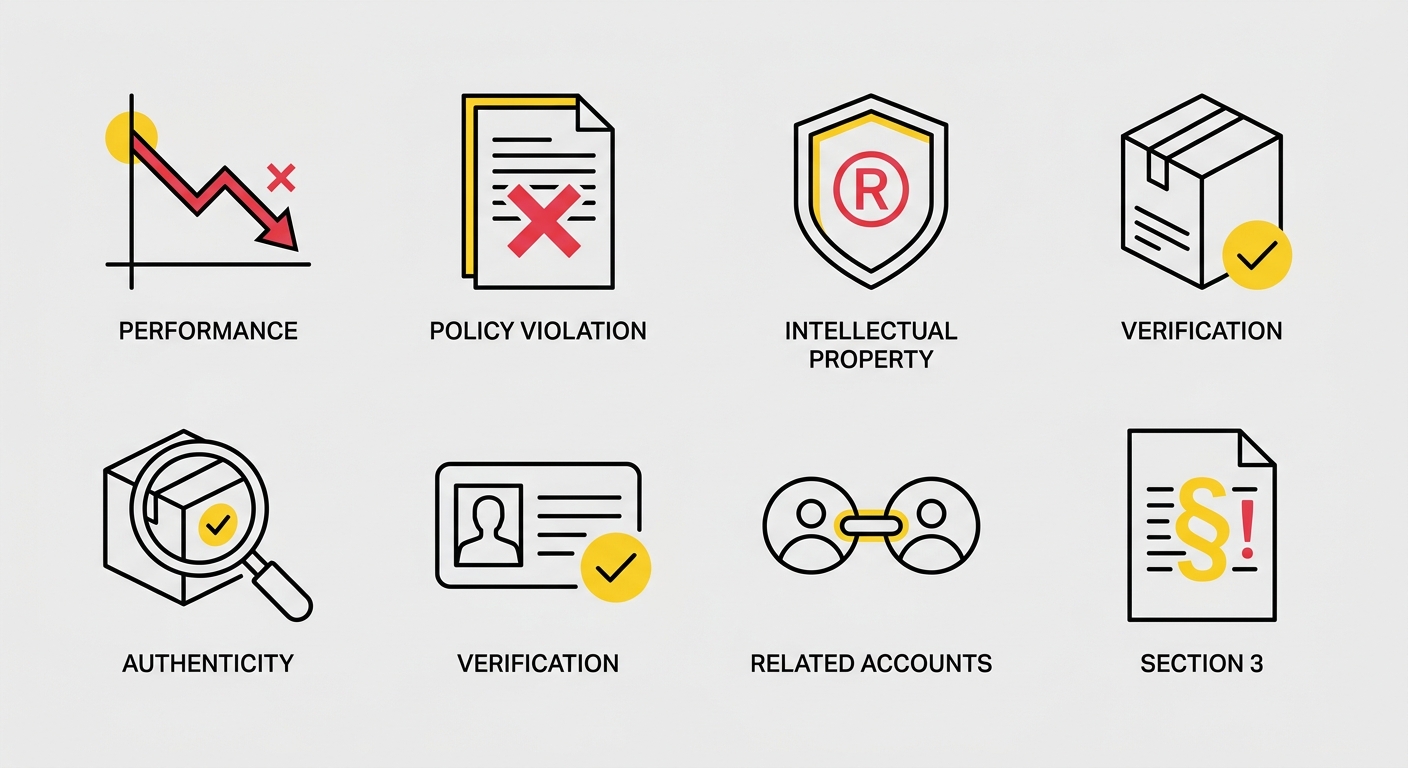
Seven distinct suspension categories, each requiring a unique appeal strategy
Account Health dashboard. This shows the specific metric or policy flag tied to the enforcement action, along with your current Account Health Rating.
Performance Notifications. This is the official record of every message Amazon has sent about your account, and it is also where most suspension-type appeals are now filed directly, through a guided template rather than a free-text box.
If the notice is genuinely vague after checking both of these, do not guess. Misreading the suspension type and appealing the wrong category is one of the most common reasons a first appeal fails outright.
Identifying Your Suspension Type Before You Write a Word
Amazon suspensions are not one category with different wording. They are seven distinct categories, and each one needs a different appeal built around different evidence. Writing the wrong appeal for the type on file is one of the most common reasons sellers stay suspended through several failed rounds. Here is how to recognize each one before drafting anything.
Amazon Performance Suspensions
The notice cites a specific metric: Order Defect Rate, late shipment rate, or valid tracking rate. This is usually the fastest category to resolve, and a strong first appeal often closes it. The evidence that matters is operational, not explanatory: records showing exactly what changed and proof the metric is back in range. A reviewer is not looking for an apology here. They are looking for a fixed number.
Amazon Policy Violation Suspensions
The notice names a specific policy: listing policy, review manipulation, ASIN creation abuse. The root cause has to match that exact policy, not policy compliance in general. An appeal that addresses the wrong policy, or speaks broadly about "following all Amazon guidelines," fails the same way a performance appeal with no metric data fails. Precision is the entire evidence requirement.
Amazon Intellectual Property (IP) Suspensions
The notice names a rights holder complaint. This is one of the few categories a standard Plan of Action cannot resolve on its own. The path forward requires either a retraction from the rights holder or evidence that the complaint itself is invalid. Everything else is preparation for one of those two outcomes, not a substitute for them.
Amazon Authenticity and Supply Chain Suspensions
The notice raises counterfeit or authenticity concerns. Verifiable supplier invoices and a clean sourcing trail are non-negotiable here, not supporting material. Funds and inventory are frequently held together in this category until the concern is resolved, which is why authenticity suspensions carry financial exposure well beyond the loss of selling privileges.
Amazon Verification Suspensions
The notice requests identity, business, or banking verification, sometimes with a video interview attached. The evidence has to match exactly: ID, business registration, and bank documents with no discrepancies across a name, an address, or a date. Even a small mismatch between documents restarts the entire review, regardless of how legitimate the underlying business is.
Amazon Related Account Suspensions
The notice alleges a connection to another Amazon account. This category is fact-intensive by nature. The appeal has to address the exact connection Amazon claims to have found, not related accounts in general, either by disputing the link directly or documenting a legitimate business reason for it.
Amazon Section 3 Deactivations
The notice cites Section 3 of the Business Solutions Agreement. This carries the highest evidentiary bar of any suspension type and the lowest reinstatement rate. Section 3 cases are reviewed by a more senior team than standard performance or policy suspensions, and a rushed or generic first appeal in this category closes doors that a stronger one would have kept open.
What to Do Immediately After an Amazon Suspension
The instinct after a deactivation email is to fix it immediately. Resist that. A rushed appeal filed in hour two, before you know your root cause or have gathered a single document, is usually worse than no appeal at all, because it is now on file alongside everything that follows. Use the first 24 hours to diagnose. Use the next 24 to build your case. Submit only when the appeal is genuinely ready.
Step 1. Identify your suspension type.
Read the notice exactly as written, more than once, before drafting anything. The specific wording determines whether this is a performance metric, a policy violation, an IP complaint, an authenticity concern, a verification hold, a related account claim, or a Section 3 deactivation, and each one needs a different appeal built around different evidence. Keep in mind that the deactivation email itself is often vague by design, and the exact trigger may not be spelled out at all.
Run the notice through Mr. Jeff AMZ's free Suspension Analyzer and get a clear breakdown in 60 seconds:
The most likely suspension root cause
A reinstatement likelihood and case complexity assessment
Next steps for getting the account back
100% free, no obligation. Analyze Your Suspension Notice
Step 2. Find the exact trigger.
Cross-check the notice against the Account Health dashboard and the Performance Notifications history. The trigger is a specific ASIN, order, metric, or policy citation, not a general area of the business. Name the wrong process here and the strongest appeal in the world still fails, because it is answering a question the reviewer never asked.
Step 3. Gather your evidence.
Pull every document connected to the identified trigger: supplier invoices, purchase orders, shipping and tracking records, product testing or authenticity certificates, and relevant communication logs. Download your full transaction and disbursement history from Seller Central now, since account data has retention limits and some records become harder to retrieve the longer an account stays deactivated.
Step 4. Build your Plan of Action.
Structure it around three sections: what happened (root cause), what you have already fixed (corrective actions, completed), and what changes permanently (preventive measures). We cover exactly what belongs in each section below.
Step 5. Submit your appeal.
Submit through the correct issue type in Account Health or Performance Notifications, not a general contact form. Attach only what supports the root cause named in the POA. One clean, complete submission outperforms three rushed ones, and unlike a rewrite, a second appeal never replaces the first. Both stay on the record, in sequence, for the reviewer to read.
Timeframes vary by suspension type. A straightforward performance suspension with a strong first appeal often moves within days. Policy, IP, and Section 3 cases run longer, sometimes considerably longer, especially during high-volume periods. There is no formal fast lane tied to revenue or urgency. A complete first submission is the fastest path available, not a fourth one sent out of frustration.
What Does a Strong Plan of Action Include?
Amazon does not reinstate accounts because a seller sounds sorry. It reinstates accounts because a document answers one question convincingly: turn this account back on, and does the same failure happen again? Every line in the POA either answers no, or it gets skipped.
Root Cause. State exactly what failed and why, tied to the specific metric or policy named in the notice. Not the supplier's fault. Not the buyer's fault. Not Amazon's fault. The reviewer is assessing an operational failure, not assigning blame.
Corrective Actions. Only what has already happened. "We removed the listing, quarantined the affected units, and corrected the sourcing documentation on [date]" reads as resolved. "We will review our process" reads as unresolved, and gets treated exactly that way.
Preventive Measures. A permanent, systemic change, not a one-time patch. Name who owns it and how often it gets checked. "We will be more careful" carries no weight. A documented weekly Account Health review with a named owner does.
Format matters as much as content. One to two pages. The three headings, used literally: Root Cause, Corrective Actions, Preventive Measures. Reviewers scan far more often than they read closely, so short factual bullets consistently outperform long paragraphs. Attach only what supports the stated root cause, and file through the correct issue type in Account Health or Performance Notifications, never a general contact form.
What Mistakes Make Reinstatement Harder?
Every one of these is understandable under the stress of a sudden deactivation. None of them help your case.
Submitting a generic appeal within the first hour. A commitment to "comply with all policies going forward" with no root cause and no completed corrective action gets denied, and now counts against you as a wasted first submission.
Filing multiple appeals back to back. Each one stays on file. A reviewer sees the full sequence, including the rushed early attempts, which makes a strong later appeal look inconsistent rather than improved.
Opening a new selling account. Amazon's systems link accounts through device data, IP addresses, banking details, and business information. A new account opened during a suspension will be detected, suspended, and linked to the original case, often producing a harder-to-appeal related account violation.
Contacting a rights holder or a buyer directly. In IP cases especially, an unsolicited message from a suspended seller can be read as pressure or harassment, and it can harden the other party's position rather than produce a retraction.
Submitting an AI-generated appeal. Seller Performance reviewers read a high volume of appeals and recognize templated or clearly machine-generated language quickly. A generic AI draft reads the same way a copy-pasted template does, and it fails for the same reason: no specific root cause, no real evidence.
Submitting fabricated or altered documents. Falsified invoices or authorization letters do not just fail. They typically end any chance of reinstatement permanently and can create legal exposure on top of it.
How Does the Amazon Fund Hold Really Work?
Reinstatement and fund recovery run on two separate clocks, and most sellers only realize this once they've already lost weeks on the wrong one. Here's what actually happens to the money.
The Fund Hold Timeline: Day 0, Day 60, Day 90
Day 0 (Deactivation): Any pending balance freezes the same day the account goes down. Not later, not once the seller notices.
Day 60: The first point a disbursement request can be filed directly, whether or not the reinstatement appeal has succeeded. Amazon shortened this from 90 days in a 2024 policy update, and most sellers never hear about the change.
Day 90: The outer edge of the standard settlement window Amazon uses to cover refunds, A-to-z claims, and chargebacks on orders placed before deactivation.
What Amazon Actually Does With the Held Balance
The money is not parked untouched. Amazon draws against it as claims come in: customer refunds, A-to-z Guarantee payouts, chargebacks on pre-suspension orders. What survives those deductions is what eventually reaches the seller's bank account.
Some of the balance may show as unavailable rather than fully withheld. The difference matters: it means Amazon is holding enough to cover a claim still in progress, not applying a blanket freeze on principle.
How to Request Your Funds Back After Day 60
Once day 60 passes, a seller can email [email protected] and open a separate investigation from the reinstatement appeal itself. Expect Amazon to ask for:
Identity documents
Financial and banking verification
Supply chain or sourcing records
In some cases, a video interview
This process runs independently of whatever is happening with the account itself.
When Amazon Can Hold Funds Indefinitely
Day 90 is not a guarantee. If the investigation turns up evidence of deceptive, fraudulent, or illegal activity, including counterfeit sales, the hold does not resolve on schedule. It continues until Amazon is satisfied, and extended waits well past the standard window are commonly reported in exactly these cases.
Does Reinstatement Automatically Release Your Money?
Not always, and this is the distinction that costs sellers the most time.
For a straightforward performance or policy suspension, the frozen balance typically releases within one to two disbursement cycles, roughly 14 to 28 days, once the account is back and the underlying risk is gone.
For anything tied to an open investigation, authenticity, fraud, or an unresolved policy concern, the balance can stay frozen even after selling privileges return. Reinstatement answers one question for Amazon. Fund release answers a different one, and the second question does not close just because the first one did.
At Mr.Jeff AMZ, fund recovery runs as part of the Account Reinstatement service once the timeline allows it, with the exact approach depending on the deactivation type.
Account Health Assurance and the 72-Hour Pre-Deactivation Window
For an account already deactivated, this explains why there was no warning, and what to watch once selling privileges are back.
Who Qualifies for Account Health Assurance
Account Health Assurance (AHA) is free, and it is not something a seller applies for. Eligibility is tied to sustained performance: an Account Health Rating of 250 or higher held for at least six consecutive months, no more than 10 days spent below that line, an active Professional selling plan, and a valid emergency contact on file. Meet the bar, and Amazon enrolls the account automatically, confirmed by email. Availability and exact thresholds can vary by marketplace, so sellers on the UK or German accounts should confirm current eligibility in Seller Central rather than assume US terms apply.
What the 72-Hour Window Requires
For an enrolled account, a new policy violation triggers outreach from an Account Health Specialist instead of an immediate deactivation. The seller gets 72 hours to respond, and the underlying issue has to be fully resolved, typically within about 10 days, not just acknowledged. An account already sitting deactivated when this article is being read either did not meet the AHA bar at the time, or the violation fell into a category the program does not cover at all, counterfeit, fraud, and identity issues among them, which bypass the window entirely. Once reinstated, treating 250 as the real target, not 200, is what keeps this safety net in place the next time something goes wrong.
Professional Help From the Mr. Jeff AMZ Reinstatement Team
If your Amazon seller account has been deactivated and you need it back fast, professional help is not an option. It is a necessity. Mr. Jeff AMZ has reinstated more than 700 Amazon seller accounts, and that track record comes with inside knowledge of exactly how Amazon's review system works and what it actually wants to see before it reinstates.
Fast Account Recovery With a Tailored Strategy
We have worked exclusively on Amazon seller account reinstatement for more than 5 years, closing every type of deactivation, from straightforward performance suspensions to the toughest Section 3 cases. That experience shaped our 3-level escalation strategy, the one we run whenever a standard first appeal will not cut it.
Full-Service Appeal Management, From Filing to Reinstatement
We do not just write the Plan of Action. We handle preparation, submission, and escalation to Amazon's senior review teams when the standard path stalls out. We do not stop until the account is back.
Help With Fund Recovery From a Deactivated Account
Recovering funds withheld on a suspended Amazon account is part of our Reinstatement Service, not a separate job handled somewhere else.
Get a Free Expert Case Review
If your Amazon seller account has been suspended, do not waste more time on appeals that get rejected. Talk to a specialist first.
Fill out the form and get a free expert consultation, a full review of your case, and a clear path back to reinstatement.

Author
Helen
Head of Client Success at Mr. Jeff AMZ
Helen leads Sales & Client Success at Mr. Jeff AMZ, guiding Amazon sellers from their first suspension panic to a fully recovered account. With years of frontline experience managing reinstatement cases, she translates Amazon's dense policy language into clear, actionable next steps and keeps sellers informed at every stage of the appeal.
Connect on LinkedInFrequently Asked Questions
How long does Amazon hold my funds after my seller account is suspended?
Amazon places all pending disbursements on hold for 90 days starting from the date of deactivation—not when you read the notice or when reinstatement occurs. This clock runs independently of your appeal process, and Amazon uses the held balance to cover any refunds or A-to-z claims during this period.
What happens to my product listings when my Amazon account is suspended?
Your listings are suppressed, not deleted. They drop out of search and the Buy Box within minutes, but your catalog data and ASINs remain intact in Amazon's system. Once your account is reinstated, listings typically restore automatically without needing to recreate them.
What are the biggest mistakes to avoid in the first 72 hours after suspension?
The most damaging mistakes include:
- Firing off an emotional or hastily written appeal
- Repeatedly calling Seller Support for reassurance
- Opening a second account to keep sales moving
- Spending time on seller forums instead of building your case
Each of these actions either wastes critical time or actively weakens your future appeal.
What happens to unfulfilled orders when my Amazon seller account is suspended?
Any orders placed before deactivation still require fulfillment, but a locked account often cannot process them. These unfulfilled orders typically become refunds or A-to-z claims, which are paid directly out of your held balance—further reducing the funds you'll eventually recover.
Does a suspension delete my Amazon seller account permanently?
No, a suspension removes selling privileges but does not close your account. Your account remains in Amazon's system with its complete history, including positive feedback, A-to-Z claim rate, return history, policy violations, and all prior appeal activity. If your appeal succeeds, Amazon reactivates the account and restores your selling privileges.
What should a Plan of Action (POA) include to get my Amazon account reinstated?
A correctly structured Plan of Action needs to include specific elements that demonstrate you understand the root cause of the suspension and have implemented concrete corrective measures. The POA should be factual, professional, and focused on actionable steps rather than emotional appeals or blame-shifting.
What happens to my FBA inventory while my account is suspended?
Your inventory sitting in Amazon's fulfillment centers continues to accrue storage fees even while your account is suspended. The inventory bill begins the same day the account goes dark, which is why taking swift, strategic action in the first 72 hours is critical to minimizing losses.