
News
Amazon Seller Updates: 5 Changes You May Have Missed in August 2026
August 28, 2026
Key Takeaways
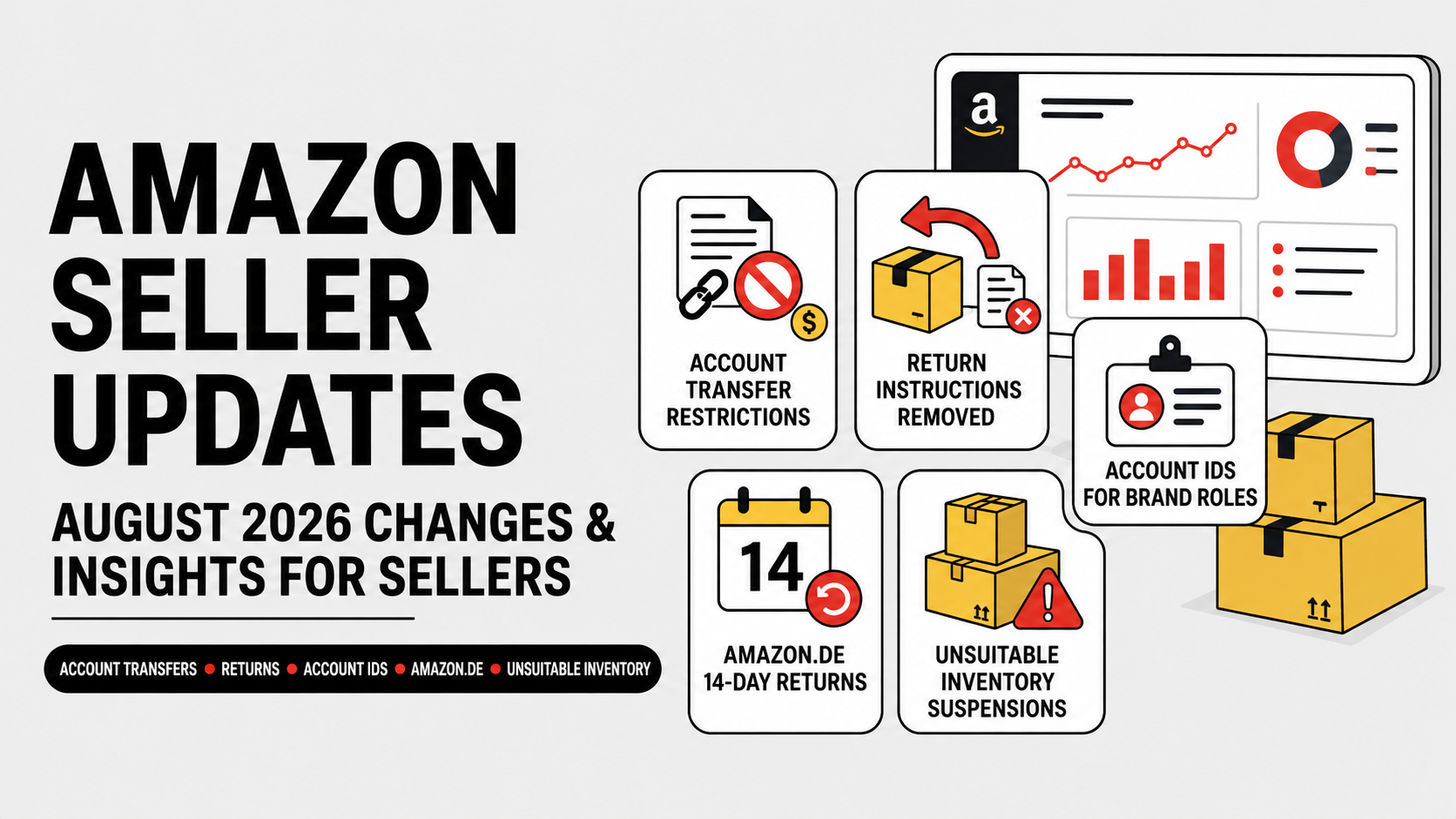
- Amazon banned pledging future Amazon payouts as loan collateral effective August 24, 2026 under its updated Business Solutions Agreement, risking suspension if violated.
- Amazon removed the custom return instructions field for FBM sellers in August 2026, eliminating a key tool to set expectations for fragile or custom items.
- Brand Registry Administrators must now use Account IDs instead of Merchant Tokens to assign selling roles, effective July 29, 2026 across all marketplaces.
- Amazon Germany reduced the return window from 30 days to 14 days for 16 categories including furniture, beauty, and pet supplies starting September 1, 2026.
- Amazon increased proactive Unsuitable Inventory audits in 2026, now requesting supply chain documentation even for products with no complaint history and rejecting retail receipts.
Amazon rarely announces everything at once. Most months, the biggest changes show up quietly in a Seller Central forum post, an email to a small group of sellers, or a single line buried in an FBM refund policy update. August 2026 followed that pattern closely. Five separate changes landed within a few weeks of each other, and each one affects a different part of how you run your account.
Here is what actually happened this month, what it means for sellers, and what to do about it before it becomes a problem. Below, you'll find the key Amazon updates you may have missed in August 2026
Amazon Revenue Pledging Faces New Restrictions Under Updated Business Seller Agreement
What Happened
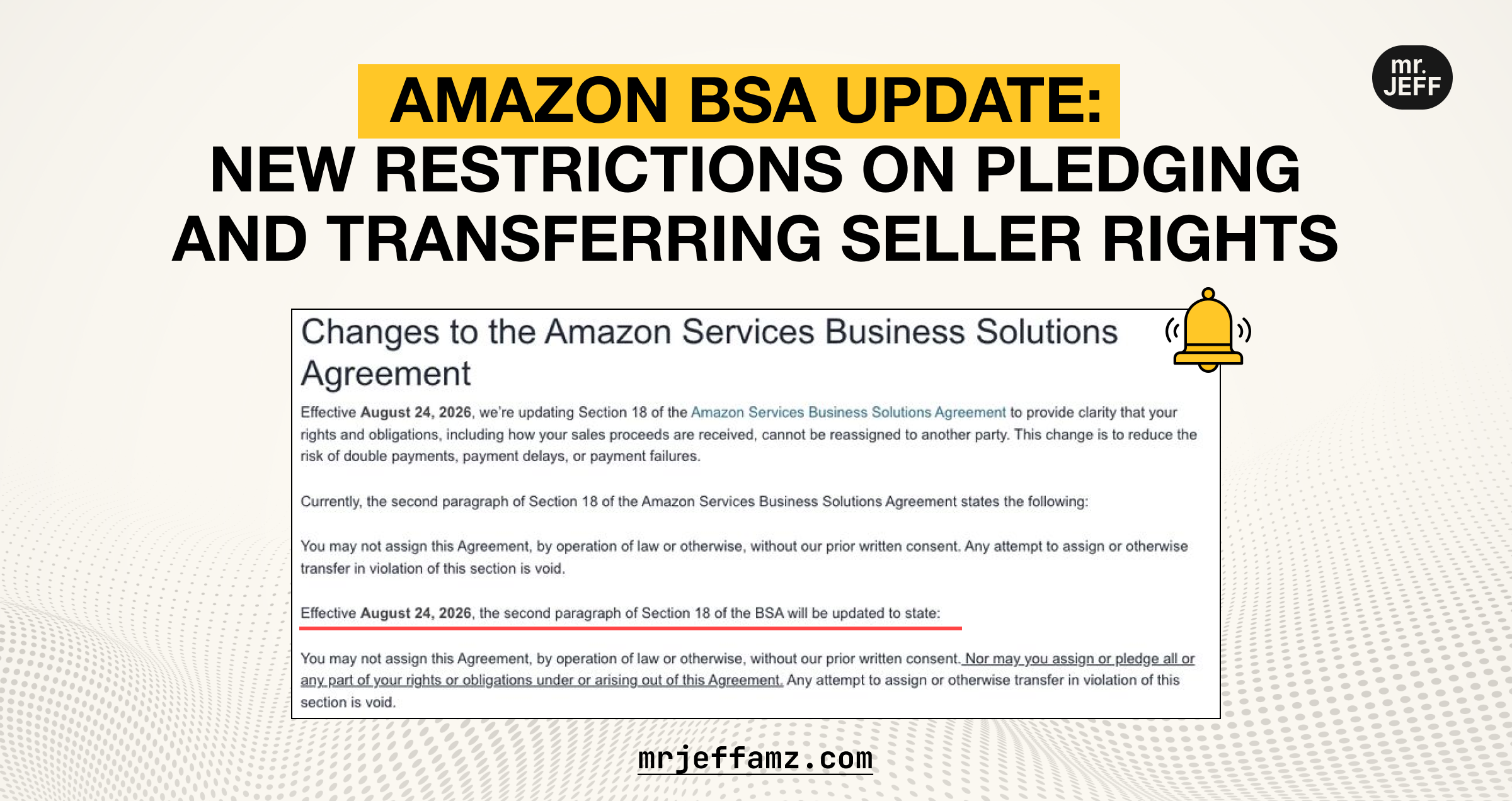
On May 29, 2026, Amazon updated its Business Solutions Agreement (BSA) to add two new restrictions, and both took effect on August 24, 2026. The first bans transferring your account, in full or in part, to someone else without going through Amazon's formal process. The second bans pledging your rights under the agreement, meaning your future Amazon payouts, as collateral for a loan.
Amazon is not auditing seller loan documents or checking UCC filings this week. The real risk shows up later, when something else forces the issue into view.
What This Means for Sellers
Not every financing deal is affected. The pledge ban only applies when a lender's security interest attaches to your Amazon payout before it reaches your bank account, typically a UCC filing listing "Amazon receivables" as collateral. Loans secured by inventory, general business assets, or funds already in your account are fine. Amazon Lending is unaffected too, since Amazon deducts those repayments directly.
The transfer ban only covers handing the account itself to someone else, through a sale, merger, or restructuring, without Amazon's sign-off. Running your account day to day is not a transfer.
The real risk is timing. A violation usually surfaces through a lender collection action, a routine account review, or a dispute over an informally sold account, and any of those can trigger a suspension or frozen balance. If that happens during Q4, the size of the balance at risk and the 90-day hold on suspended funds make it far more costly.
What To Do Now
Check your financing paperwork for language listing "Amazon receivables" or your Amazon payouts as loan collateral.
If it's structured that way, talk to your lender now about shifting collateral to inventory or other assets.
Confirm your registered account entity matches who's actually running it, under Settings, then Account Info, then Business Information.
If you transferred your account informally, open a Seller Central compliance case now to disclose it.
Amazon Removes Custom Return Instructions From Seller Central
What Happened
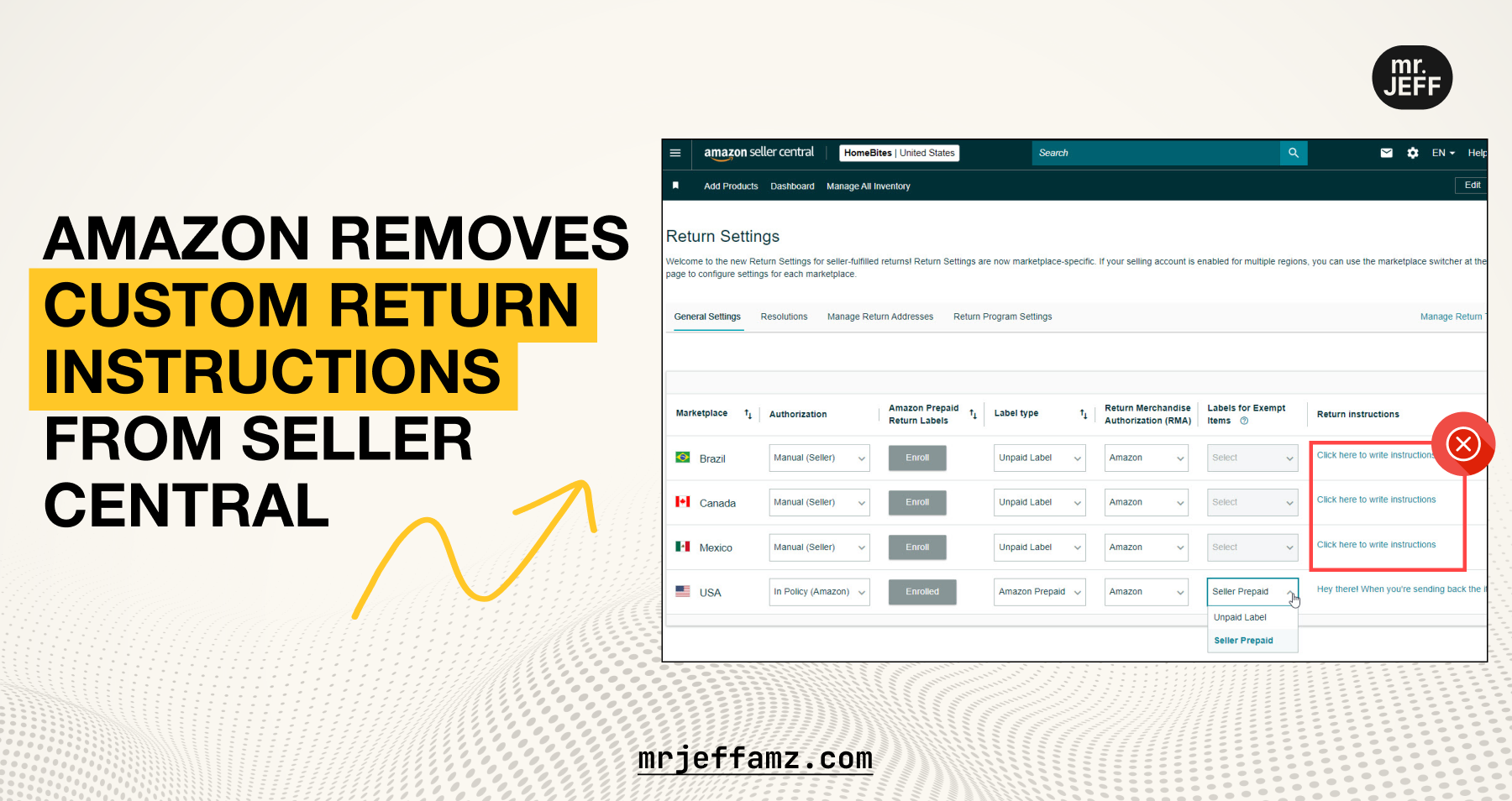
Amazon is eliminating the field inside Return Settings that let FBM (seller-fulfilled) sellers write custom return instructions, effective August 2026. This field let you tell a customer, once a return was authorized, things like requiring original packaging, explaining how to handle a fragile or custom item, or clarifying who covers return shipping in cases outside Amazon's standard policy.
“Starting August 2026, the option to add return instructions in your return settings will no longer be available.”
What This Means for Sellers
This is not an isolated change. It is the latest in a string of return-related updates Amazon rolled out through 2026. The refund processing window moved from two business days to four calendar days back in January. Buyer-seller messaging during returns was removed earlier in the year. Prepaid return labels became mandatory for all US seller-fulfilled orders regardless of item value on February 8, closing the high-value item exemption that used to protect sellers of expensive products.
Stacked together, these changes remove nearly every tool an FBM seller had to intervene in a return before it turned into a refund. If you sell custom products, fragile goods, or anything in original manufacturer packaging that affects resale value, the removed instructions field was often your only way to set expectations before an item shipped back to you.
What To Do Now
Move any packaging or condition guidance into product inserts or your standard order confirmation messaging.
Don't count on Amazon providing an equivalent replacement.
Watch your SAFE-T claim timing. You generally have four days after receiving a return to file a claim, and eligible claims can cover the label cost plus up to 50 percent of the item's price depending on category.
Review your return metrics now. A spike in return complaints and A-to-Z claims quietly drags down account health scores before it becomes an enforcement issue.
Amazon Replaces Merchant Tokens With Account IDs for Brand Registry Selling Roles
What Happened
Effective July 29, 2026, Brand Registry Administrators now use Account IDs instead of Merchant Tokens to assign or modify selling roles. Amazon confirmed the change through its official News_Amazon account on the Seller Central forums in early August.
What This Means for Sellers
Selling roles control access to brand benefits like A+ Content, Stores, and Vine. Under the old system, a Brand Administrator managing multiple marketplaces had to track a separate Merchant Token for each one. Account ID is a single, worldwide identifier that replaces that entire workflow. If you manage selling roles for your own brand or for client accounts, the Merchant Token method you may have used before no longer applies.
This is a narrow, technical update, and it has not been widely covered outside Amazon's own forum post. If you are a Brand Registry Administrator and this is the first time you are hearing about it, you are not behind. Most sellers have not seen it yet either.
What To Do Now
Find your Account ID under the gear icon, then Settings, then Manage Accounts. To confirm your Account Owner, check User Permissions for the user listed as "Owner" under Account Role. If you do not have access to User Permissions, contact your Seller Central Administrator before you need to assign or modify a selling role, not in the middle of doing it.
Amazon.de Cuts Return Window to 14 Days for 16 Categories
What Happened
Amazon notified sellers on the German marketplace that starting September 1, 2026, the voluntary 30-day return period will no longer apply to 16 product categories. The change surfaced in early August through a message posted to the Amazon Seller Forum.
What This Means for Sellers
Affected categories include furniture, beauty, luxury beauty, pet supplies, food and beverages, wine, luggage, musical instruments, tires, mobile electronics, and business or industrial supplies, among others. Only the statutory 14-day right of withdrawal under Section 355 of the German Civil Code will apply going forward. Clothing, shoes, watches, jewelry, and Amazon's own devices such as Echo, Fire TV, and Kindle keep the existing 30-day window.
There is a transition period. Orders delivered by October 1, 2026 still fall under the old 30-day rule. After that, only the shorter window applies to the listed categories.
What To Do Now
If you sell in any of the 16 affected categories on Amazon.de, update your stated return policy to match the new window before September 1 to avoid a mismatch between your listed terms and what actually applies, which can expose you to a warning letter under German consumer protection rules. You can still choose to voluntarily offer a longer return period as a competitive differentiator against Amazon retail in the same category, but you take on responsibility for handling those returns yourself if you do.
Amazon Sellers Report a Spike in Amazon Suspensions Over Unsuitable Inventory
What's Happening
Our reinstatement team has seen a jump in cases tied to Amazon's Unsuitable Inventory policy over the past several weeks, and we are not the only ones seeing it. Reinstatement firms and seller forums report the same pattern: more accounts getting flagged, quarantined, or suspended over inventory Amazon suspects is counterfeit, unsafe, expired, mislabeled, or otherwise unfit for sale.
The policy itself is not new. What changed is how often Amazon reaches for it. Amazon used to request supply chain documentation reactively, after a specific complaint came in. In 2026, that shifted to proactive supply chain audits, pulling documentation on products with no complaint history at all. A clean sales record no longer guarantees you won't get a documentation request.
What This Means for Sellers
Unsuitable Inventory covers more than counterfeit claims. Amazon can flag inventory for expired dates, incorrect labeling, or documentation that doesn't hold up, and the account can be suspended alongside the inventory action itself. Once flagged, you generally have 30 days to submit a full evidence package, including invoices, purchase orders, packing slips, lot data, photos, and quality control records, plus a Plan of Action addressing the root cause.
Retail receipts from Walmart, Target, or similar sources are not accepted as sourcing proof for most categories, and invoices with mismatched information or missing lot numbers get rejected automatically. Sellers running retail arbitrage or informal dropshipping are especially exposed, since that sourcing model rarely produces the clean, wholesale-grade invoice chain Amazon now expects.
A Real Case From Our Files: This seller's account was deactivated over Unsuitable Inventory, even though they never violated the policy
An experienced Amazon seller reached out to us for help after his account was deactivated under an Unsuitable Inventory Investigation over two ASINs, freezing his funds and blocking him from removing any FBA inventory. His products and suppliers were genuine, but Amazon rejected his invoices twice, both times pointing at the supplier as the risk. The Mr. Jeff AMZ team built a strong appeal and reinstated this account in less than 3 weeks.
What To Do Now
Pull your current supplier invoices today and confirm they show your business name, product details, and quantities that match your FBA inventory.
Make sure invoices are wholesale or manufacturer-issued. Retail receipts will not hold up if Amazon asks for sourcing proof.
Keep at least 12 months of invoices and authorization letters organized and ready to upload, not scattered across email threads.
If you run any dropshipping or retail arbitrage sourcing, check now whether your documentation could survive a supply chain audit, not just a customer complaint.
Unsuitable Inventory suspensions are one of the more complex case types to appeal, so we recommend getting professional reinstatement help right away rather than submitting an appeal on your own. At Mr. Jeff AMZ, we've successfully restored 650+ seller accounts, including Unsuitable Inventory Suspension cases. Learn more at mrjeffamz.com.
Final Thoughts
None of these changes are catastrophic on their own. Together, they point in the same direction Amazon has been moving all year: less manual intervention available to sellers, more automated enforcement behind the scenes, and more responsibility shifted onto operators to catch problems before Amazon's systems do it for them.
If any of these changes have already turned into an Amazon account health issue or a suspension, the Mr. Jeff AMZ team has handled cases across all of these areas and can help you figure out the fastest path back. We specialize in account and listing reinstatement, and we're ready to help.

Author
Helen
Head of Client Success at Mr. Jeff AMZ
Helen leads Sales & Client Success at Mr. Jeff AMZ, guiding Amazon sellers from their first suspension panic to a fully recovered account. With years of frontline experience managing reinstatement cases, she translates Amazon's dense policy language into clear, actionable next steps and keeps sellers informed at every stage of the appeal.
Connect on LinkedInFrequently Asked Questions
What types of financing are affected by Amazon's new revenue pledging restrictions?
The new restrictions only affect loans where a lender's security interest attaches to your Amazon payouts before they reach your bank account—typically through a UCC filing listing "Amazon receivables" as collateral. Loans secured by inventory, general business assets, or funds already in your account are not affected. Amazon Lending is also unaffected since those repayments are deducted directly by Amazon.
When did Amazon's Business Solutions Agreement changes take effect?
The updated Business Solutions Agreement was announced on May 29, 2026, but the two new restrictions—banning unauthorized account transfers and pledging Amazon payouts as loan collateral—officially took effect on August 24, 2026.
How can I check if my current business loan violates Amazon's new pledge restrictions?
Review your financing paperwork carefully for any language that lists "Amazon receivables" or your Amazon payouts specifically as loan collateral. If your loan is structured this way, contact your lender immediately to discuss shifting the collateral to inventory or other business assets that aren't restricted under the new agreement.
What happens if I violate the new account transfer or revenue pledging rules?
Violations typically surface during lender collection actions, routine account reviews, or disputes over informally sold accounts. The consequences can include account suspension or frozen balances. This is especially risky during Q4, when account balances are higher and Amazon's 90-day hold on suspended funds can cause significant financial damage.
What should I do if I've already informally transferred my Amazon seller account?
If you transferred your account without going through Amazon's formal process, you should open a Seller Central compliance case immediately to disclose the transfer. Additionally, verify that your registered account entity matches who is actually operating it by going to Settings → Account Info → Business Information.
Why is Amazon removing custom return instructions for FBM sellers?
Amazon is eliminating the custom return instructions field from Return Settings for FBM (seller-fulfilled) sellers as of August 2026. While the full reasoning wasn't detailed, this removes the ability to provide customers with specific guidance once a return is authorized, which may impact how sellers communicate their return processes.
How does Amazon typically announce important seller policy changes?
Amazon rarely announces everything at once. Most significant changes appear quietly through Seller Central forum posts, emails sent to select groups of sellers, or single lines buried in policy update documents. Sellers need to actively monitor multiple channels to stay informed about updates that could affect their accounts.