
Case Studies
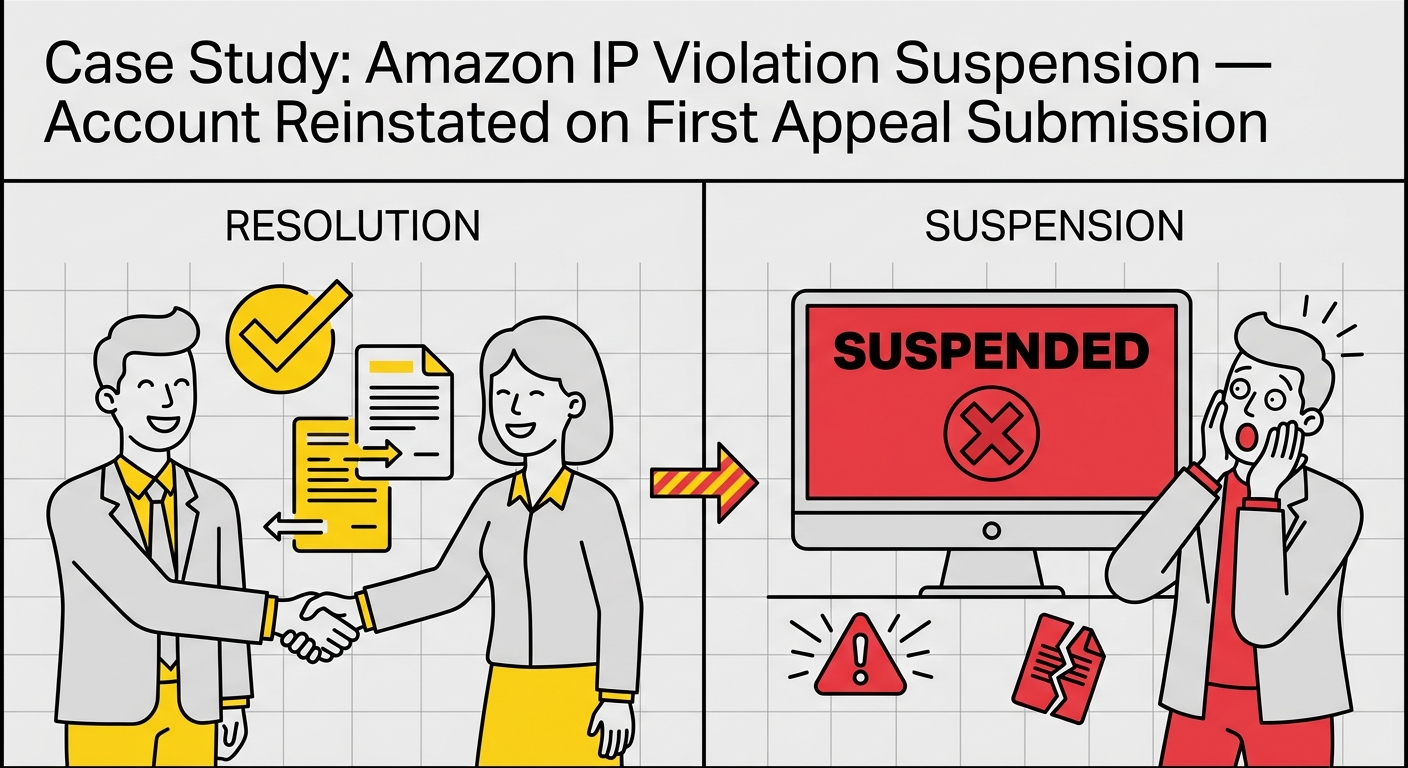
Case Study: Amazon IP Violation Suspension — Account Reinstated on First Appeal Submission
May 22, 2026
Key Takeaways
- An Amazon seller was suspended for trademark infringement weeks after the rights owner retracted all complaints and Account Health cleared, proving retractions don't prevent automated suspensions.
- Over 70% of sellers who fail self-submitted Amazon appeals already have the right documentation but lack proper structure and narrative sequencing in their submissions.
- A circular design element added to a seller's logo created enough visual similarity to trigger trademark complaints, showing even minor branding choices can cause IP violations.
- Amazon's enforcement system processes IP complaints faster than retraction updates propagate, creating a known gap where resolved issues still trigger account deactivations.
- The seller's account was reinstated on the first professionally structured appeal after multiple self-submitted rejections by explicitly addressing the timeline disconnect between complaint retraction and suspension.
Amazon IP Violation Suspension: Complete Reinstatement Case Study
Imagine doing everything right — reaching out to the brand, resolving the complaint, getting the retraction in writing, watching your Account Health go green and then getting suspended anyway.
That's not a hypothetical. That's exactly what happened to our client. And if you've ever felt like Amazon's enforcement system makes no sense, this case will feel very familiar.
What Happened: Trademark Infringement Suspension
The seller had been running a solid Amazon business. Then a few IP complaints landed on his Account Health Dashboard — all related to trademark infringement on his product logo.
Here's the thing: it wasn't a blatant rip-off. He had his own logo. He just added a circle around it for design purposes. That visual element made it look similar enough to another brand's trademark that the rights owner noticed and filed complaints.
When he found out, he didn't wait for Amazon to sort it out. He picked up the phone (well, sent an email), reached out to the brand directly, explained the situation, and resolved it. The rights owner accepted his explanation and retracted all the complaints. His Account Health Dashboard cleared.
Case closed, right?
Not quite.
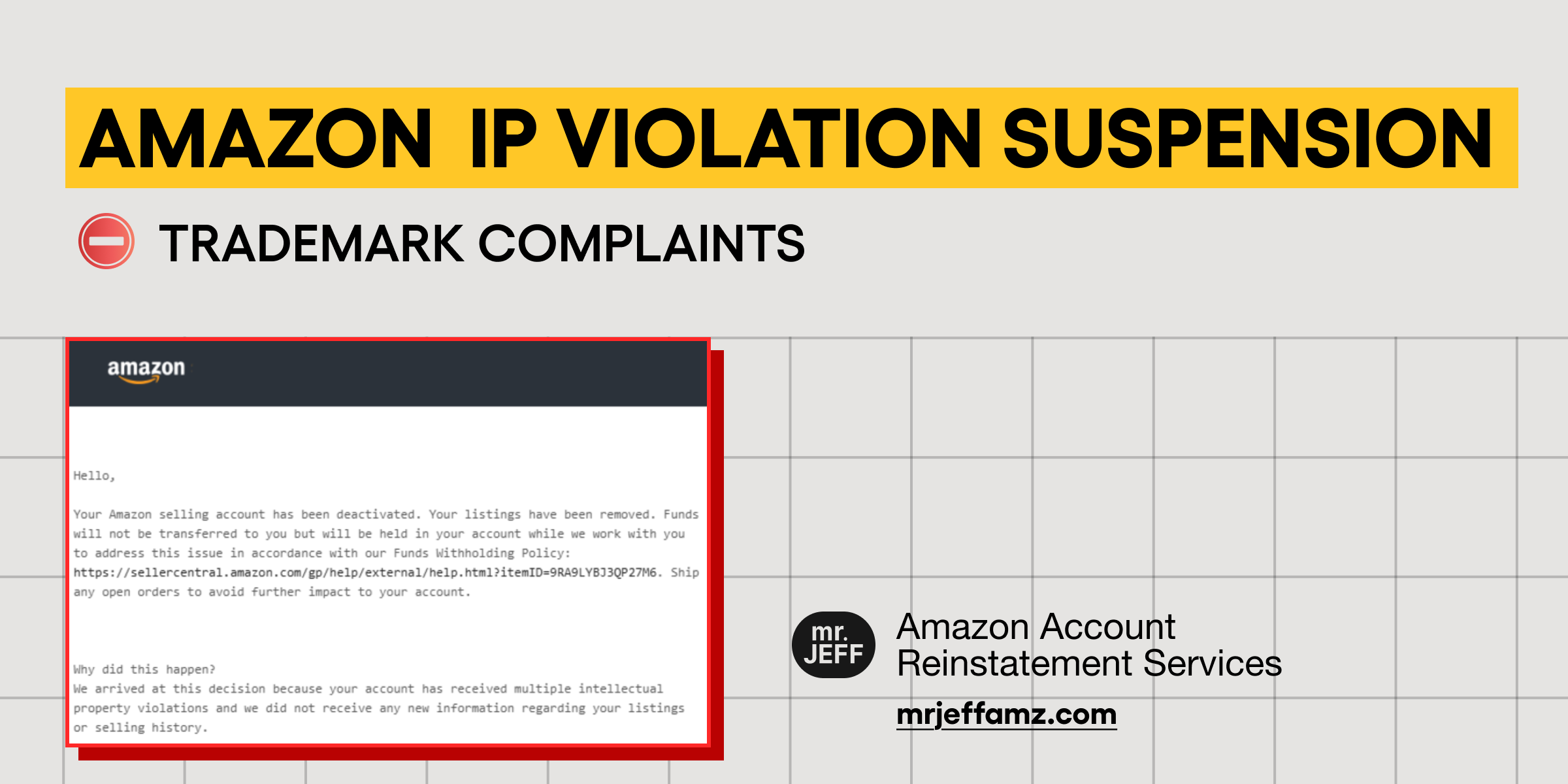
A few weeks later, Amazon deactivated his account — still citing intellectual property infringement. The same complaints that had already been retracted. The same issue that had already been resolved.
Why Amazon IP Violations Are So Complicated
📊 By the numbers: IP complaints are one of the top 3 reasons Amazon sellers get suspended. According to internal data we've seen across hundreds of cases, a significant portion of IP-related suspensions involve situations where the underlying complaint was already resolved — but Amazon's enforcement system didn't catch up in time.
Amazon processes an enormous volume of IP complaints. The system isn't built for nuance — it's built for speed. By the time a complaint retraction is processed, the suspension trigger may have already been pulled. This is a known gap in the system, and it's why sellers sometimes find themselves suspended even after the underlying issue has been fully resolved.
Knowing this matters. It changes how you approach the appeal — because you're not just explaining what happened. You're also explaining a system failure that the reviewer may not be immediately aware of.
Failed Self-Submitted Appeals
After the deactivation, the seller didn't just sit on his hands. He submitted multiple appeals on his own — laying out the situation, including the retraction, explaining the timeline. Reasonable stuff.
Every single one was rejected.
💡 Mr. Jeff Expert Insight: "This is one of the most common patterns we see. A seller has a legitimate case, submits the right information, and still gets rejected. Why? Because Amazon's reviewers are processing hundreds of cases a day. If your appeal doesn't immediately tell a clear, logical story — with the right structure and the right evidence in the right order — it's easy for it to get dismissed. It's not always about what you say. It's about how you say it."
This is a painful but important truth: having the right facts doesn't automatically produce the right outcome.
Amazon's appeal review process isn't an investigation where someone digs through your case looking for evidence in your favor. Reviewers read what's in front of them. If the story isn't clear, logical, and well-supported from the first sentence, it doesn't get the benefit of the doubt — it gets rejected.
After multiple failed attempts, the seller reached out to us.
Professional Amazon Account Reinstatement Strategy
Step 1: Case Investigation and Documentation Review
Before writing a single word of a new appeal, we went through the entire case history. All previous submissions. The original deactivation notice. Every IP complaint. The retraction documentation. The Account Health timeline. Every piece of prior communication with Amazon.
This kind of full audit is the foundation of effective reinstatement work. In cases where multiple appeals have already failed, the problem is almost never a lack of information. The problem is almost always in how that information is being presented — or what's missing from the presentation.
📊 Stat: In our experience, over 70% of sellers who come to us after failed self-submitted appeals already have most of the documentation they need. The gap isn't in the evidence — it's in the structure and the narrative.
We don't skip this step, even when a case seems straightforward on the surface. Details matter. Context matters. And sometimes the most important insight in a case is buried in a piece of communication the seller didn't even think was relevant.
Step 2: Identifying Appeal Gaps and Missing Elements
After reviewing everything, we had a clear picture of what was there and what wasn't. In this case, the core evidence was solid: the retraction existed, the Account Health had been cleared, and the seller had documentation of his proactive outreach to the rights owner.
But the previous appeals hadn't connected those dots in a way that was clear and immediate for a reviewer who was seeing this case for the first time. The timeline wasn't laid out sequentially. The relationship between the retraction and the deactivation wasn't explicitly addressed. And the corrective action section — which Amazon requires as part of any reinstatement appeal — wasn't specific enough to be credible.
We also identified additional supporting materials that could strengthen the case and eliminate any remaining ambiguity.
Step 3: Building the Winning Reinstatement Appeal
This is where the real work happened.
A successful reinstatement appeal isn't just a list of facts. It's a story — one that takes the reviewer from "here's what Amazon thinks happened" to "here's what actually happened and here's the proof." The sequence matters. The language matters. The level of specificity matters.
We rebuilt the appeal from the ground up:
Opening — acknowledging the situation clearly. We didn't start by arguing. We started by demonstrating that we understood Amazon's concern and took it seriously. This is important — reviewers respond better to appeals that show self-awareness than ones that lead with defensiveness.
The root cause — what actually triggered the complaints. We explained the logo design issue concisely and factually: the seller used his own logo with a circular design element, which created unintentional visual similarity with another brand's trademark. No intent to infringe. A design decision with an outcome the seller didn't anticipate.
The resolution — documented and timestamped. We laid out the timeline of how the seller proactively contacted the rights owner, what was communicated, and when the complaints were retracted. Every step was supported with documentation.
The disconnect — why the deactivation didn't make sense. This was a critical element that the previous appeals hadn't addressed directly. We explicitly explained the gap: the account was deactivated after the complaints had already been retracted and the Account Health had been cleared. We made that inconsistency unmissable.
Corrective actions — specific and credible. We outlined exactly what the seller had done to ensure this couldn't happen again: the logo had been redesigned to eliminate any visual similarity, updated product imagery had been uploaded, and a trademark clearance review had been completed before relaunching.
The goal was simple: make it impossible for Amazon's reviewer to misread the timeline or miss the key facts. Every sentence was there for a reason.
The Result: Successful Amazon Account Reinstatement
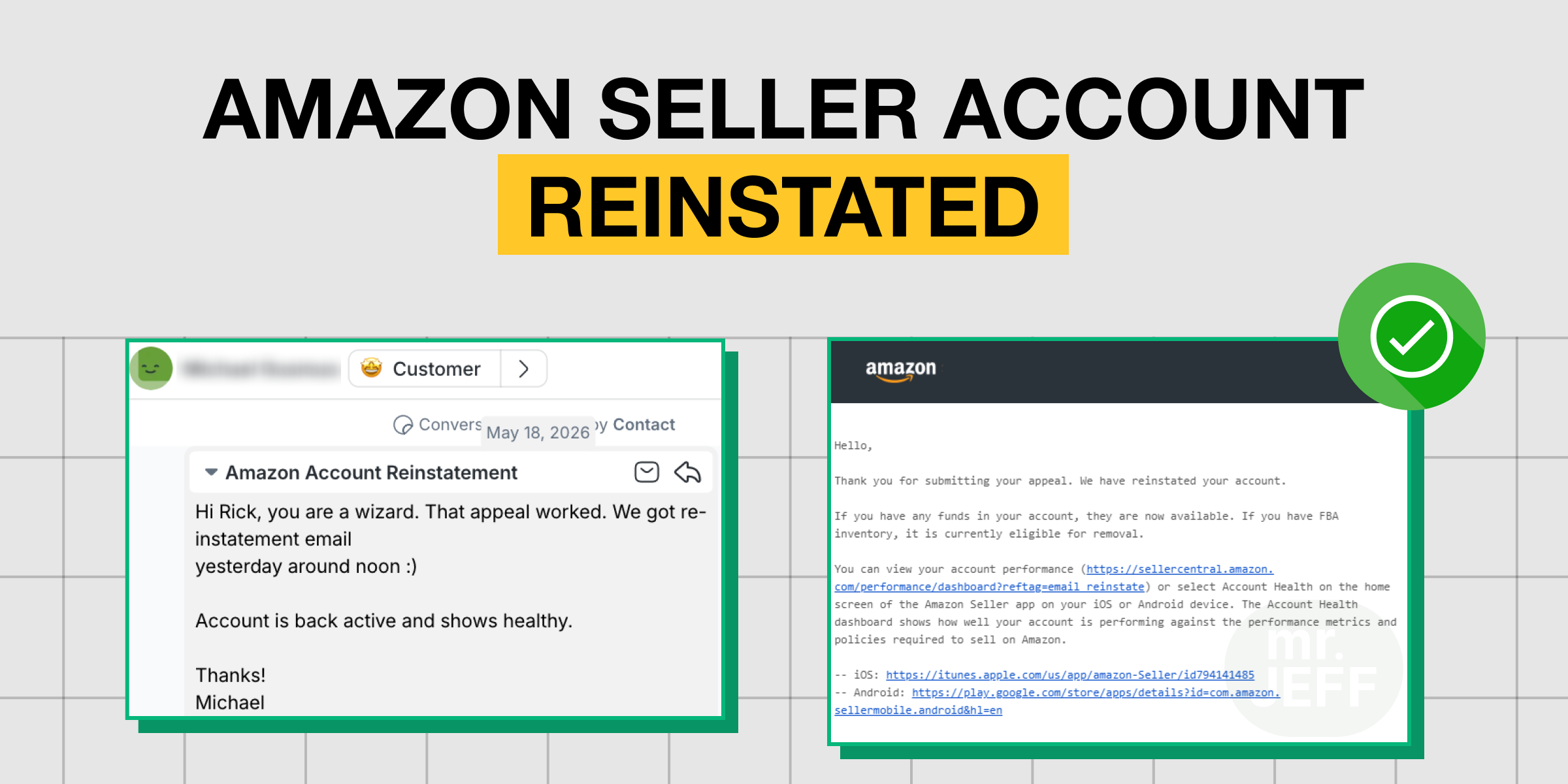
✅ Account fully reinstated
The seller regained access to their Amazon account and was able to resume selling after what had been a disruptive and high-stakes suspension. The resolution came through a combination of thorough documentation, persistent follow-up, and strategic escalation outside of Amazon's standard appeal process.
Key Lessons for Amazon Sellers
🔸 Your cleared dashboard is not a guarantee.
Amazon's systems don't always sync in real time. A complaint retraction can take time to propagate through the enforcement system, and in that window, a suspension can still trigger. If this happens to you, don't assume Amazon already knows the issue is resolved — you have to tell them, clearly and with proof.
This is a gap in Amazon's system that's worth knowing about before it affects you. If you ever receive IP complaints, resolve them as quickly as possible, get the retraction in writing, and document the timeline carefully. If a suspension follows anyway, that documentation becomes your most important asset.
🔸 Logo design matters more than you think.
A small design element — in this case, a circle around a logo was enough to create visual similarity with another brand's trademark. You don't have to copy a logo to get flagged for it. Before finalizing any product branding, it's worth doing a trademark search and a visual similarity check. Prevention is infinitely easier than reinstatement.
🔸 Doing the right thing isn't enough. Documenting it is.
This seller did everything right — reached out proactively, resolved the issue directly with the rights owner, got the complaints retracted. But none of that mattered until it was presented correctly in an appeal.
Always save your correspondence with rights owners. Always get retractions in writing, not just verbally. Keep screenshots of your Account Health before and after. If you're communicating with a brand about an IP concern, treat every message like it might end up in an appeal — because it might.
🔸 The structure of your appeal matters as much as the content
If there's one thing this case demonstrates more clearly than anything else, it's that presentation is everything in an Amazon reinstatement appeal. The seller had the evidence. He had the documentation. He had a legitimate case. And he still couldn't get reinstated on his own because the appeals weren't structured in a way that made the story immediately clear to Amazon's reviewer.
Think about it from the reviewer's perspective: they're reading dozens of appeals a day. They're not going to hunt through a disorganized document looking for the key facts. If the story isn't clear in the first few paragraphs, the appeal gets rejected and the reviewer moves on.
Structure your appeal like a legal brief, not like a complaint letter. State the facts clearly. Present them in chronological order. Connect the evidence explicitly to the points you're making. End with a credible, specific corrective action plan. And always, always address the specific reason Amazon gave for the suspension — don't dance around it.
🔸 Rejected appeals aren't the end.
Multiple rejections feel like a closed door. They're not. They usually mean the approach needs to change, not that the case is unwinnable. If your appeals keep getting rejected, the answer isn't to submit the same thing again with minor tweaks. It's to step back, reassess the strategy, and start fresh.
💡 Mr. Jeff Expert Insight: "One of the biggest mistakes sellers make is treating a failed appeal like a failure of the facts. In most cases, the facts are fine. What failed was the presentation. Amazon's reviewers aren't investigators — they're readers. Your appeal needs to be so clear and logical that the right decision is obvious. That's the standard we write to every single time."
🚨 Need Help With Amazon Account Reinstatement?
If your Amazon seller account has been suspended for an IP policy violation or any other policy violation — it's critical to act strategically from the start. Every failed appeal makes the next one harder. The sooner you get the right team involved, the better your chances.
At Mr. Jeff AMZ, we specialize in reinstating suspended Amazon seller accounts, even in the most complex cases. Our team has successfully helped 650+ sellers get their accounts back and return to selling.
Here's what you get when you work with Mr. Jeff AMZ:
🔍 Insider Expertise — Our specialists include ex-Amazon staff and top Amazon sellers who understand exactly how Amazon reviews appeals behind the scenes.
✍️ Custom Plans — No Templates — Every Plan of Action (POA) is written from scratch, fully tailored to your specific suspension and account history.
🔄 Unlimited Revisions — We work on your case until reinstatement. No revision limits, no hidden fees.
🤝 Dedicated 1-on-1 Support — You'll have a personal reinstatement expert guiding you through every step of the process.
⚡ Fast-Track for Urgent Cases — If your business is on pause and time matters, we offer priority handling for urgent reinstatement cases.
✅ Honest Case Review — If reinstatement isn't realistically possible, we'll tell you upfront. No false promises. No wasted time.
Get a Free Expert Case Review
If your Amazon seller account has been suspended, don't risk getting stuck in an endless appeal loop.
👉 Fill out the form and get a free expert consultation with a detailed review of your Amazon suspension case.

Author
Rick
Senior Reinstatement Consultant at Mr. Jeff AMZ
Rick is a Senior Reinstatement Consultant at Mr. Jeff AMZ with 6 years of experience appealing Amazon suspensions. He specializes in solving complex Amazon issues like Section 3, IP, and review-related enforcement, helping sellers recover deactivated accounts. His superpower is knowing Amazon's policies better than most Amazon reviewers do and building a compelling, watertight case for any position.
Connect on LinkedInFrequently Asked Questions
Why was my Amazon account suspended even after I got the IP complaint retracted?
Amazon's enforcement system often has a timing gap between when complaints are retracted and when the system processes them. Even if you've resolved the issue with the rights owner and received a retraction, the suspension trigger may have already been activated. This is a known system limitation that affects many sellers who have legitimately resolved their IP issues.
What was the specific IP violation issue in this case study?
The seller had added a circle around their own logo for design purposes, which inadvertently made it visually similar to another brand's trademark. It wasn't intentional infringement – they had their own logo but the added design element triggered the similarity. The rights owner filed trademark infringement complaints based on this visual resemblance.
Why do self-submitted appeals for IP violations often get rejected?
Amazon reviewers process hundreds of cases daily and need appeals that immediately tell a clear, logical story with the right structure and evidence. Many sellers submit reasonable information but fail to present it in the format reviewers expect. Without proper structuring and presentation, even legitimate cases with full documentation can be rejected multiple times.
What are the top reasons Amazon sellers get suspended?
According to the article, IP complaints are one of the top 3 reasons Amazon sellers face suspension. A significant portion of these IP-related suspensions involve situations where the complaint was already resolved, but Amazon's system didn't process the retraction in time. The enforcement system prioritizes speed over nuance, leading to these types of suspensions.
How quickly should I contact a brand if I receive an IP complaint?
You should reach out to the brand immediately upon receiving the complaint. The case study seller contacted the rights owner right away, explained the situation, and successfully resolved it. However, even with quick action and a retraction, you may still face suspension due to system delays, so documenting everything is crucial.
What makes Amazon's IP violation enforcement system so challenging for sellers?
Amazon's system processes an enormous volume of IP complaints and is built for speed rather than nuance. The enforcement system may trigger suspensions before retractions are fully processed, creating a gap that catches legitimate sellers. Understanding this system limitation is crucial for crafting effective appeals that address both the complaint and the system failure.
Should I hire a professional service if my IP violation appeals keep getting rejected?
If you've submitted multiple appeals with proper documentation and they're still being rejected, professional help may be necessary. The case study shows that expert services like Mr. Jeff AMZ achieved full reinstatement on the first submission after the seller's own appeals failed. Professionals understand the specific structure and presentation Amazon reviewers need to see.