Case Studies
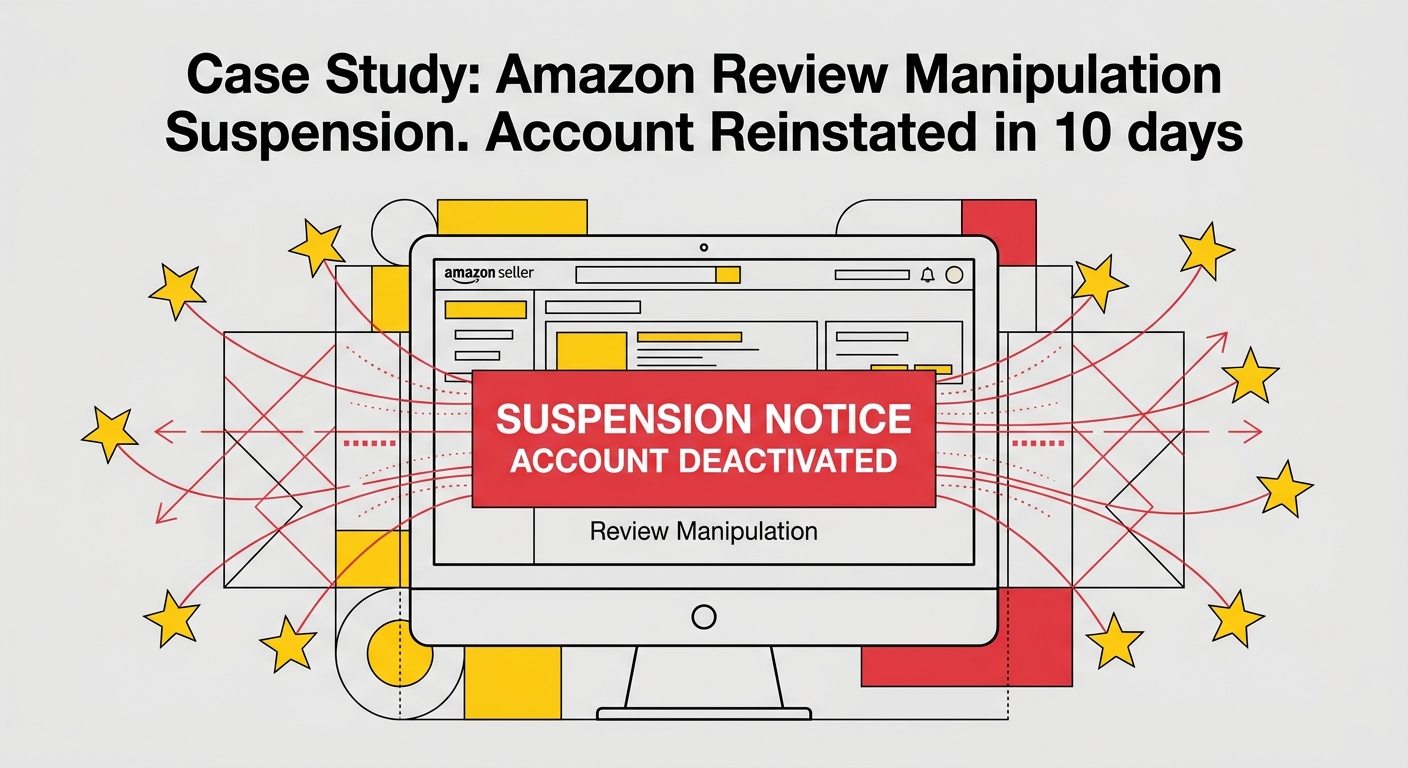
Case Study: Amazon Review Manipulation Suspension. Account Reinstated in 10 days
April 28, 2026
Key Takeaways
- An Amazon seller suspended for review manipulation in March 2026 had their account reinstated in 10 days after identifying a third-party review request tool as the likely trigger.
- Amazon suspends accounts for review manipulation even without seller intent when automated tools send review requests outside Amazon-approved workflows or create unnatural messaging patterns.
- Submitting multiple weak appeals that only deny wrongdoing increases rejection risk; successful reinstatement requires identifying root cause, corrective actions, and preventive measures in the Plan of Action.
- Common 2026 review manipulation triggers include third-party automation tools, offering incentives for reviews, asking customers to change negative reviews, and product inserts directing customers to leave reviews.
- Sellers should immediately stop using third-party review tools and switch to Amazon's native Request a Review button to avoid automated enforcement flags for suspected manipulation.
Why Review Manipulation Suspensions Are a Serious Risk for Amazon Sellers in 2026
Amazon review manipulation suspensions remain one of the most dangerous account health issues for sellers in 2026 because they directly affect buyer trust — one of Amazon’s core marketplace priorities. When Amazon believes a seller has attempted to influence customer reviews, the case is usually treated as more than a simple listing violation. It can lead to Amazon account suspension, ASIN removal, blocked disbursements, loss of ranking, and repeated appeal rejections if the response is not structured correctly.
The difficult part is that many sellers are suspended for alleged review manipulation even when there was no clear intent to manipulate reviews. Amazon does not always explain the exact trigger. Instead, sellers may receive a general deactivation notice stating that their account was involved in activity intended to influence reviews. That leaves the seller trying to understand what Amazon’s internal system flagged and how to respond.
In 2026, the most common triggers for Amazon review manipulation suspensions include:
using third-party tools to send automated review requests;
sending review request messages outside Amazon-approved workflows;
asking buyers to leave only positive reviews;
offering discounts, refunds, gift cards, bonuses, or free products in exchange for reviews;
contacting customers after a negative review and asking them to change or remove it;
using product inserts with language that directs happy customers to leave reviews;
asking friends, employees, family members, or connected accounts to review products;
unusual review spikes, especially after promotions or product launches;
suspicious review patterns connected to competitors, agencies, or external traffic campaigns;
variation abuse, where unrelated products are merged to collect or transfer reviews.
Amazon’s Seller Code of Conduct requires sellers to act fairly and honestly, and Amazon’s review rules prohibit attempts to influence customer feedback. This is why even “neutral” actions can become risky if Amazon interprets them as an attempt to control review behavior. Amazon’s broader review enforcement also aligns with increased regulatory attention around fake or misleading reviews in the U.S., including the FTC’s rule targeting deceptive review practices.
For sellers, the biggest mistake is responding emotionally or simply saying: “We did not manipulate reviews.” That may be true, but it often does not solve the case. Amazon expects a clear Plan of Action that identifies the possible root cause, explains what was corrected, and shows how the seller will prevent similar account health issues in the future.
A strong Amazon review manipulation appeal should focus on compliance, not just intent. Sellers need to review their Buyer-Seller Messaging, third-party tools, product inserts, review request process, staff access, and external marketing activities. The goal is to show Amazon that the seller understands the risk, has removed any questionable processes, and now follows only Amazon-approved review request methods.
Overview
Review manipulation suspensions are especially challenging because Amazon often does not provide a detailed explanation of what exactly triggered the enforcement. A seller may believe they followed the rules, while Amazon’s internal systems may still detect activity that appears risky — such as automated review requests, unusual messaging patterns, or the use of third-party tools.
That is why these cases require more than a simple denial. To reinstate the account, the appeal must address Amazon’s concern directly, explain the possible trigger, and show what corrective and preventive actions were taken to protect review integrity.
The case below shows how one Amazon seller was deactivated for alleged review policy manipulation, even though there was no intentional attempt to influence customer reviews — and how a properly structured appeal helped restore the account after the second submission.
The Challenge
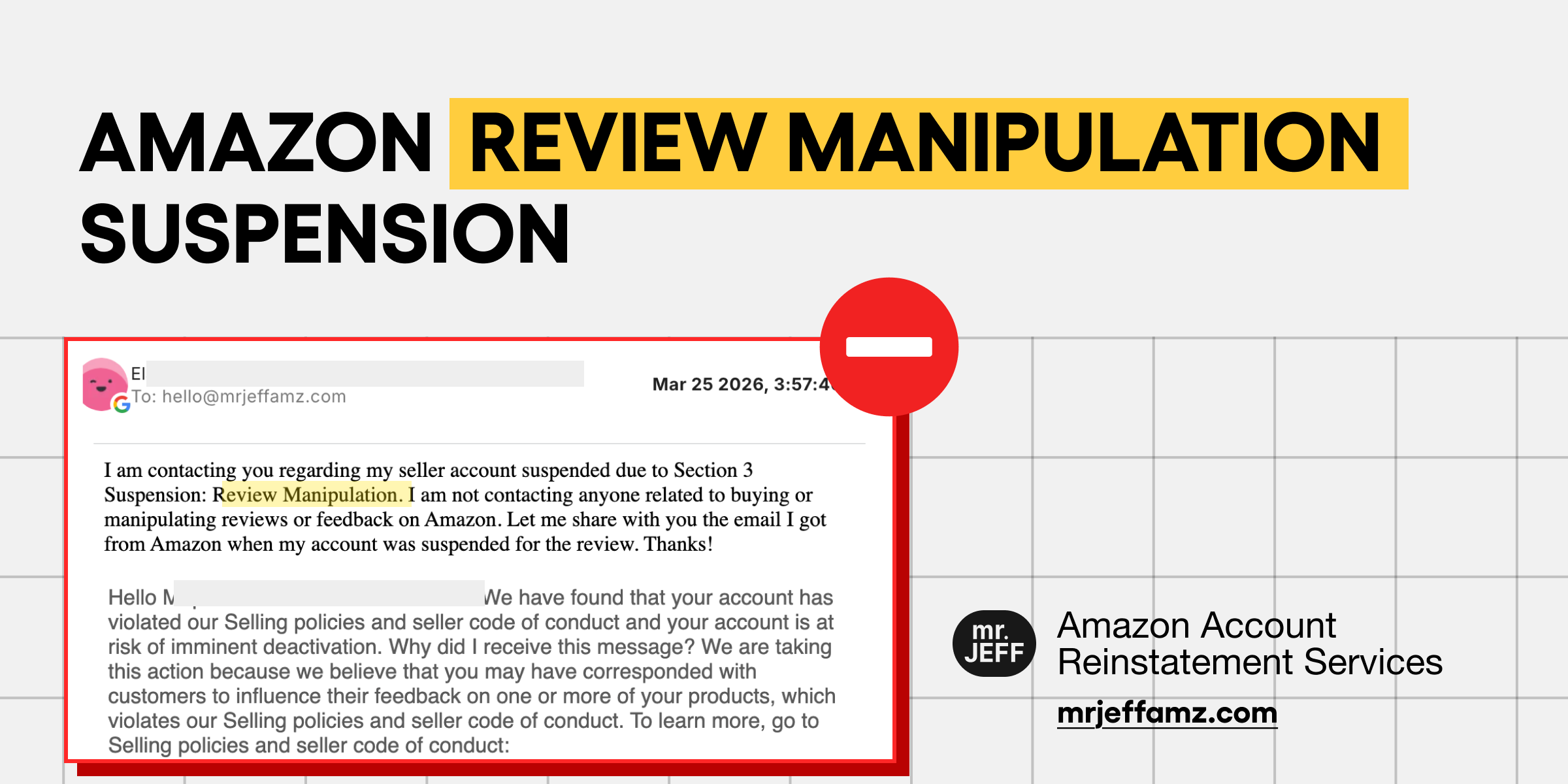
In March 2026, Harley, an experienced Amazon seller in the electronics category, contacted Mr. Jeff AMZ after his seller account was deactivated due to suspected review manipulation.
According to Amazon, the account was involved in activities intended to influence customer reviews — a serious violation of Amazon’s Customer Reviews Policy and one of the most sensitive enforcement categories for sellers.
From the very beginning, Harley was clear: there had been no intentional attempt to manipulate reviews.
He confirmed that:
no incentives were offered to customers;
no biased or manipulative language was used;
no direct requests were made to influence review outcomes.
Still, the account remained suspended. Amazon did not provide a clear explanation of the exact trigger, which made the case more difficult to diagnose and this is a common issue in Amazon review manipulation suspension cases.
Before contacting us, Harley had already submitted several appeals on his own. Each one was rejected without a detailed explanation from Amazon. At that point, continuing to send similar appeals would only increase the risk of repeated rejections and delay the reinstatement process.
That is when Harley made the right decision and reached out to the Mr. Jeff AMZ team for professional Amazon account reinstatement support.
Investigation & Root Cause Analysis
Our first step was a full account audit and suspension analysis.
We reviewed:
Buyer-Seller Messaging activity
Request a Review button usage
Third-party tools connected to the account
Timing and frequency of review requests
Key Finding
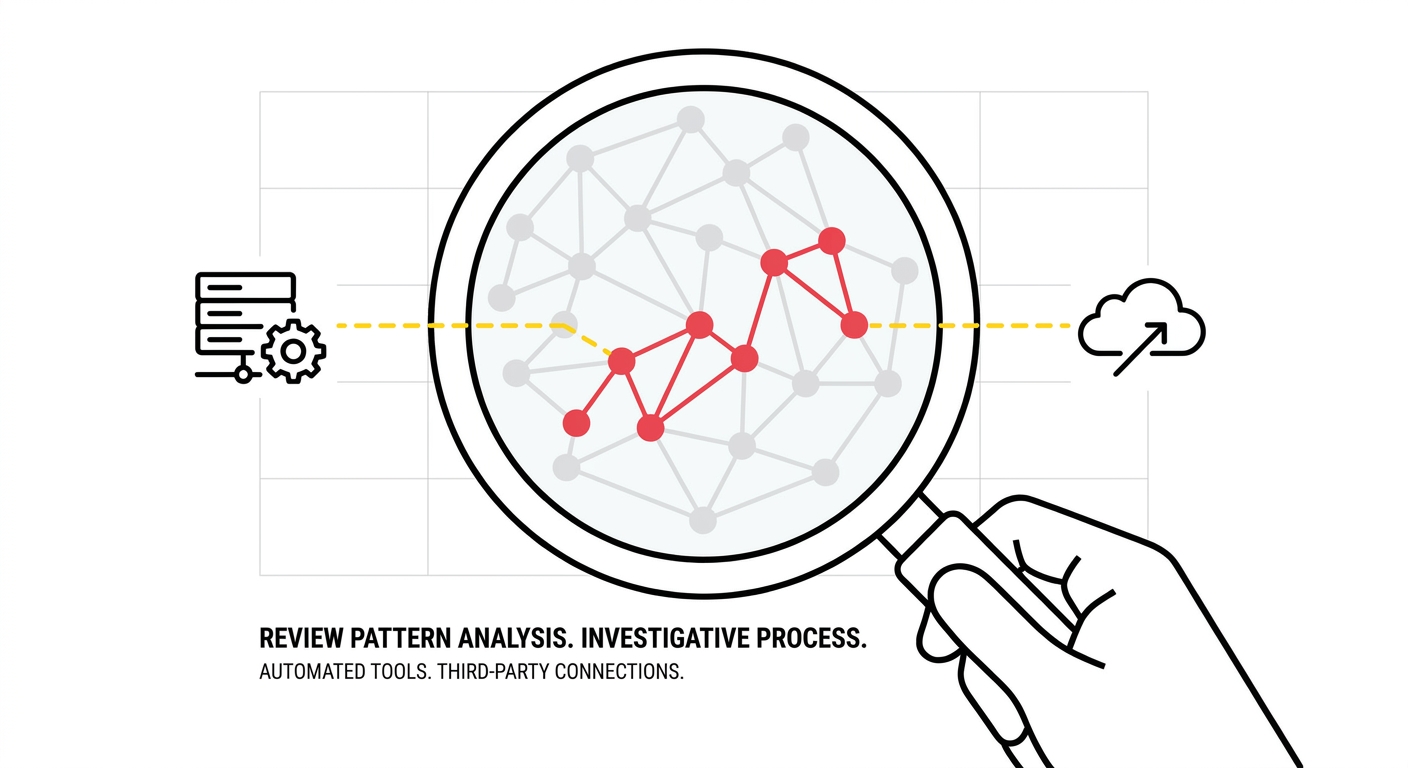
The most likely trigger was the use of a third-party review request tool.
While the messages sent were neutral and compliant on the surface, Amazon may interpret automated or bulk review requests as potential review manipulation behavior, especially if:
Requests are sent outside Amazon-approved workflows
Messaging frequency appears unnatural
Tools bypass native Amazon systems
This is a critical insight for Amazon sellers:
Even compliant-looking actions can trigger enforcement if they conflict with Amazon’s internal trust signals.
Our Strategy: Reframing the Appeal
At this stage, it became clear that simply defending the seller’s position was not enough. We implemented a structured appeal strategy aligned with Amazon’s expectations:
1. Acknowledging the Possible Trigger
Even without intentional violation, we addressed:
The use of third-party tools
The possibility of misinterpretation by Amazon
2. Clear Root Cause Definition
We framed the issue as: Improper use of a third-party review request system that may not fully align with Amazon’s communication guidelines.
3. Corrective Actions
Immediate suspension of the third-party tool
Transition to Amazon’s native Request a Review system
Internal review of all customer communication processes
4. Preventive Measures
Implementation of strict compliance protocols
Limiting review requests to Amazon-approved methods
Monitoring communication frequency and timing
Staff training on Amazon review policies
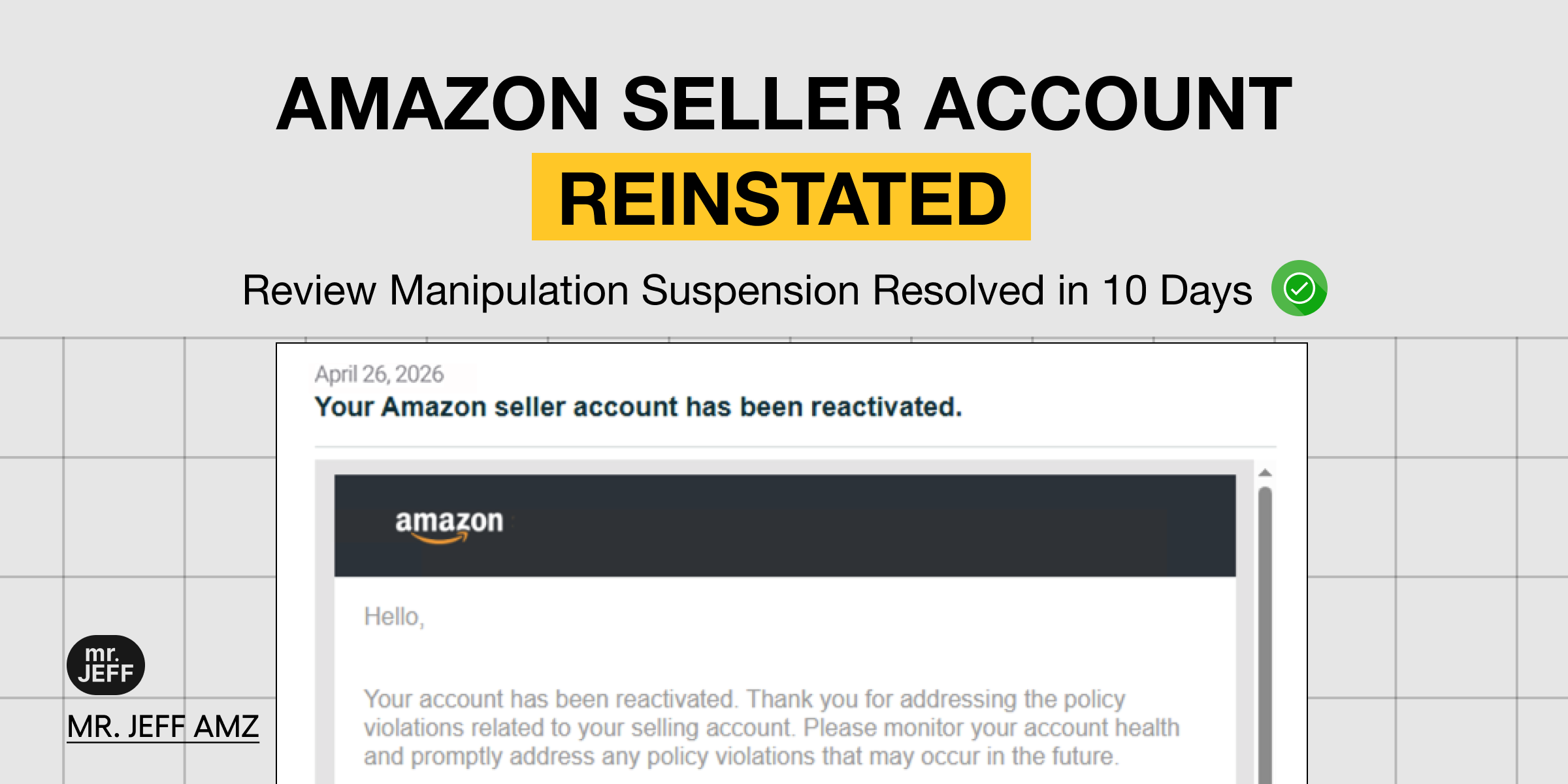
✅ The Result
After restructuring the appeal and submitting it to the Seller Performance Team:
The case moved forward after the second submission
The account was fully reinstated
Selling privileges were restored
Business operations resumed without further restrictions
⌛️ Turnaround Time: 10 days
Key Takeaways for Amazon Sellers
This case is a strong reminder that Amazon review manipulation suspensions are not always caused by obvious misconduct. In many cases, the issue comes from how Amazon interprets seller activity, customer communication, or third-party tool usage.
1. Intent Is Not Enough
Amazon evaluates patterns: review request frequency, messaging history, third-party tools, and customer communication. Even neutral activity can look suspicious if it creates a compliance risk.
2. Third-Party Tools Can Trigger Flags
Review request tools may create problems if they send messages outside Amazon-approved workflows or create unnatural activity patterns. Sellers should regularly audit every tool connected to their account.
3. Denial Is Not an Appeal Strategy
Simply saying “we did not manipulate reviews” is usually not enough. A strong Amazon appeal must explain the possible trigger, corrective actions, and preventive measures.
4. Structure Wins Cases
A proper Plan of Action should clearly cover:
root cause;
corrective actions;
preventive steps;
confirmation that future review requests will follow Amazon policy.
5. Repeated Weak Appeals Make Things Worse
Submitting the same explanation again and again can lead to more rejections. If Amazon has already denied several appeals, the next submission needs a new strategy — not just a revised wording.
6. Review Compliance Must Be Proactive
Sellers should regularly check review request templates, product inserts, automation tools, and staff communication. The safest approach is to use only Amazon-approved review request methods.
🚨 Need Help With Amazon Account Reinstatement?
If your Amazon seller account has been suspended for review manipulation or any other policy violation, it’s critical to act strategically from the start.
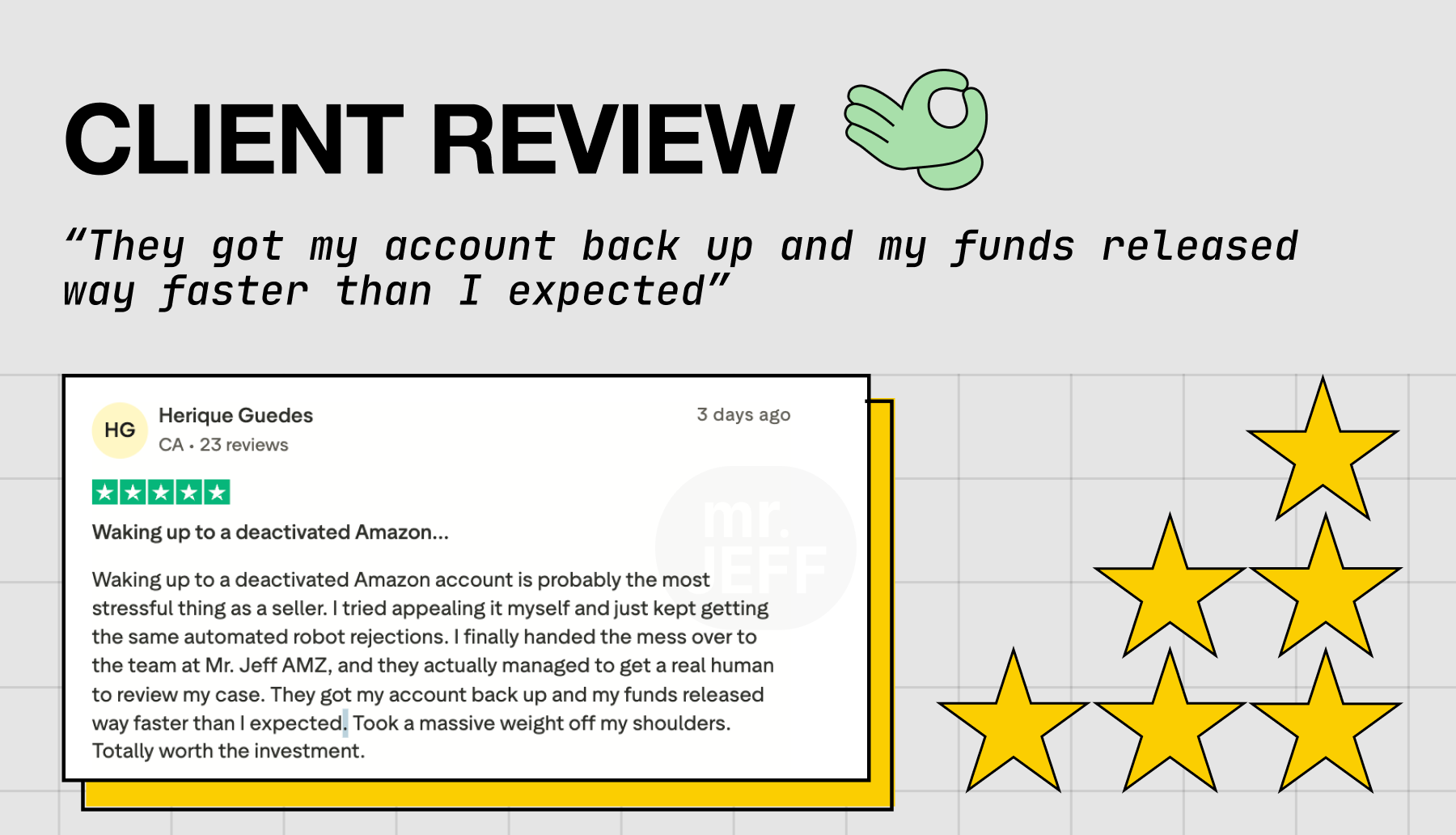
At Mr. Jeff AMZ, we specialize in reinstating suspended Amazon seller accounts, even in the most complex cases. Our team has successfully helped 600+ sellers get their accounts back and return to selling.
Insider Expertise
Our specialists include ex-Amazon staff and top Amazon sellers who understand how Amazon reviews appeals behind the scenes.Custom Plans — No Templates
Every Plan of Action (POA) is written from scratch, fully tailored to your specific suspension and account history.Unlimited Revisions
We work on your case until reinstatement — no revision limits, no hidden fees.Dedicated 1-on-1 Support
You'll have a personal reinstatement expert guiding you through every step of the process.Fast-Track for Urgent Cases
If your business is on pause and time matters, we offer priority handling for urgent reinstatement cases.Honest Case Review
If reinstatement isn't realistically possible, we'll tell you upfront. No false promises. No wasted time.
Get a Free Expert Case Review
If your Amazon seller account has been suspended, don't risk getting stuck in an endless appeal loop.
👉 Fill out the form and get a free expert consultation with a detailed review of your Amazon suspension case.

Author
Rick
Senior Reinstatement Consultant at Mr. Jeff AMZ
Rick is a Senior Reinstatement Consultant at Mr. Jeff AMZ with 6 years of experience appealing Amazon suspensions. He specializes in solving complex Amazon issues like Section 3, IP, and review-related enforcement, helping sellers recover deactivated accounts. His superpower is knowing Amazon's policies better than most Amazon reviewers do and building a compelling, watertight case for any position.
Connect on LinkedInFrequently Asked Questions
What are the most common triggers for Amazon review manipulation suspensions in 2026?
The most common triggers include: using third-party tools for automated review requests, offering incentives (discounts, gift cards, free products) for reviews, contacting customers to change negative reviews, using product inserts that encourage only positive reviews, and suspicious review patterns like sudden spikes after promotions. Even asking friends or family to review products can trigger a suspension.
What happens to my Amazon seller account if I'm suspended for review manipulation?
Review manipulation suspensions can result in complete account deactivation, ASIN removal, blocked disbursements, loss of product rankings, and repeated appeal rejections. Amazon treats these cases seriously because they directly impact buyer trust, making them more severe than simple listing violations.
Can I be suspended for review manipulation even if I didn't intentionally manipulate reviews?
Yes, many sellers are suspended without clear intent to manipulate reviews. Amazon's automated systems may flag activities they interpret as attempts to influence reviews, even if you believed your actions were legitimate. Amazon rarely explains the exact trigger, leaving sellers to identify potential issues themselves.
What should I include in my Plan of Action for a review manipulation appeal?
Your Plan of Action must identify the possible root cause, explain what corrections were made, and demonstrate prevention measures for the future. Focus on compliance rather than just denying intent. Review your buyer messaging, third-party tools, product inserts, review request processes, staff access, and external marketing activities.
What's the biggest mistake sellers make when appealing review manipulation suspensions?
The biggest mistake is responding emotionally or simply stating "We did not manipulate reviews." While this may be true, it doesn't solve the case. Amazon expects a comprehensive Plan of Action that shows you understand their concerns and have taken concrete steps to ensure compliance.
How long does it typically take to get reinstated after a review manipulation suspension?
Based on this case study, reinstatement was achieved in just 10 days using the right strategy. However, timeframes vary depending on the quality of your appeal and the complexity of your case. Without a proper Plan of Action, appeals can be rejected multiple times, extending the suspension indefinitely.
Are product inserts that ask for reviews considered review manipulation?
Product inserts with language that directs only happy customers to leave reviews are considered review manipulation. Any wording that attempts to filter who leaves reviews or encourages only positive feedback violates Amazon's policies. Even seemingly neutral review requests in inserts can be risky if Amazon interprets them as attempts to control review behavior.