
Amazon Tips
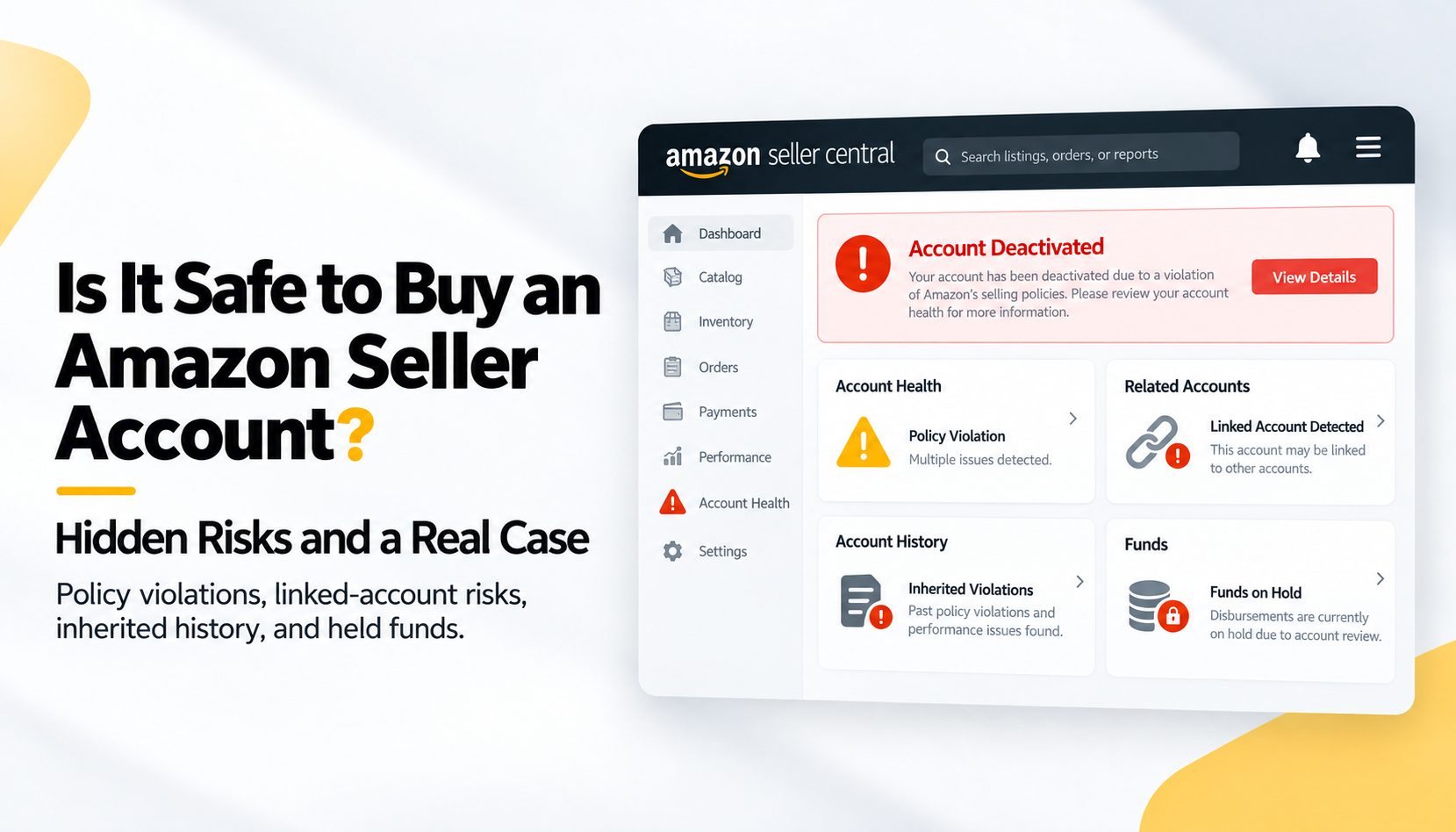
Is It Safe to Buy an Amazon Seller Account? The Hidden Risks and a Real Case
October 6, 2026
Key Takeaways
- Buying an Amazon seller account violates Amazon's Business Solutions Agreement, which prohibits transferring rights or obligations without Amazon's written consent since August 24, 2026.
- Purchased Amazon accounts inherit the previous owner's complete history including IP complaints, policy warnings, and ASIN violations that can trigger immediate suspension.
- A seller who bought an account after his own deactivation had the purchased account suspended within one week due to an old IP violation from a previous owner.
- Reinstating your original Amazon account preserves your ASINs, reviews, seller feedback, Brand Registry, funds, and listings while avoiding related account violations.
- Amazon's Suspension Analyzer by Mr. Jeff AMZ identifies the root cause of deactivation and provides tailored reinstatement steps in under one minute.
Buying an Amazon seller account after your own gets deactivated looks like the fast, cheap way back into the marketplace. In practice it is one of the riskiest moves a seller can make, and in most cases it costs more than reinstating the account you already have.
A typical scenario we see: a seller receives a deactivation notice, spends a few days reading forum threads, finds an account for sale at a fraction of the price of professional reinstatement, and buys it. A few weeks later the new account is deactivated too. Now the seller has lost the purchase price, the setup time, the launch budget and, sometimes, the money sitting in the account.
This guide walks through the real pros and cons of buying an Amazon account, what Amazon's rules say about it, what you need to know before you buy one, and a real case from our own practice in which an account was suspended almost immediately after it was purchased.
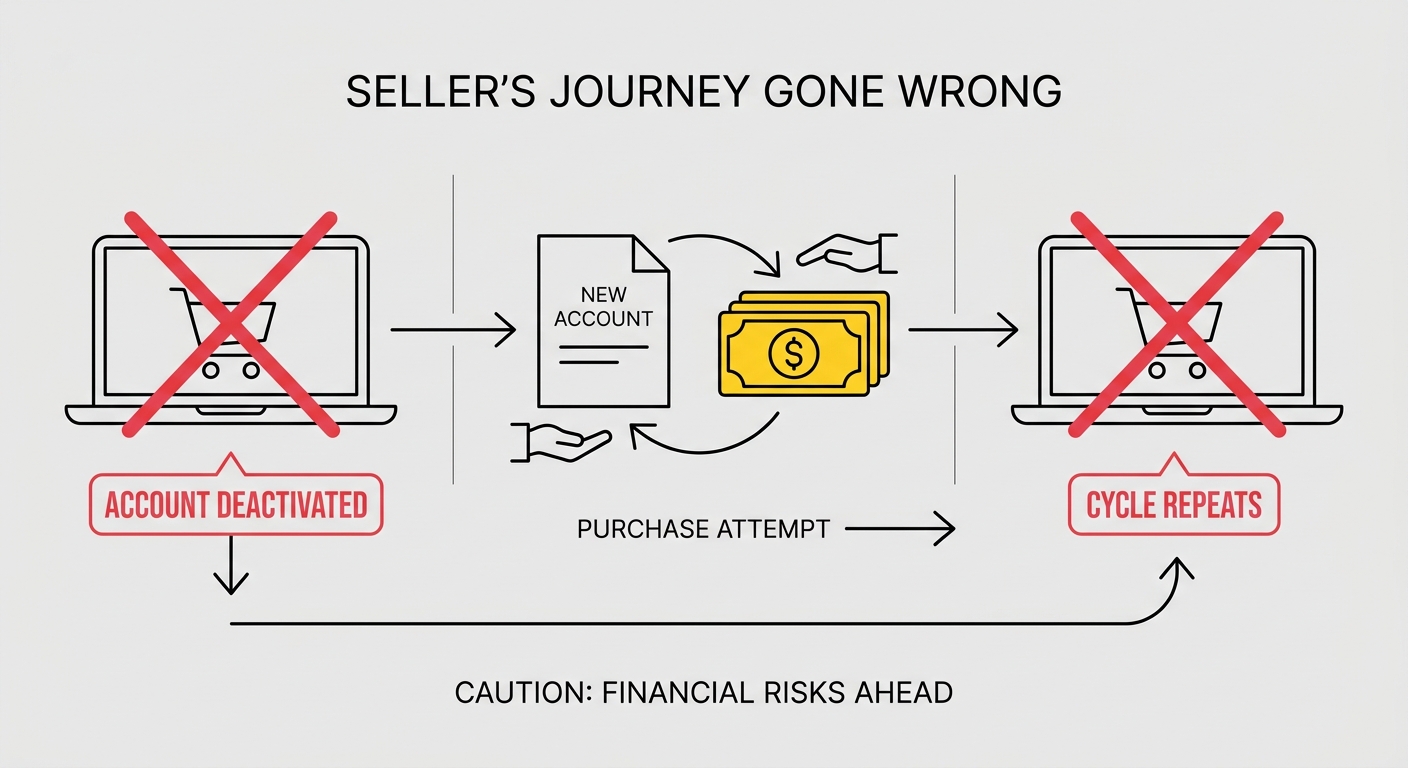
The costly cycle: buying a new account often leads to the same outcome
Why buying an Amazon seller account looks like the easy way out
Sellers who lose an account usually worry about the same three things: time, money and control.
Time comes first. Inventory is sitting in a warehouse, a supplier is waiting for the next order, and an appeal can take weeks. An account that is already live promises sales next week.
Money is second. The asking price for an account is often lower than the fee for professional reinstatement, and a broker quotes it as one flat number. An appeal feels open-ended by comparison.
Control is third. An appeal means waiting for Amazon to answer. A purchase is a transaction you can finish today.
Brokers and sellers in Telegram and Facebook groups know this and pitch accordingly: "aged account," "verified," "clean history," "comes with sales." The listings rarely say what the account was used for, who else has had access to it, or which ASINs ever passed through it.
All three arguments rest on one assumption, that the purchased account will keep working. That is where most of these deals fall apart.
Is it allowed to buy an Amazon seller account?
Not in the way most sellers do it. Amazon's Business Solutions Agreement (BSA), the contract every seller accepts, already required Amazon's written consent before the agreement could be transferred. The update that took effect on August 24, 2026 goes further: sellers may no longer transfer or pledge their "rights or obligations" under the BSA, not only the agreement itself.
Amazon does have a formal route for genuine business changes such as an acquisition or merger. The seller opens a case in Seller Central, explains the change and submits documents such as business licenses. That path exists for deals where a legal entity changes hands. It was not built for a broker passing login details to a stranger.
Three practical consequences follow.
Ownership has to match. Every account is tied to a verified person or business, with ID, bank and tax details. When the person running the account does not match what Amazon has on file, Amazon may suspend the account or hold funds until it is resolved.
One seller, one account. Amazon's Prohibited Seller Activities policy bars operating more than one seller account without prior permission, and a suspended second account is treated like any other suspension: it needs a plan of action and an appeal. If you are the person whose account was just deactivated, a second account is exactly what that rule is aimed at.
Amazon is not a party to the deal. If the purchased account is deactivated, you are negotiating with a broker or a seller, not with Amazon.
What is hidden behind the "advantages" of buying an Amazon account
Every argument for buying an account sounds reasonable until you look at what sits behind it. These are the five most common "advantages" and what is actually underneath each one.
"It's fast." The account may be live, but changing the identity and payment details triggers new checks, and any mismatch can put the account on hold. The speed disappears if the account is suspended in week two.
"It's cheaper." The price is only the first payment. Inventory, ad spend and launch costs all sit on an account that can be suspended for reasons you cannot see.
"It comes with history and seller feedback." History cuts both ways. It carries the previous owner's violations, complaints and ASINs along with the good numbers.
"It already has category approvals." Approvals were earned by the original seller. A change of operator can bring them back under review, and a restricted category comes with its own compliance record.
"I get to skip the appeal." You skip the process that fixes the underlying problem and take on a new account with that problem unfixed. If Amazon links you to your old deactivated account, the new one can be suspended as a related account.
Each of these benefits depends on the account staying active, and that is the one thing you cannot verify before you pay.

The risks of buying an Amazon account
The risks fall into six groups, and most of them cannot be seen from the outside.
1. You inherit the account's entire history. Listings, ASINs, customer complaints, IP notices and policy warnings from earlier owners stay attached to the account. You become responsible for them whether or not anyone mentioned them at the sale.
2. Old IP complaints can come back. Intellectual property notices often point at listings created long ago. A product added years before the sale can still be the basis for a rights-owner complaint against the account you now own. The case below shows exactly this.
3. Related-account links. Amazon connects accounts through shared details and behavior. One Amazon seller law firm reports buyers being suspended because the purchased account was related to another account held by the previous owner, or opened by them after the sale, with suspensions arriving within months and even years after closing. You cannot audit what the seller does next.
4. Your own history follows you. If you are the seller whose account was just deactivated, the new account may share a name, bank details, address, device or payment method with the old one. An account bought right after a suspension can read as an attempt to get around it, and it can weaken your original appeal because the new account becomes evidence against you.
5. Someone else may still hold the keys. Previous owners know the original email address, phone number and payment details. Unless every recovery detail has been changed properly, the account is not fully yours.
6. Money and inventory are exposed. When an account is deactivated, the balance is usually held and FBA inventory is stuck. The purchase price is the smallest part of the loss.
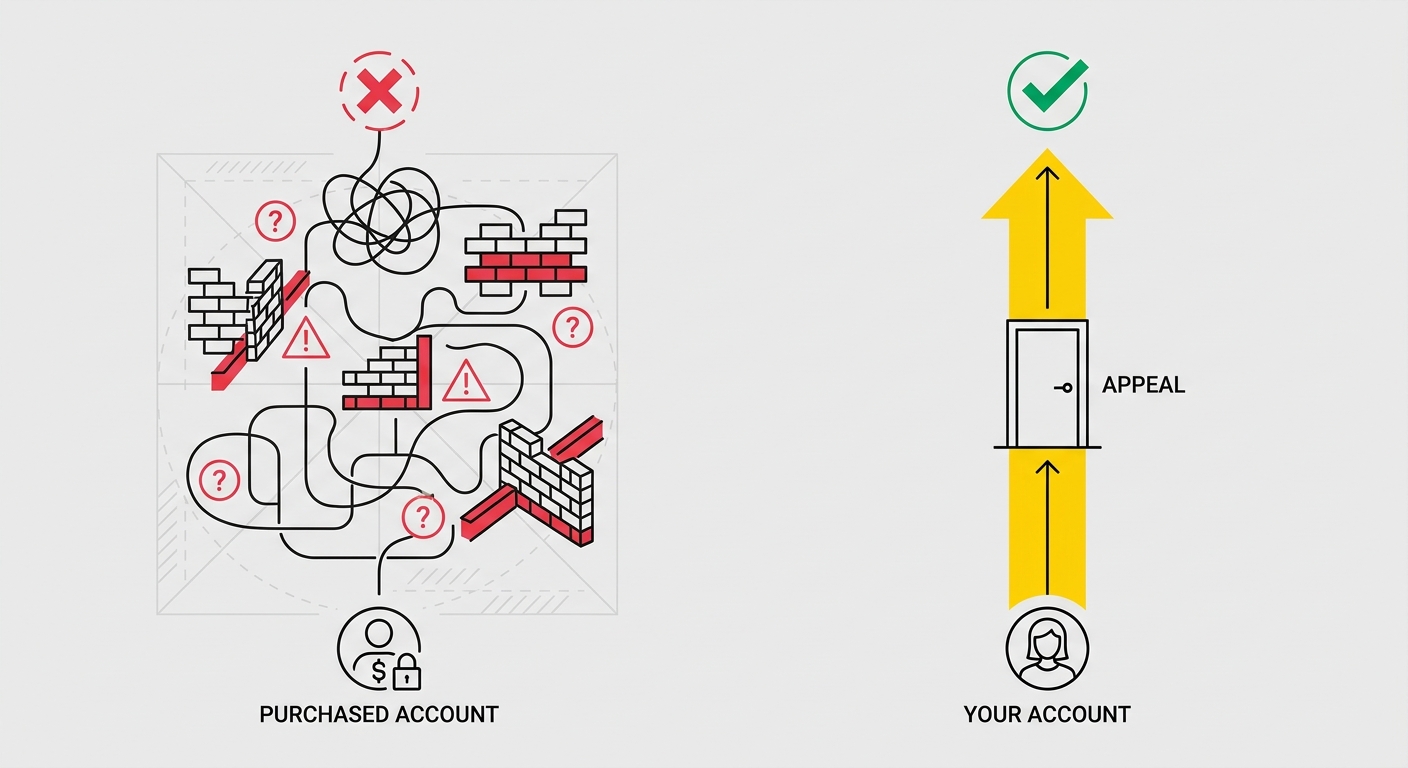
Two paths forward: the complexity of a purchased account vs. the clarity of reinstatement
🔍 Case study: an account deactivated one week after purchase
A seller recently came to us with the following case.
His own account had been deactivated under Section 3 of Amazon's policies, the concern about selling inauthentic products. He believed that reinstating it was impossible and decided to buy a new account instead. He bought an older Amazon account, the transfer went through smoothly, and he started preparing the account for the launch of his own brand. All of the old inventory was removed completely.
Then, unexpectedly, the account was deactivated for a violation of Amazon's Intellectual Property policy. The notice named a very well-known, large brand. The ASIN in question had never had a single sale, and the product had been added to the account long before it changed hands.
When we started digging into the situation, we found some unpleasant information: the account had already been sold three times, the last sale 11 months earlier.
❗️ Why was the account deactivated, even without active sales?
This is the key point to understand.
1️⃣ Amazon analyzes the account's history, not only its current activity. Past violations, listings, ASINs and complaints remain in the system permanently.
2️⃣ Deleting inventory ≠ cleaning the account. Even if you remove everything from the account, Amazon keeps taking the historical data into account.
3️⃣ When you buy an account, you inherit every risk of the previous owner. It makes no difference whether you knew about them or not.
Buying an account means buying someone else's history, someone else's violations and someone else's risks. Even if an account looks clean at first glance, that does not mean there will be no problems.
✅ What did we do?
We reviewed the state of the account and the text of the deactivation notice.
We walked the seller through what restoring his original account could offer compared with the purchased one: a record he controlled; a cause that could be identified and addressed; an appeal built on his own history instead of a stranger's.
Given the situation, the seller decided to move forward with reinstating his own account.
Spoiler: we reinstated his own Amazon seller account in less than 6 weeks.
➡️ Read the full reinstatement story.
Why reinstating your own Amazon account is the safer bet
You keep what you built. ASINs, reviews, seller feedback, Brand Registry if you are enrolled, and years of sales history all live in the original account. A purchased account starts with nothing of yours in it.
Your funds stay in play. Amazon typically holds the balance of a deactivated account while it reviews the case. The route to that money runs through the account itself. Once the account is reinstated, you also regain access to your funds.
Your listings stay in place. Product pages, content, pricing history and ASIN-level performance remain tied to your account, so after reinstatement you resume selling instead of rebuilding the catalog from scratch.
No new setup. Your verified identity, tax and bank details stay on the account, so you skip another round of registration and checks.
You avoid a related-account problem. One account, one history, nothing to explain about why a second account appeared right after the first was suspended.
You stay within Amazon's rules. An appeal goes through Amazon's own channel, so there is no off-platform transfer to explain and no extra risk created by the way you got the account.
The fix is specific. You have the full account history, Amazon's messages, the appeal history and a clear understanding of what likely triggered the deactivation. That is a strong starting point for an appeal and gives you good chances of getting the account reinstated, especially with professional help from Mr. Jeff AMZ.
Taken together, these points make reinstating your own account the safest way to get back to selling and to build a stable business, without carrying a stranger's history and risks along with it.
How Amazon account reinstatement works
Every deactivation is different, but strong appeals follow the same logic.
Read the notice closely. Identify the exact policy, the ASINs or orders involved and the evidence Amazon cites. For a faster route, use the Suspension Analyzer by Mr. Jeff AMZ and get a breakdown of your deactivation notice in less than a minute:
identification of the likely root cause
an explanation of the deactivation type and its possible trigger
clear steps toward reinstating the account, tailored to your suspension type
Audit the account. Go through Account Health, performance notifications, ASIN history, complaints and any earlier correspondence with Seller Performance.
Find the real root cause. Be honest about what went wrong, and note where Amazon's claim looks mistaken.
Write the Plan of Action. Amazon expects three things: the root cause, the actions you have taken to fix it, and the steps that prevent it from happening again.
Attach the evidence. Supplier invoices, authorization letters, rights-owner retractions and internal procedures, depending on the policy involved.
Submit and follow up. If the appeal is rejected, read the reply for what is still missing and answer that, instead of sending the same text again.
Complex deactivations, and cases where an appeal has already been rejected, are where professional reinstatement help matters most. If you are in that position, talk to specialists before you submit again. At Mr. Jeff AMZ, we have specialized in account reinstatement for more than 5 years and have reinstated hundreds of seller accounts.
The bottom line
A bought account feels like a fresh start, but it comes with someone else's history, a purchase that Amazon's rules do not support, and no way to see what is in the file. Your own account has problems too, but they are known, specific and fixable.
If your Amazon account is deactivated, start with the notice. Send it to us and our team will tell you honestly whether reinstatement is realistic. Mr. Jeff AMZ has worked with sellers on reinstatement and account health since 2021 across all Amazon marketplaces.
Need Help With Amazon Account Reinstatement?
If your Amazon seller account was deactivated, that doesn't mean the account is lost. In cases like this, strategic escalation to the right channels, backed by professional help, is often what decides the outcome.
At Mr. Jeff AMZ, we specialize in reinstating suspended Amazon seller accounts, even in the most complex cases. Our team has successfully helped hundreds of Amazon sellers get their accounts back and return to selling.
Here's what you get when you work with Mr. Jeff AMZ:
Insider Expertise — Our specialists include ex-Amazon staff and top Amazon sellers who understand exactly how Amazon reviews appeals behind the scenes.
Custom Plans, No Templates — Every submission is built from scratch, fully tailored to your specific violation type and account history.
Unlimited Revisions — We work on your case until reinstatement. No revision limits, no hidden fees.
Dedicated 1-on-1 Support — You'll have a personal senior reinstatement manager guiding you through every step of the process.
Fast-Track for Urgent Cases — If your business is on pause and time matters, we offer priority handling for urgent reinstatement cases.
Honest Case Review — If reinstatement isn't realistically possible, we'll tell you upfront. No false promises. No wasted time.
Get a Free Expert Case Review
➡️ Fill out the form and get a free expert consultation with our reinstatement specialist.

Author
Helen
Head of Client Success at Mr. Jeff AMZ
Helen leads Sales & Client Success at Mr. Jeff AMZ, guiding Amazon sellers from their first suspension panic to a fully recovered account. With years of frontline experience managing reinstatement cases, she translates Amazon's dense policy language into clear, actionable next steps and keeps sellers informed at every stage of the appeal.
Connect on LinkedInFrequently Asked Questions
Is it legal to buy an Amazon seller account?
While not illegal, buying an Amazon seller account violates Amazon's Business Solutions Agreement (BSA). Amazon requires written consent before any account transfer, and the August 2026 update further prohibits transferring rights or obligations under the BSA. Most account sales through brokers or online groups don't follow Amazon's formal transfer process.
What happens if Amazon catches me using a purchased account?
Amazon will likely deactivate the purchased account, often within weeks of the transfer. You'll lose the purchase price, any setup costs, your launch budget, and potentially funds held in the account. Additionally, Amazon may link your identity to the deactivation, making it harder to operate on the platform in the future.
Why do purchased Amazon accounts get suspended so quickly?
Amazon's verification systems detect inconsistencies when ownership details don't match the new operator. Every account is tied to verified identity documents, bank accounts, and tax information. When login patterns, IP addresses, or business details suddenly change without proper documentation, Amazon flags the account for review.
Is buying an account cheaper than getting my suspended account reinstated?
While the upfront cost may seem lower, buying an account typically costs more in the long run. When the purchased account gets deactivated, you lose the purchase price, setup time, inventory investments, and any funds in the account. Professional reinstatement of your original account is often the more cost-effective solution.
Does Amazon have a legitimate process for transferring account ownership?
Yes, Amazon does offer a formal route for genuine business changes like acquisitions or mergers. Sellers must open a case in Seller Central, explain the ownership change, and submit documentation such as business licenses. However, this process was designed for legitimate business transactions—not for brokers selling account access to strangers.
What should I do instead of buying an Amazon seller account?
Consider these alternatives:
- Appeal your suspension through Amazon's official process
- Hire a professional reinstatement service for your existing account
- Address the root cause of your deactivation to prevent future issues
Reinstating your original account is usually safer and more sustainable than starting over with a purchased one.
What red flags should I watch for when someone offers to sell me an Amazon account?
Be wary of sellers who advertise "aged accounts," "verified," or "clean history" without providing details about previous ASINs, past users, or what the account was used for. Legitimate business transfers require proper documentation through Amazon—not login credentials passed through Telegram or Facebook groups.