
Amazon Tips
Amazon Appeal Rejected? Fix It Now - Expert Guide
January 12, 2026
Key Takeaways
- Amazon rejects appeals primarily when sellers fail to identify the specific root cause of their policy violation with detailed evidence and analysis.
- Successful Amazon appeals should be 400-600 words and include specific corrective actions already taken, preventive measures, and supporting documentation like invoices or new SOPs.
- Emotional appeals mentioning financial hardship or family obligations do not influence Amazon's Performance team, which requires strictly professional, fact-based responses instead.
- Sellers must address every ASIN and policy violation mentioned in their suspension notice individually, as missing even one issue guarantees appeal rejection.
- If an appeal is rejected multiple times, sellers should wait 24-48 hours before resubmitting and strengthen their documentation rather than immediately reappealing with the same approach.
Amazon Appeal Rejected? Fix It Now - Expert Guide
Getting that dreaded email from Amazon saying your appeal has been rejected feels like a punch to the gut. You've poured your heart into crafting what you thought was the perfect appeal, only to receive another rejection notice. If you're reading this, chances are you're frustrated, confused, and desperately seeking answers.
Here's the thing: Amazon rejects thousands of appeals daily, but it's not because they enjoy making sellers suffer. Most rejections happen for specific, fixable reasons that sellers simply aren't aware of. In this comprehensive guide, we'll uncover the hidden reasons behind appeal rejections and show you exactly how to fix them to get your Amazon seller account reinstated.
The Top 10 Reasons Amazon Rejects Appeals (And What to Do Instead)
1. Your Appeal Lacks a Clear Root Cause Analysis
The number one reason appeals fail? Sellers don't properly identify and explain the root cause of their policy violation. Amazon doesn't want to hear excuses or sob stories – they want to know you understand exactly what went wrong.
What Amazon Wants to See:
A specific explanation of what caused the violation
Evidence that you've investigated the issue thoroughly
Clear acknowledgment of the policy you violated
How to Fix It: Start your appeal by stating the exact policy you violated and provide a detailed analysis of why it happened. For instance, if you received an inauthentic complaint, explain the specific supplier issue or inventory management problem that led to it.
2. You're Making Emotional Appeals Instead of Professional Ones
Look, we get it. Your Amazon business might be your livelihood, and a suspension feels personal. But Amazon's Performance team reviews hundreds of appeals daily – emotional pleas about feeding your family or paying bills won't move the needle.
Common Emotional Mistakes:
"This is my only source of income"
"I have employees depending on me"
"I've been a loyal seller for X years"
How to Fix It: Keep your appeal strictly professional and fact-based. Focus on demonstrating your understanding of Amazon's policies and your concrete plan to prevent future violations. Save the personal story for your autobiography.
3. Your Plan of Action Is Too Vague
Amazon needs to see specific, actionable steps you'll take to prevent future issues. Saying "we'll do better" or "we'll be more careful" is like telling your doctor you'll "try to be healthier" – it means nothing without specifics.
Elements of a Strong Plan of Action:
Immediate Actions:
What you've already done to address the issue
Specific changes implemented in your operations
New quality control measures in place
Preventive Measures:
New SOPs (Standard Operating Procedures) created
Staff training programs implemented
Technology or software solutions adopted
Monitoring Systems:
How you'll track compliance going forward
Regular audit schedules
Key performance indicators you'll monitor
4. You're Denying Responsibility or Blaming Others
Even if your supplier sent you counterfeit goods or a customer made a false claim, pointing fingers won't help your appeal. Amazon holds you responsible for everything that happens in your seller account, period.
How to Fix It: Accept full responsibility while still explaining the circumstances. For example: "While our supplier provided falsified documentation, we acknowledge that it's our responsibility to verify all products before listing them on Amazon. We've since implemented a three-step verification process..."
5. Your Appeal Is Too Long or Too Short
Amazon's Performance team has limited time to review each appeal. A 10-page novel won't get read, but a three-sentence response shows you're not taking it seriously.
The Goldilocks Formula for Appeal Length:
Introduction: 2-3 sentences acknowledging the issue
Root Cause: 1-2 paragraphs explaining what went wrong
Corrective Actions: 3-5 bullet points of completed actions
Preventive Measures: 3-5 bullet points of future safeguards
Conclusion: 1-2 sentences requesting reinstatement
Total Length: Aim for 400-600 words for most appeals.
6. You Haven't Addressed All the Issues Amazon Raised
If Amazon suspended you for multiple ASINs or policy violations, you must address each one individually. Missing even one issue guarantees a rejection.
How to Fix It: Create a checklist of every issue mentioned in your suspension notice. Structure your appeal with clear sections addressing each violation separately, then tie them together with an overarching improvement plan.
7. Your Documentation Doesn't Support Your Claims
Saying you've implemented new procedures without proof is like claiming you can fly without demonstrating it. Amazon wants evidence, not promises.
Essential Documentation to Include:
Invoices from authorized suppliers
New standard operating procedures (as PDF attachments)
Staff training records or certificates
Screenshots of new software or systems implemented
Supplier authorization letters
Quality control checklists
8. You're Using an Obviously Templated Response
Amazon can spot a generic template from a mile away. If your appeal could apply to any seller facing any issue, it's too generic.
Red Flags of Template Usage:
Generic policy quotes without specific application
Vague improvement promises
No mention of your specific products or business model
Copied text from online forums or appeal services
How to Fix It: Write your appeal from scratch, focusing on your unique situation. Reference specific ASINs, dates, and circumstances. Show Amazon that a real human who understands their specific violation wrote this appeal.
9. You Haven't Fixed the Underlying Issue
This might sound obvious, but many sellers submit appeals before actually fixing the problem. If you're appealing an intellectual property complaint without removing the infringing listings, you're wasting everyone's time.
Pre-Appeal Checklist:
Remove all policy-violating listings
Resolve any pending customer complaints
Update any outdated account information
Clear any outstanding performance notifications
Implement at least some corrective measures
10. Your Appeal Contains Errors or Inconsistencies
Grammatical errors, contradictions, or factual mistakes instantly damage your credibility. If you can't proofread an appeal, how can Amazon trust you to manage quality control?
Common Credibility Killers:
Spelling or grammatical errors
Incorrect policy citations
Contradictory statements
Wrong dates or ASIN numbers
Formatting issues that make the appeal hard to read
The Anatomy of a Successful Appeal
Now that you know what not to do, let's break down exactly what a successful appeal looks like:
Opening Statement
"We acknowledge that we violated Amazon's [specific policy] on [date] with ASIN [number]. We take full responsibility for this violation and have taken immediate action to address it."
Root Cause Analysis
Provide a clear, factual explanation of what led to the violation. Be specific about dates, suppliers, processes, or systems that failed.
Immediate Corrective Actions
List 3-5 specific actions you've already taken, with dates and supporting documentation where applicable.
Long-term Prevention Plan
Detail 3-5 systemic changes that will prevent recurrence, including new processes, training, or technology implementations.
Closing Request
"We are committed to maintaining Amazon's high standards and request the opportunity to demonstrate our improved operations through reinstatement."
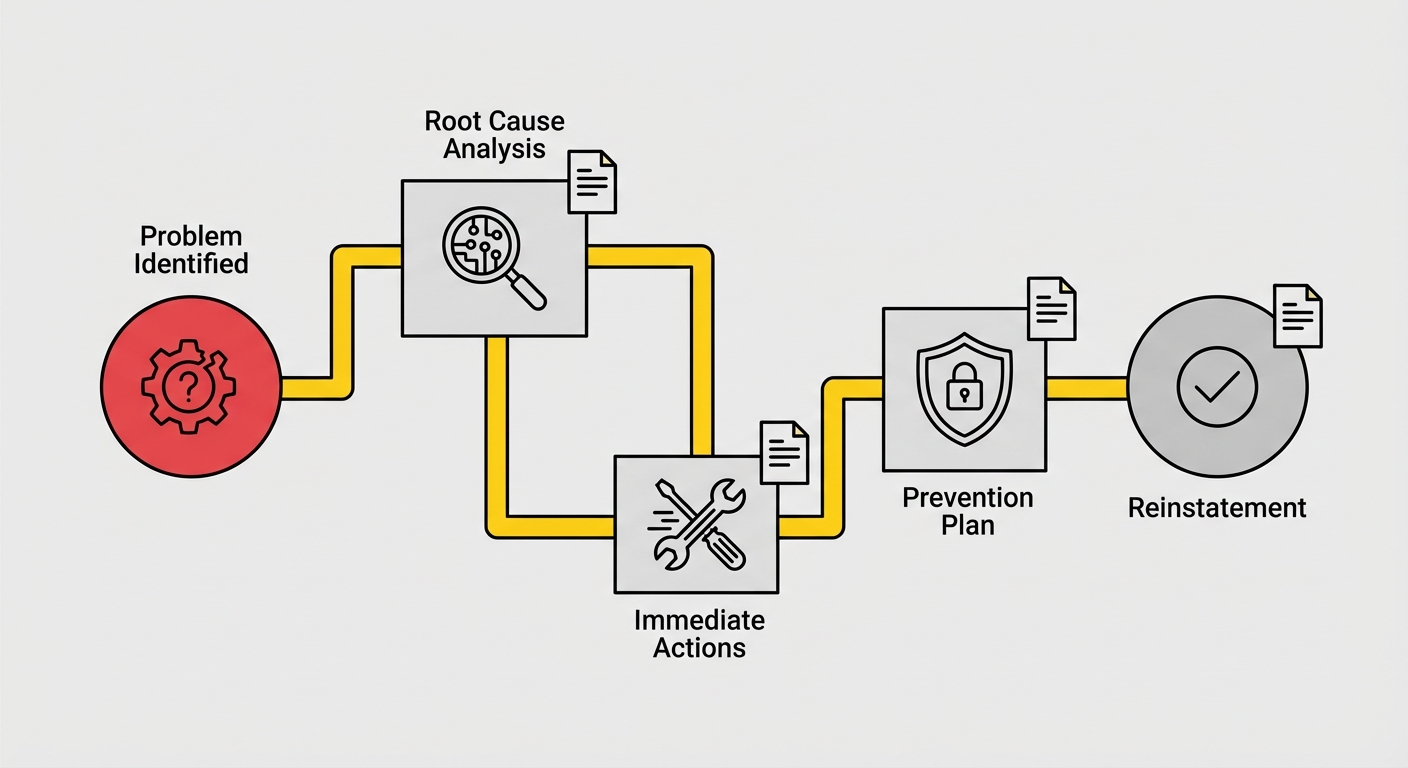
The successful appeal roadmap: A systematic approach to reinstatement
What to Do If Your Appeal Gets Rejected Again
If you've followed all the advice above and still received a rejection, don't panic. Here's your action plan:
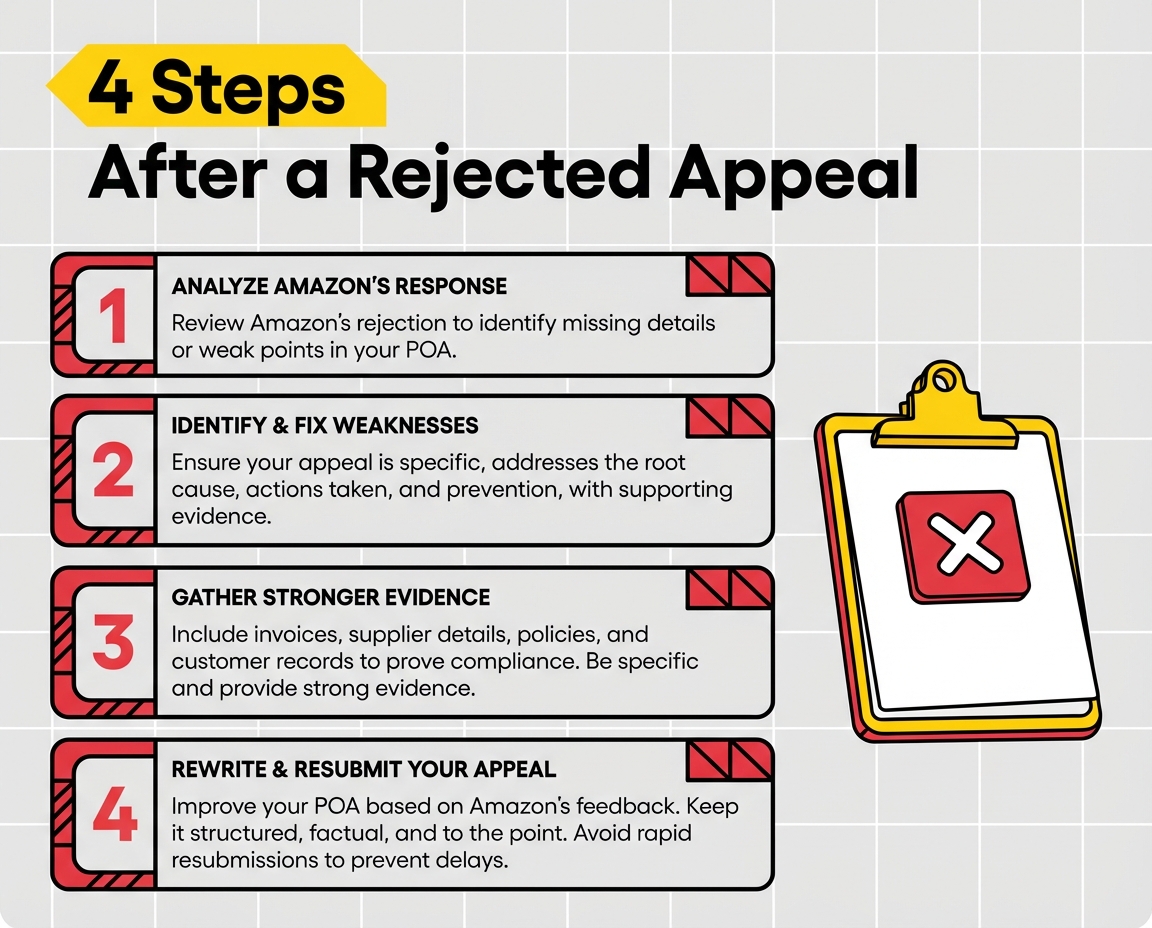
1. Wait 24-48 Hours
Don't immediately resubmit. Take time to cool down and reassess.
2. Analyze the Rejection
Look for any specific feedback in the rejection notice. Sometimes Amazon provides hints about what's missing.
3. Strengthen Your Documentation
Gather additional evidence, invoices, or create more detailed procedural documents.
4. Consider Professional Help
If you're on your third or fourth rejection, it might be time to consult with an Amazon reinstatement service that specializes in complex cases.
5. Escalate Appropriately
As a last resort, you can escalate to Amazon's executive team, but only after exhausting regular channels and ensuring your appeal is bulletproof.
Conclusion: Your Path to Reinstatement
Getting your Amazon appeal rejected doesn't mean your selling journey is over – it means you need to approach the situation differently. The key to a successful appeal isn't about convincing Amazon to give you another chance; it's about demonstrating that you understand their policies and have implemented concrete changes to ensure compliance.
Remember, Amazon wants compliant sellers who contribute to a positive customer experience. Show them you can be that seller by addressing each issue thoroughly, providing specific solutions, and backing up your claims with solid documentation.
If you're facing a particularly complex suspension or need help with related issues like Amazon account verification or policy compliance, don't hesitate to seek professional guidance. The cost of expert help is minimal compared to the ongoing losses from a suspended account.
Take action today: Review your rejection notice, identify which of these common mistakes you made, and craft a stronger appeal that addresses Amazon's real concerns. Your business depends on it, and with the right approach, reinstatement
Why Choose Mr. Jeff AMZ for Account Reinstatement?
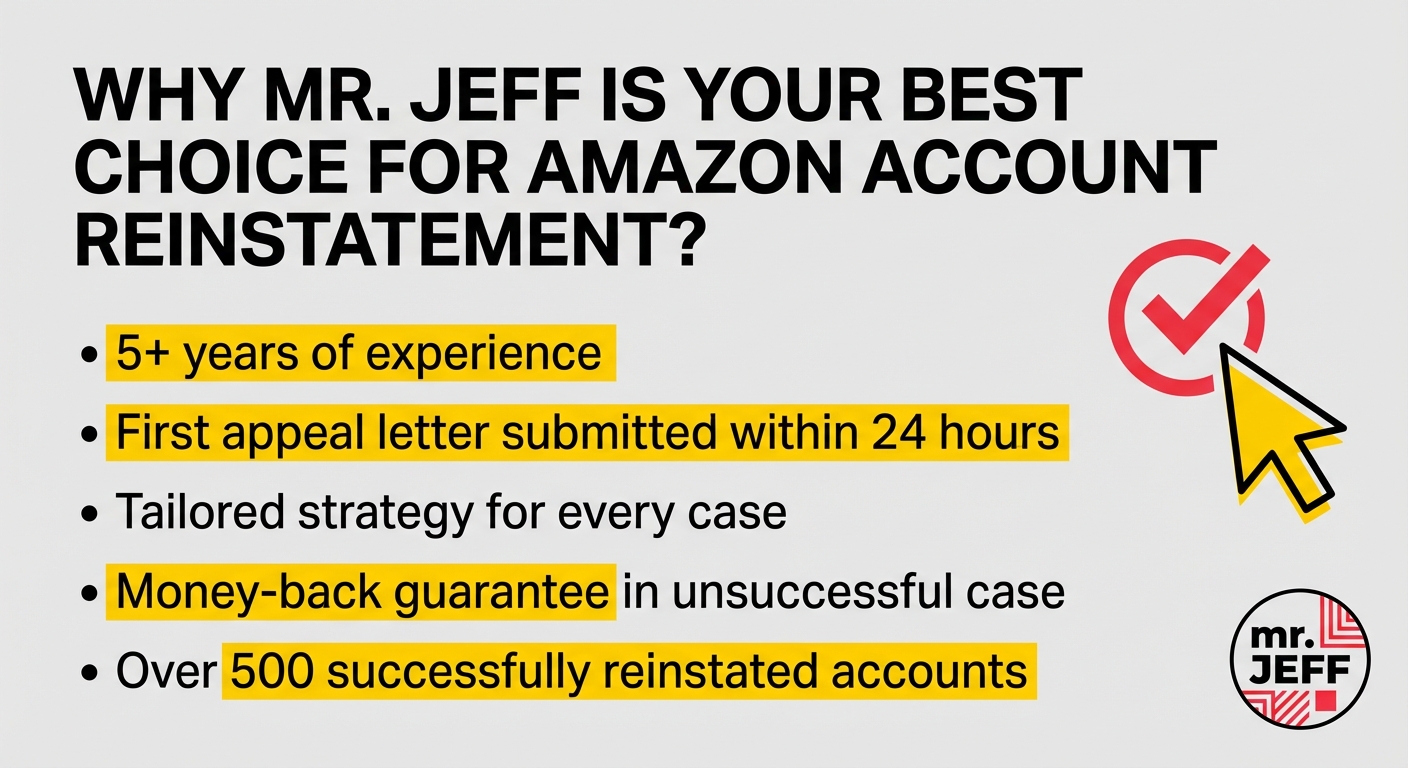
At Mr. Jeff AMZ, we specialize in reinstating suspended Amazon seller accounts, even in the most complex cases. Our team has successfully helped 500+ sellers get their accounts back and return to selling.
Insider Expertise
Our specialists include ex-Amazon staff and top Amazon sellers who understand how Amazon reviews appeals behind the scenes.Custom Plans — No Templates
Every Plan of Action (POA) is written from scratch, fully tailored to your specific suspension and account history.Unlimited Revisions
We work on your case until reinstatement — no revision limits, no hidden fees.Dedicated 1-on-1 Support
You’ll have a personal reinstatement expert guiding you through every step of the process.Fast-Track for Urgent Cases
If your business is on pause and time matters, we offer priority handling for urgent reinstatement cases.Honest Case Review
If reinstatement isn’t realistically possible, we’ll tell you upfront. No false promises. No wasted time.
Our reinstatement specialists know exactly what Amazon expects — and how to craft a POA that Amazon actually approves.
Get a full analysis of your Amazon suspension in just 2 minutes
Not sure where to begin your appeal or which strategy gives you the best chance of reinstatement?
Simply upload your amazon deactivation notice into Ban Decoder and get a full expert case analysis in just 2 minutes.
Expert Policy Analysis
Success Probability Calculation
Instant Reinstatement Strategy Report
No guessing. No generic advice.
Just a clear, data-driven plan to move forward with confidence.

Author
Rick
Senior Reinstatement Consultant at Mr. Jeff AMZ
Rick is a Senior Reinstatement Consultant at Mr. Jeff AMZ with 6 years of experience appealing Amazon suspensions. He specializes in solving complex Amazon issues like Section 3, IP, and review-related enforcement, helping sellers recover deactivated accounts. His superpower is knowing Amazon's policies better than most Amazon reviewers do and building a compelling, watertight case for any position.
Connect on LinkedIn