Amazon Tips
Competitor Sabotage on Amazon: How Your Competitor Can Trigger Your Account Suspension.
May 7, 2026
Key Takeaways
- Amazon's automated enforcement system removes listings and suspends accounts before verifying complaints, allowing competitors to weaponize fake IP infringement reports using only throwaway email addresses.
- Competitors purchase products to file fake safety complaints or send buyer messages referencing fabricated review-for-refund agreements, triggering Amazon AI flags that result in seller suspensions.
- Bad actors inject restricted keywords like antibacterial or antimicrobial into competitor listings through Amazon's open catalog contribution system, causing automatic reclassification and compliance suspensions.
- Registering a trademark and enrolling in Amazon Brand Registry provides priority standing and direct escalation channels that significantly reduce vulnerability to IP complaint attacks and listing manipulation.
- Monitoring your listing for unauthorized changes weekly and documenting suspicious complaint patterns with timestamps creates the legal paper trail necessary to prove coordinated competitor sabotage to Amazon.
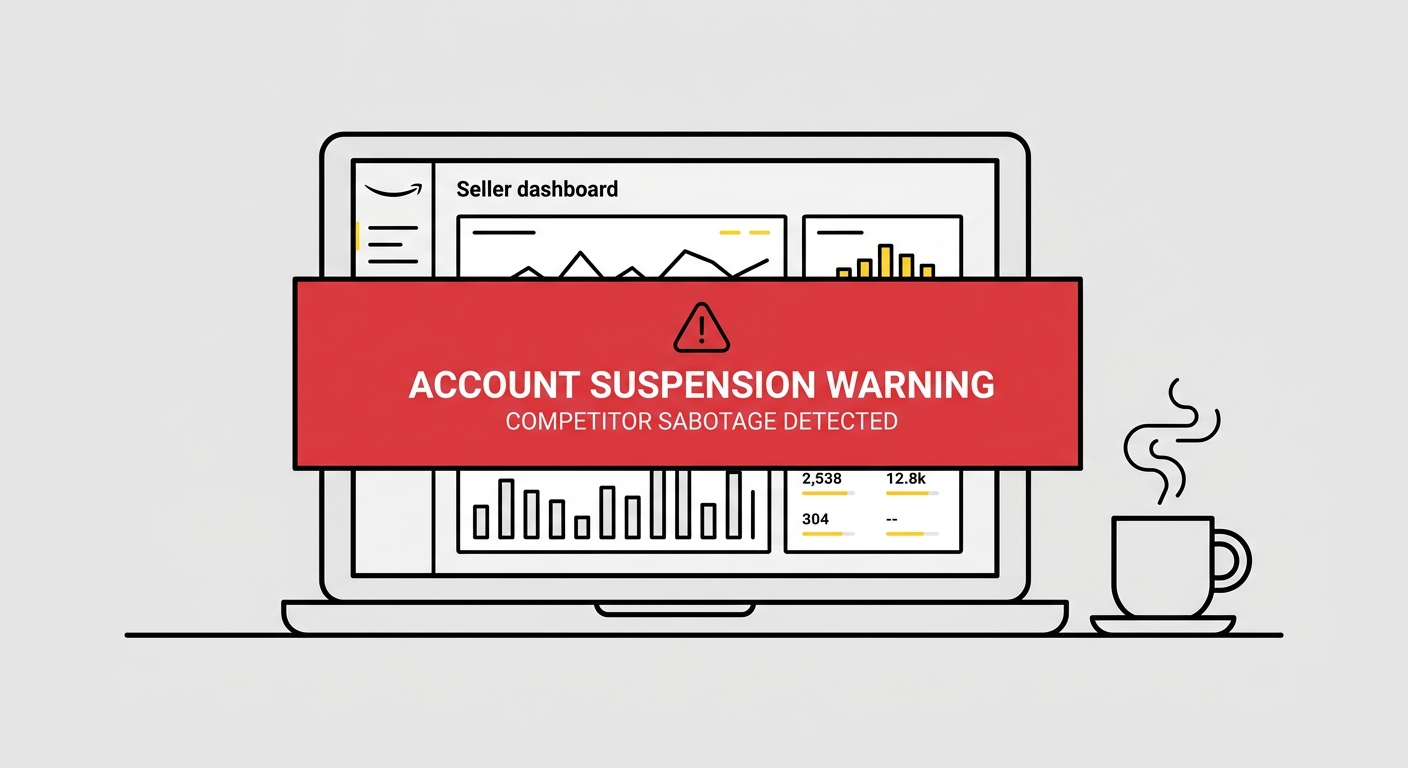
Picture this: It's Tuesday morning. You open Seller Central with a coffee in hand, and instead of your usual sales dashboard, you see it — a red banner "Your account has been deactivated". No warning, no explanation that makes sense, nothing but a vague notice about a "policy violation." Your listings are gone. Your FBA inventory is locked. Your revenue is zero.
You did nothing wrong. You followed every rule. So what happened?
In a growing number of cases, the answer is simple and brutal: a competitor did this to you. On purpose.
This is not a conspiracy theory. Amazon's enforcement system as powerful and well-intentioned as it is has a design flaw that bad actors figured out years ago. Amazon reacts first and investigates later. That means anyone who knows how to trigger a complaint, a flag, or a policy violation can effectively pull the plug on your business while you sleep.
I've helped hundreds of sellers navigate account reinstatement cases. A significant chunk of those suspensions weren't caused by seller mistakes — they were manufactured by competitors using black-hat tactics. In this article, I'm going to walk you through every major attack vector, explain exactly how these sabotage campaigns work, and give you a practical playbook to protect your account before and after an attack.
Let's get into it.
Who This Article Is For
Private label sellers, resellers, and brand owners selling on Amazon.com
Sellers who want to understand Amazon account suspension causes, IP complaint abuse, and black-hat competitor tactics — and how to defend against them.
Amazon businesses looking for proactive account protection strategies
How Amazon's Enforcement System Gets Weaponized
Before we get into specific tactics, you need to understand why Amazon is so easy to exploit in the first place.
Amazon processes millions of seller interactions every day. To manage this at scale, they rely heavily on AI and automated enforcement systems. These systems scan listings, flag keywords, process complaints, and trigger suspensions — all without a human being ever looking at your case.
That automation is Amazon's strength. It's also its greatest vulnerability.
The moment a complaint hits Amazon's system whether it's an IP infringement report, a safety concern, a fake buyer complaint, or a suspicious account link — the algorithm acts. Your listing goes down. Your account gets flagged. The burden of proof immediately shifts to you.
Amazon doesn't verify complaints before acting. They don't require the person filing a report to prove they have standing. They don't cross-check whether the complaint is part of a pattern of competitor abuse. They react, and then — maybe, if you appeal correctly they investigate.
This is the gap that black-hat sellers have turned into a full-service sabotage industry. Let's look at exactly how they do it.
ATTACK #1 — FAKE INTELLECTUAL PROPERTY COMPLAINTS
The IP Complaint Attack: The Nuclear Option
This is the most effective weapon in a bad actor's arsenal, and it's terrifyingly easy to deploy.
Amazon has an IP infringement reporting form that anyone can use. You don't need a seller account. You don't need legal representation. You don't need proof that you own anything. All you need is an email address, a product ASIN, and the ability to click "Submit."
How the Fake IP Attack Works
Step 1. A competitor identifies your best-selling ASIN — usually your top revenue driver.
Step 2. They create a throwaway email address and submit an IP infringement complaint to Amazon, claiming you're violating their trademark, copyright, or design patent.
Step 3. Amazon's system automatically removes your listing and sends you a notice to "contact the rights owner" at the email provided.
Step 4. You email that address. It either bounces, goes unanswered, or sends you in circles.
Step 5. Your ASIN stays down until Amazon hears from the "brand owner." Which never happens, because there is no brand owner.
In documented reinstatement cases, we've seen competitors cycle through five, ten, even fifteen different aliases and email addresses to keep filing claims after Amazon initially intervenes. Every time Amazon dismisses one complaint, a new one arrives from a different address, with slightly different wording.
For escalated attacks, some bad actors go further — they register a trademark for a name similar to yours, then file a legitimate-looking complaint. This is sometimes called a "ghost brand" attack. The IP claim looks real because, technically, it is. Fighting it requires legal action, not just an Amazon appeal.
⚠ Warning Signs You're Under an IP Attack
• Your best-selling ASIN goes down without any listing changes on your end
• Amazon's notice says to contact a rights holder at a free email address
• You receive multiple, repeated IP complaints within days of each other
• Complaints arrive shortly after you start outranking a competitor in search results
• The "brand" filing complaints has no public web presence or trademark registration you can verify
How to Defend Against It
• Register your own trademark before a competitor does. Brand Registry gives you priority standing and Amazon's direct escalation channels.
• Document every complaint: dates, email addresses used, ASIN targeted, timestamp of listing removal. Patterns of abuse are your strongest argument.
• File a counter-notification and send a detailed abuse report to Amazon's legal team directly — not just standard Seller Support.
• For repeated attacks from different aliases, consult an Amazon-focused appeal experts. A cease-and-desist letter to the identified party (even if anonymous) — creates a legal paper trail that Amazon takes seriously.
ATTACK #2 — FAKE BUYER COMPLAINTS & REVIEW BOMBING
The Fake Buyer Attack: Manufactured Evidence
This one is particularly insidious because it creates what looks, on the surface, like a legitimate customer problem. Amazon's AI sees it as a seller performance issue. You see it as something that came out of nowhere.
The Review Manipulation Trap
A competitor sets up a fake buyer account — or hires a service to do it — and purchases your product. They then send you a buyer message that says something like: "Thanks for the purchase. Per our agreement, I'll leave a 5-star review once I receive the refund."
You've never made any such agreement. But now there's a message in your account that, to Amazon's AI, looks like evidence of review manipulation. You can be suspended for a scheme you never participated in.
In 2025, Amazon's enforcement team dramatically increased suspensions in the Customer Product Reviews category. Their systems are trained to detect patterns — and a competitor who knows exactly which message strings trigger those detectors can manufacture the evidence themselves.
The Safety Complaint Flood
Fake buyers can also file safety complaints — claiming your product caused injury, triggered an allergic reaction, contained hazardous material, or caused an electrical fire. Amazon's Product Safety Team investigates immediately, and "immediately" means your listing comes down first.
Amazon's AI relies heavily on keyword detection. If buyer messages or reviews contain words like "fake," "inauthentic," "dangerous," "didn't work," or "injured," automated flags trigger before any human review.
A coordinated campaign of fake reviews using these keywords — spread across one to two weeks to look organic — can tank your rating, trigger enforcement flags, and spike your Order Defect Rate all at once.
The Switch-and-Return Scam
This is a classic that still works. A competitor purchases your product, swaps it with a counterfeit or significantly inferior item, then returns it and files an "inauthentic item" complaint with Amazon.
When the returned item comes back to you, it's obvious the product was switched. But proving that to Amazon is another matter. They see: a buyer complaint, a return, an "inauthentic" report. Their AI sees a pattern that matches fraud — just not in the direction it actually happened.
⚠ Warning Signs You're Under a Fake Buyer Attack
• Sudden spike in 1-star reviews with vague, generic language appearing within days
• Buyer messages referencing agreements or conversations you never had
• Returns arriving with products that are clearly not what you shipped
• ODR (Order Defect Rate) or return rate spiking with no change in your product or supplier
• Multiple negative reviews posted by accounts with no purchase history or limited review activity
How to Defend Against It
• Screenshot and save every suspicious buyer message immediately. Time-stamped evidence is critical.
• When a switched-return arrives, photograph everything — the packaging, the product, the return label — before touching it.
• Monitor your ODR, return rate, and review patterns weekly. Anomalies caught early are easier to address before they trigger enforcement.
• If you suspect coordinated review manipulation, report the specific review URLs to Amazon with your documented evidence of the attack pattern.

ATTACK #3 — LISTING MANIPULATION
The Silent Attack: Poisoning Your Own Listing
This is the attack most sellers never see coming — because it doesn't look like an attack from the outside. It looks like Amazon randomly flagged your listing for a compliance issue.
Amazon's catalog is an open contribution system. Other sellers, vendors, and in some cases automated tools can suggest edits to product listings. Amazon's AI often accepts these contributions automatically, especially if they come from accounts with established contribution history.
Competitors know this. They use it to poison your listing from the inside.
How Keyword Injection Works
Your product is a simple water bottle. A competitor opens a catalog contribution tool, adds "antibacterial" to your backend search terms, and submits it. Amazon's system automatically re-classifies your product as potentially falling under EPA pesticide regulations. Your PPC ads get blocked. Your listing gets flagged for compliance review. You're suspended before you even know what happened.
The same technique can classify benign health products as medical devices, simple cleaning products as regulated hazmat, or ordinary supplements as unapproved drugs — just by injecting the right trigger words.
Other keyword-injection targets include:
• "Anti-fungal" or "antimicrobial" → EPA pesticide classification
• "Kills 99.9% of germs" → drug-like claims requiring FDA compliance
• "Prevents infection" → medical device territory
• "Contains lithium" (even falsely) → hazmat FBA storage restrictions
Listing Hijacking and Content Tampering
Beyond keywords, bad actors can submit title changes, image swaps, or bullet point modifications that introduce policy-violating content into your listing — changes you may not notice until Amazon suppresses your ASIN.
Hijackers can also attach counterfeit products to your ASIN by adding themselves as sellers on your listing. Customers receive inferior products, leave negative reviews, and file complaints — all against your listing, even though it was someone else's inventory.
Proactive Defense: Audit Your Listing Monthly
• Download your Listing Category Report from Seller Central (Reports > Inventory Reports)
• Review every backend field — especially search terms, subject matter, and intended use
• Fill in every available field with legitimate content — blank fields are open doors for injection
• Set up listing-change alerts with monitoring tools so you're notified the moment your listing changes
• Use Ai or a compliance tool to scan your listing for restricted keywords every quarter
How to Defend Against It
• Lock down your listing with Brand Registry. It significantly reduces your vulnerability to unauthorized contributions.
• Enroll in Amazon's Transparency Program for serialized product authentication — this blocks counterfeit sellers from joining your listing.
• Check your listing for unauthorized changes every 1–2 weeks. Fix content issues before Amazon flags them.
• Use Amazon's A+ Content to control more of your detail page — branded content is harder to override than standard text.
ATTACK #4 — RELATED ACCOUNT TRAPS & PPC CLICK FRAUD
The Related Account Trap
Amazon's related-account detection system is one of its most aggressive and least forgiving enforcement mechanisms. If Amazon decides your account is linked to a previously suspended account, your account goes down immediately — even if you've never done anything wrong.
Here's the part that most sellers don't realize: this system can be manipulated.
Amazon links accounts based on dozens of data points — IP addresses, device fingerprints, bank accounts, tax IDs, business addresses, email addresses, and even behavioral patterns. A competitor who knows your business address can register a fake seller account using that address, get it suspended, and create a link to your legitimate account.
Other manufactured link methods include:
• Using your return address as their fake account's business address
• Flooding your account with orders from an IP address that Amazon has flagged or banned
• Submitting catalog contributions from a device or network that has a history with a suspended account
The result: you wake up to a message that your account is "related to another account that may not be used to sell on our site" — and you have absolutely no idea who or what you're linked to.
⚠ Related Account Risk: Things You Might Not Know Create Links
• Using public Wi-Fi or a coworking space to log into Seller Central
• Your virtual assistant accessing other Amazon accounts from the same computer or network
• Sharing a 3PL warehouse with another seller whose account gets suspended
• A former employee opening their own Amazon account after leaving your company
• Old, forgotten seller accounts you opened years ago and abandoned
PPC Click Fraud: Draining Your Ad Budget
This attack doesn't directly suspend your account — but it can destroy your profitability, kill your ad rankings, and signal anomalous account activity to Amazon's systems.
Click farms — services that use real people or bots to repeatedly click on sponsored listings — can be hired for a few hundred dollars. A competitor points that service at your best-performing ad campaign. Your budget evaporates with zero real customers. Your ACoS goes through the roof. Your campaign optimization data gets corrupted.
In sustained campaigns, click fraud can push a seller to pause ads entirely — which tanks organic ranking momentum and signals instability to the algorithm.
How to Defend Against
• Use a dedicated IP address and device for Seller Central. Never access your account from public networks or shared computers.
• Monitor your ad campaigns for sudden, abnormal spikes in clicks with no corresponding conversion activity.
• If you notice unusual traffic patterns, document them and report to Amazon via Seller Central's reporting channels.
• Regularly audit who has access to your account — employees, VAs, agencies. Remove anyone who no longer needs it.
• If you suspect a manufactured account link, report it to Amazon Abuse Prevention immediately before they flag you first.
Your Amazon Account Defense Playbook
Now that you know how the attacks work, let's talk about what to actually do — both to prevent them and to fight back when they land.
Before Any Attack: Build Your Defense Infrastructure
• Enroll in Amazon Brand Registry — your single most important account protection tool. It gives you greater listing control, access to A+ Content, and direct escalation pathways unavailable to unregistered sellers.
• Register your trademark, ideally before your product launches. An active registration changes your options dramatically when an IP complaint arrives.
• Build a "defense file" — a folder containing your supplier invoices, product test reports, authorization letters, trademark registration, brand guidelines, and any compliance certifications. Have this ready to submit within hours, not days.
• Set up listing-change alerts using monitoring tools. Know the moment your listing is edited, a new seller joins it, or your buy box changes hands.
• Use unique product identifiers — GS1-verified UPCs, serial numbers, Transparency codes — to authenticate your inventory and block counterfeit sellers.
When an Attack Lands: The First 48 Hours
The first two days after a suspension notice determine whether you're back in a week or fighting for months. Here's what to do:
• Do not panic-appeal. A rushed, vague Plan of Action hurts more than it helps. Spend the first few hours analyzing, not writing.
• Identify the specific trigger. Read the suspension notice carefully. Is it an IP complaint? A safety flag? A policy violation? An account linkage? Each requires a different response strategy.
• Gather evidence of the attack. Suspicious messages, pattern anomalies, screenshots, return item photos — collect everything before anything disappears.
• File an abuse report alongside your reinstatement appeal. Use [email protected] with "Competitor Sabotage" in the subject line. Attach all documented evidence.
• Appeal through the correct channel — use the appeal link in your Performance Notifications, not a new support case. Each duplicate case weakens your position.
Writing Your Plan of Action
Your Plan of Action (POA) is not an apology — it's a professional business document. Amazon wants to see three things:
• Root cause: What specifically caused this issue? Be precise, not generic.
• Corrective actions: What have you already done to address it?
• Preventive measures: What systems do you now have in place to prevent recurrence?
If you've been falsely targeted, your POA needs to simultaneously address Amazon's stated concern and document the attack against you. This dual approach — compliance response plus abuse documentation — is what separates fast reinstatements from month-long ordeals.
When to Bring in an Amazon Reinstatement Specialist
There are situations where DIY appeals simply are not enough:
• Repeated IP complaints from the same or similar sources, despite Amazon’s intervention
• False patent or trademark claims backed by actual — even if fraudulent — registrations
• Account deactivation after multiple rejected appeals
In these cases, professional Amazon reinstatement help is not just an option — it becomes a necessity.
An Amazon-experienced appeal expert can build a stronger case, communicate through the right escalation channels, document violations of Amazon’s Seller Code of Conduct, and, in serious cases, help prepare the evidence needed to challenge the party filing false complaints.
At Mr. Jeff AMZ, we have successfully resolved hundreds of suspension cases using our proven 3-step escalation strategy. In complex Amazon seller account suspension cases, this approach gives sellers the highest chance of faster reinstatement — especially when standard appeals have already failed.

✅ Amazon Account Protection Checklist
☑ Enrolled in Amazon Brand Registry with active trademark
☑ Enrolled in Transparency Program (serialized authentication)
☑ Listing-change alerts configured and tested
☑ Defense file ready: invoices, test reports, authorizations, trademark docs
☑ All listing fields filled — no blank backend fields
☑ Seller Central access restricted to dedicated IP and device
☑ VA/agency access audited and limited to necessary personnel
☑ Listing Category Report downloaded and reviewed this month
☑ Anomalous PPC activity monitored via campaign reports
☑ Know your escalation path: Support → Performance → Legal
Amazon's 2026 Enforcement Reality
One last thing worth saying plainly: Amazon's enforcement has gotten more aggressive, not less, heading into 2026. Their AI systems are more sophisticated, their Counterfeit Crimes Unit is better resourced, and their automated suspension triggers are more sensitive than ever.
That's mostly good news — Amazon is getting better at catching actual bad actors. But it also means legitimate sellers get caught in the crossfire more often. False positives from AI enforcement are real. Automated suspensions based on manufactured complaints are real. The sellers who survive this environment are the ones who treat account protection as a core business function, not an afterthought.
The difference between a seller who recovers in five days and one who fights for five months usually isn't the severity of the attack. It's the quality of their preparation.
The Bottom Line
Amazon's marketplace is genuinely competitive and some of that competition has turned predatory. Fake IP complaints, coordinated review bombing, keyword injection, manufactured account links, and PPC click fraud are not edge cases. They are documented, systematic attacks that real sellers deal with every day.
Knowing how these attacks work is your first line of defense. Implementing the protection infrastructure — Brand Registry, monitoring tools, a ready defense file, a documented escalation process — is your second.
And if an attack lands anyway? Don't go it alone. The fastest path through a suspension is a calm, evidence-backed appeal that shows Amazon exactly what happened, why it wasn't your fault, and what systems you've put in place to prevent it from happening again.
If you're dealing with an Amazon account suspension right now — whether from competitor sabotage, an IP complaint, a performance issue, or anything else — reach out to Mr.Jeff AMZ. Amazon seller account reinstatement is what we do. We've seen every variation of this, and we know the path back.
Need Help With an Amazon Account Suspension?
If your Amazon seller account has been suspended after competitor sabotage, repeated IP complaints, review manipulation flags, related account issues, or policy violations, the next appeal matters.
At this stage, a generic Plan of Action is not enough. Amazon needs a clear explanation of what happened, strong supporting evidence, and a structured reinstatement strategy that addresses the exact reason behind the enforcement action.
At Mr. Jeff AMZ, we help sellers move through the Amazon account reinstatement process with a calm, evidence-backed approach. Our team has handled hundreds of suspension cases, including complex situations involving false IP complaints, inauthentic claims, dropshipping violations, related accounts, Section 3 deactivations, and competitor abuse.
We don't use copy-paste appeal templates. Every case starts with a detailed investigation of the suspension notice, account history, ASIN-level issues, buyer complaints, documentation, and previous appeal attempts. From there, we build a custom reinstatement strategy designed to show Amazon what happened, what actions were taken, and why the account should be reinstated.
For difficult cases, we also use our proven 3-step escalation strategy to move beyond standard appeal loops and reach the right Amazon teams when necessary.
Get a Free Expert Case Review
If your Amazon seller account is currently suspended, do not risk another rejected appeal.
Request a Free Expert Case Review, and our Amazon reinstatement specialists will analyze your case, identify the likely root cause, and explain the best strategy to restore your selling privileges as quickly and safely as possible.
How It Works
Fill out the form on our website.
Tell us what happened with your Amazon account.
Share your suspension notice or performance notification.
Get a personal consultation with an Amazon reinstatement expert.
Amazon suspensions are stressful, but they are not always final. With the right evidence, the right appeal structure, and the right escalation path, many accounts can be recovered.
👉 Get your free expert case review from the Mr. Jeff AMZ team today.

Author
Rick
Senior Reinstatement Consultant at Mr. Jeff AMZ
Rick is a Senior Reinstatement Consultant at Mr. Jeff AMZ with 6 years of experience appealing Amazon suspensions. He specializes in solving complex Amazon issues like Section 3, IP, and review-related enforcement, helping sellers recover deactivated accounts. His superpower is knowing Amazon's policies better than most Amazon reviewers do and building a compelling, watertight case for any position.
Connect on LinkedInFrequently Asked Questions
What are the most common competitor sabotage tactics used to trigger Amazon account suspensions?
The most common tactics include fake intellectual property (IP) complaints, which are considered the "nuclear option" due to their effectiveness. Other methods include review attacks, listing manipulation, and creating related account traps. These tactics exploit Amazon's automated enforcement system, which acts first and investigates later.
Why is Amazon's enforcement system vulnerable to competitor attacks?
Amazon's system processes millions of interactions daily using AI and automated enforcement. The critical vulnerability is that Amazon doesn't verify complaints before taking action — they don't check if complainants have standing or if reports are part of competitor abuse patterns. This "react first, investigate later" approach shifts the burden of proof to sellers.
What happens when a competitor files a fake complaint against my Amazon account?
Once a complaint hits Amazon's system, the algorithm acts immediately. Your listings may be taken down, your account gets flagged, and in severe cases, your entire account can be deactivated with FBA inventory locked. You'll typically see a vague notice about a "policy violation" without clear explanation, and your revenue drops to zero while you work to resolve it.
How can I protect my Amazon seller account from competitor sabotage?
The article promises to provide a practical playbook for protection both before and after an attack. While specific strategies aren't detailed in the excerpt, protection typically involves monitoring your account closely, documenting all business practices, maintaining clean account health metrics, and being prepared with proper documentation for rapid response to false complaints.
Is competitor sabotage on Amazon really that common?
Yes, according to the article's author who has helped hundreds of sellers with reinstatement cases, a significant chunk of suspensions weren't caused by seller mistakes but were manufactured by competitors. The author states this has evolved into a "full-service sabotage industry" where bad actors have systematically exploited Amazon's enforcement gaps.
What should I do immediately if my Amazon account is suspended due to a competitor attack?
First, don't panic — understand that the burden of proof has shifted to you. You need to appeal correctly and provide evidence that the suspension was triggered by false complaints. The key is understanding exactly which attack vector was used against you (IP complaint, safety concern, fake buyer complaint, etc.) so you can craft the appropriate response.
Who is most at risk for competitor sabotage on Amazon?
The article specifically addresses private label sellers, resellers, and brand owners selling on Amazon.com. Generally, sellers in competitive niches, those with high-ranking products, or businesses showing rapid growth are more likely targets as competitors may see them as threats worth eliminating through black-hat tactics.